- Animals
- ›Chordates
- ›Vertebrates
- ›Birds
- ›Woodpeckers and Allies
- ›Woodpeckers
- ›Typical woodpeckers
- ›Pied woodpeckers and allies
- ›Melanerpes
On eBird ↗
Acorn Woodpecker
Live sightings near you, the range map, bar charts of when it is seen, and Macaulay Library photos and recordings.
Acorn Woodpecker
Melanerpes formicivorus
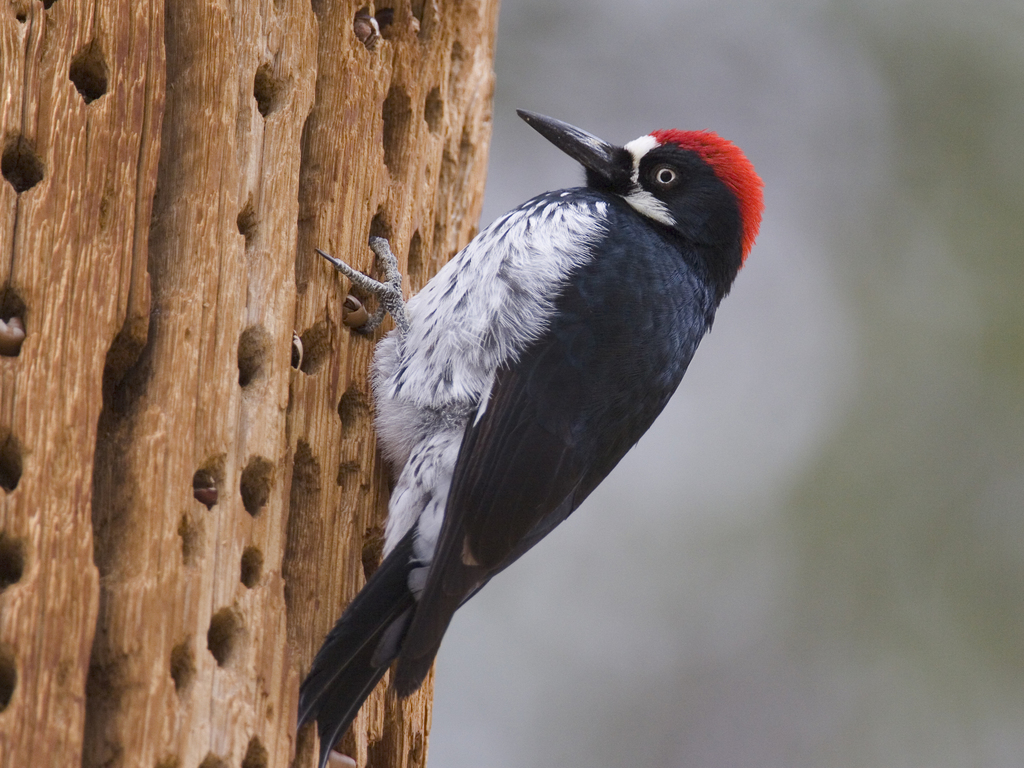
The acorn woodpecker (Melanerpes formicivorus) is a medium-sized woodpecker with a length of around 20 cm (8 in), and an average weight of 85 g (3.0 oz). It is found across Central America, as well as North into the western United States and South into parts of Colombia.
From the article Acorn woodpecker on Wikipedia (CC BY-SA), quoted section by section
Description
The adult acorn woodpecker has a brownish-black head, back, wings and tail, white forehead, throat, belly and rump. The eyes are initially dark in fledglings, turning to white within a few months. There is a small part on the small of their backs where there are some greenish feathers. The bird is mostly black, with adult males have a red cap starting at the forehead, whereas females have a black area between the forehead and the cap. The white neck, throat, and forehead patches are distinctive identifiers. When flying, they take a few flaps of their wings and drop a foot or so. White circles on their wings are visible when in flight. Acorn woodpeckers have a call that sounds almost like they are laughing. Measurements:
Length: 19–23 cm (7.5–9.1 in) Weight: 65–90 g (2.3–3.2 oz) Wingspan: 35–43 cm (14–17 in)
Distribution and habitat. The acorn woodpecker's habitat is forested areas with oaks in the coastal areas and foothills of Oregon, California, and the southwestern United States, south through Central America to Colombia. This species may occur at low elevations in the north of its range, but rarely below 1,000 m (3,300 ft) in Central America, and it breeds up to the timberline. Nests are excavated in a cavity in a dead tree or a dead part of a tree.
What it does
Acorn woodpeckers are omnivorous and get most of their food from tree sap, insects, and green and mature acorns. In California, acorn woodpeckers obtain acorns from several oak species including valley oak, blue oak, coast live oak, California black oak, and canyon live oak which comprises 50% or more of their diet. In Arizona and New Mexico, acorns account for 25-50% of their diet. The relative importance of each species varies geographically and from year to year with acorn production. At Hastings reservation in California's central coast, Acorn woodpeckers sometimes exhibit two breeding seasons: the usual one in spring, and on one-third of years, one in August centered around the new acorn crop. The woodpeckers often inhabit areas where several oak species are present, whose acorn crops do not necessarily peak or fail in the same years, evening out the acorn supply.
Many populations of this woodpecker store acorns in "granaries", usually large trees or woody structures (such as utility poles, pinecones, fence posts and wood tri on buildings) which contain hundreds to thousands of individually drilled storage holes. They may use living or dead trees and prefer trees with thick and/or relatively soft bark, including Quercus lobata. The same granaries are used year after year and new holes are always being added. …
Wikipedia: “Food and feeding”
In human culture
Walter Lantz is believed to have patterned the call of his cartoon character Woody Woodpecker on that of the acorn woodpecker, while patterning his appearance on that of the pileated woodpecker, which has a prominent crest.
Wikipedia: “Popular culture”
Listen
Looking for field recordings…
Where it lives
Recorded sightings
—
geo-referenced records in GBIF, from museums, herbaria and field observers.
Drag the globe to turn it. Dots are where records exist, not a range map; darker means more records.
In the stacks
Searching the stacks…
Every page naming Melanerpes formicivorus in the Biodiversity Heritage Library →
This page is assembled live from iNaturalist, GBIF, Wikipedia, the Source Library and the Internet Archive. It is not yet part of the hand-edited codex. iNaturalist taxon 18209.