- Plants
- ›Vascular Plants
- ›flowering plants
- ›Dicots
- ›canellas, winter's-bark, and allies
- ›canella family
- ›Warburgia
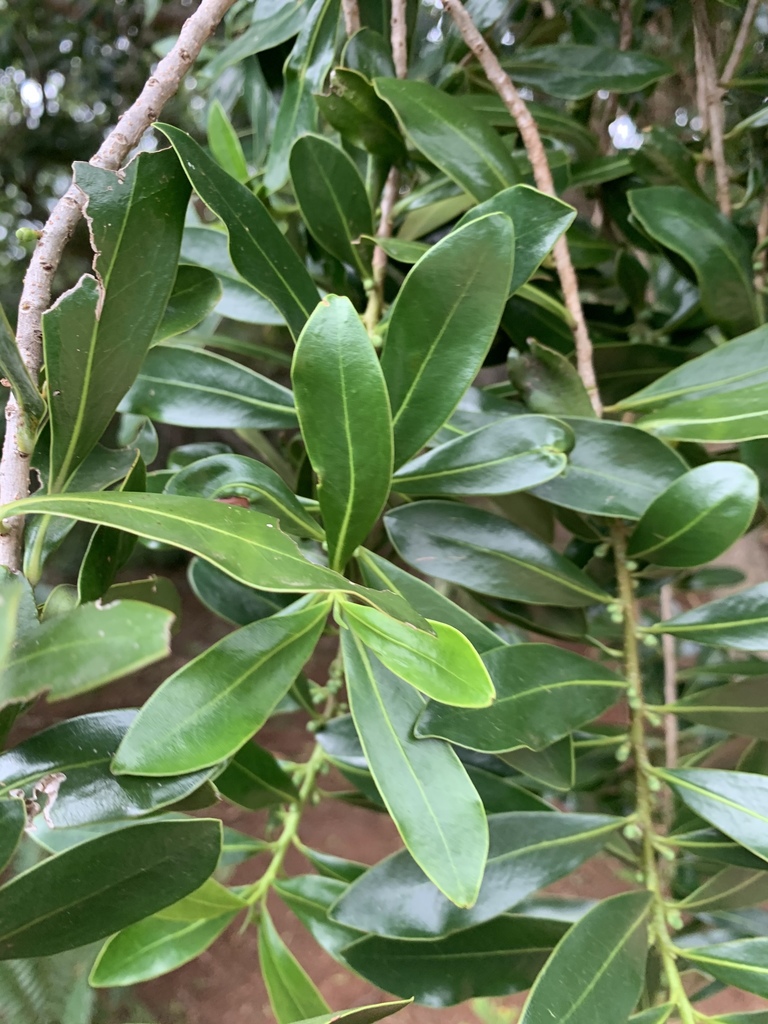
Kenya Greenheart
Warburgia salutaris
Warburgia salutaris (pepper-bark tree, Afrikaans: Peperbasboom, Sotho: Molaka, Venda: Mulanga, Zulu: Isibaha) is a species of tree in the family Canellaceae. It is native to southwestern Africa, including Mozambique, Zimbabwe, and KwaZulu-Natal the Northern Provinces of South Africa. It is threatened by habitat loss. It is a popular medicinal plant and is overharvested in the wild, another reason for its endangerment. The Pepper-bark tree is a protected tree in South Africa. Various projects are investigating methods of propagation under controlled conditions with subsequent planting in the wild.
This is an erect tree growing up to about ten metres in maximum height, but known to reach 20 metres at times. It has a thick canopy of aromatic, shiny green leaves. The evergreen leaf blades are lance-shaped, measuring up to 11 cm long by 3 wide. The flowers have ten yellow-green petals. They are each just under a centimeter long and are solitary or borne in small clusters of up to 3. The fruit is a berry, leathery purple or black in color when ripe, measuring up to 4 cm wide.
From the article Warburgia salutaris on Wikipedia (CC BY-SA), quoted section by section
In medicine
This plant is used medicinally by the Maasai people to treat malaria. It is used as a snuff or smoked for respiratory complaints such as common cold and cough. The bark can be purchased at markets in Tanzania, and elsewhere. Moreover, "Dried bark is chewed and the juice swallowed, thus acting as remedy for stomach-ache, constipation, coughs, fever, toothache, muscle pains, weak joints, and general body pains."
Wikipedia: “Traditional medicine”
Where it lives
Recorded sightings
—
geo-referenced records in GBIF, from museums, herbaria and field observers.
Drag the globe to turn it. Dots are where records exist, not a range map; darker means more records.
In the stacks
Searching the stacks…
Every page naming Warburgia salutaris in the Biodiversity Heritage Library →
This page is assembled live from iNaturalist, GBIF, Wikipedia, the Source Library and the Internet Archive. It is not yet part of the hand-edited codex. iNaturalist taxon 182206.