- Animals
- ›Chordates
- ›Vertebrates
- ›Birds
- ›Woodpeckers and Allies
- ›Woodpeckers
- ›Typical woodpeckers
- ›Green Woodpeckers, Flickers, and Allies
- ›Colaptes
On eBird ↗
Fernandina's Flicker
Live sightings near you, the range map, bar charts of when it is seen, and Macaulay Library photos and recordings.
Fernandina's Flicker
Colaptes fernandinae
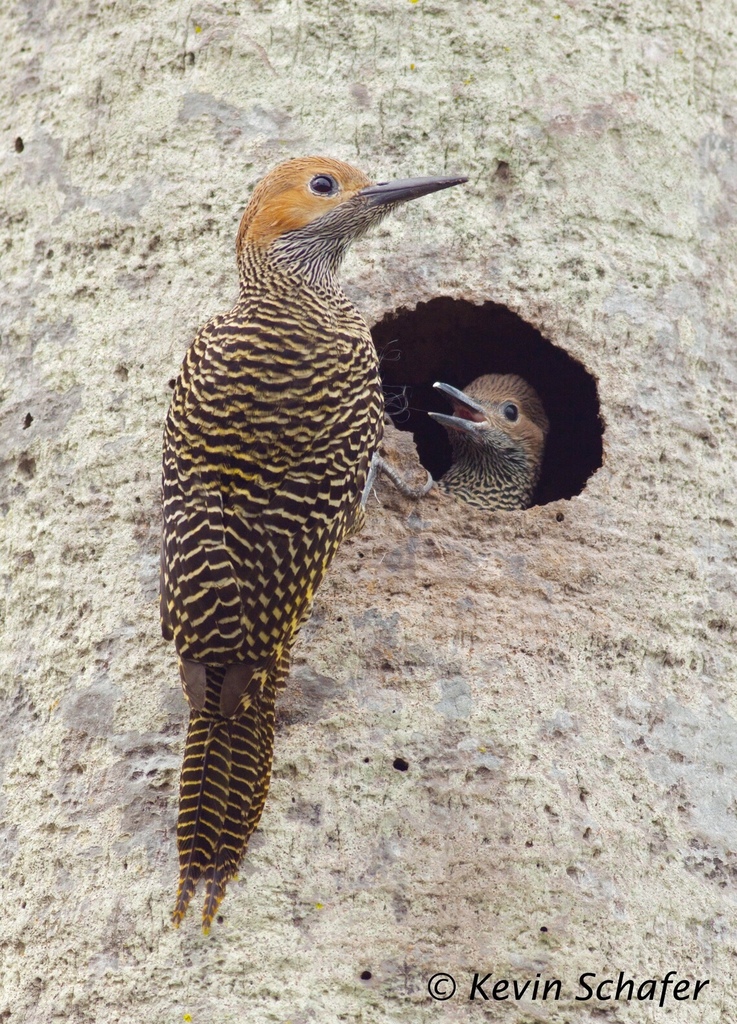
Fernandina's flicker (Colaptes fernandinae) is a species of bird in the woodpecker family. Endemic to Cuba, its small population of 600–800 birds makes it one of the most endangered species of woodpecker in the world. The Fernandina's flicker is threatened by habitat loss.
From the article Fernandina's flicker on Wikipedia (CC BY-SA), quoted section by section
Description
Fernandina's flicker is a medium-sized woodpecker, ranging in length from 14–15 in (36–38 cm). Birds of central Cuba are generally somewhat smaller than those from eastern and western Cuba. On males, the crown and nape are buffy cinnamon, with fine black streaking and occasional tinges of red. The ear-coverts are a buffish-yellow to cinnamon. The chin and throat are off-white with heavy black streaking; males have a distinctive black malar stripe, while in females the black malar is instead heavily streaked with white. The upperparts are pale yellow to yellowish-tan, with dense blackish-brown to black barring, while the underparts are pale yellowish-buff with dark brown barring that is paler and weaker on the belly. The undertail is yellow, while the rump and uppertail coverts are paler, with narrower barring. Its underwings are yellow, and the distinctive yellow coloration is visible in flight. Juveniles are duller and browner, with broader markings on the underside and less distinctive barring above.
Range & habitat
Fernandina's flicker is endemic to Cuba, where it occurs primarily in lowland open-palm savannah and dry savanna, dry forests,pastures, swampy forest, forest edges, and sometimes in dense woodlands. It is closely associated with palm trees, particularly the Sabal palmetto (Saval parviflora) and the royal palm (Roystonea regia). Though it was apparently never common, it was formerly found across the island. Now, however, it is restricted to isolated locations in nine of the country's 15 provinces: Camagüey, Cienfuegos, Granma, Holguín, Las Tunas, Matanzas, Pinar del Río, Santiago de Cuba, and Villa Clara. The largest population is found in Zapata Swamp, where some 120 pairs are estimated to live, though this number may have dropped following recent hurricanes.
Wikipedia: “Distribution and habitat”
What it does
Though not a particularly social bird, populations of Fernandina's flicker in the Zapata Swamp have been observed forming loose colonies. It regularly fights with other woodpeckers.
Feeding. Like other flickers, Fernandina's flicker often forages on the ground; it primarily feeds on ants, but will also pursue other insects, worms, grubs, and seeds. It uses its strong bill to probe the ground and flick aside leaf litter. In addition to ground foraging, it also feeds on ants & termites found in both live and dead palms, particularly during the wet season when the ground is flooded.
Breeding. Fernandina's flicker breeds between March and June. From late December through January courtship takes place, during which pairs regularly engage in high-flying chases. Nest excavation begins in February or March. Like all woodpeckers, it is a cavity nester, and nests primarily in palms of genuses Copernicia, Sabal, and Roystonea. It is also known to nest in other palms such as juçara (Euterpe edulis) and wild tamarind (Lysiloma latisiliquum). …
Wikipedia: “Behavior”
Listen
Looking for field recordings…
Where it lives
Recorded sightings
—
geo-referenced records in GBIF, from museums, herbaria and field observers.
Drag the globe to turn it. Dots are where records exist, not a range map; darker means more records.
In the stacks
Searching the stacks…
Every page naming Colaptes fernandinae in the Biodiversity Heritage Library →
This page is assembled live from iNaturalist, GBIF, Wikipedia, the Source Library and the Internet Archive. It is not yet part of the hand-edited codex. iNaturalist taxon 18235.