- Animals
- ›Chordates
- ›Vertebrates
- ›Birds
- ›Woodpeckers and Allies
- ›Woodpeckers
- ›Typical woodpeckers
- ›Campephilini
- ›Campephilus
On eBird ↗
Magellanic Woodpecker
Live sightings near you, the range map, bar charts of when it is seen, and Macaulay Library photos and recordings.
Magellanic Woodpecker
Campephilus magellanicus
The Magellanic woodpecker (Campephilus magellanicus) is a species of large woodpecker found in southern Chile and southwestern Argentina; it is resident within its range. This species is the southernmost example of the genus Campephilus, which includes the famous ivory-billed woodpecker (C. principalis).
From the article Magellanic woodpecker on Wikipedia (CC BY-SA), quoted section by section
Description
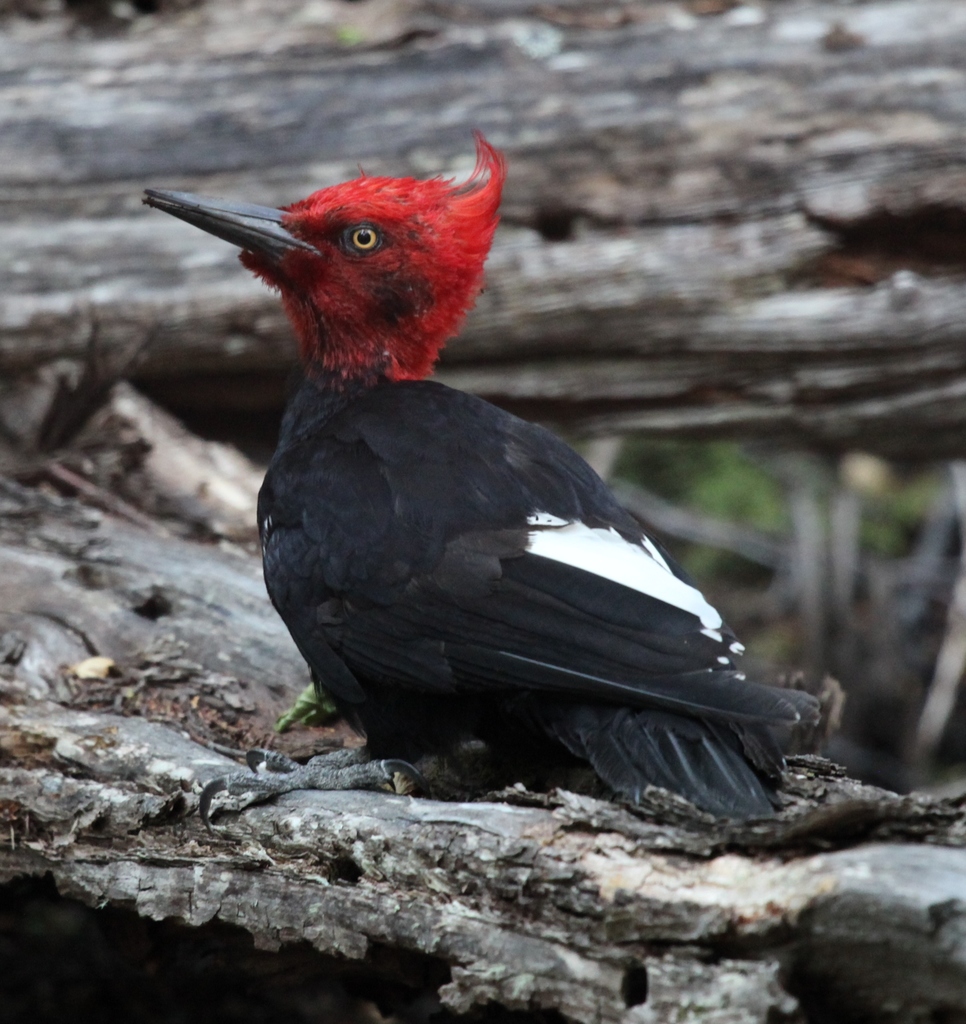
The Magellanic woodpecker is 36 to 45 cm (14 to 18 in) in length. Males of this species weigh 312–369 g (11.0–13.0 oz), and females weigh 276–312 g (9.7–11.0 oz). Among standard measurements, the wing chord is 20.5 to 23 cm (8.1 to 9.1 in), the tail is 13.9 to 16.8 cm (5.5 to 6.6 in), the bill is 4.3 to 6 cm (1.7 to 2.4 in), and the tarsus is 3.3 to 3.9 cm (1.3 to 1.5 in). It is the largest South American woodpecker and one of the largest woodpeckers in the world. Among the species known to exist, only the non-neotropical members of the genus Dryocopus and the great slaty woodpecker (Mulleripicus pulverulentus) are larger-bodied. With the likely extinction of the ivory-billed and imperial woodpeckers (Campephilus imperialis), the Magellanic woodpecker is the largest living species of the genus Campephilus. With an average weight of 339 g (12.0 oz) in males and 291 g (10.3 oz) in females, it is perhaps the heaviest certainly extant woodpecker in the Americas. This species is mainly pure black, with a white wing patch and a grey, chisel-like beak. Males have a crimson head and crest. Females have a mainly black head, but an area of red coloration occurs near the base of the bill. Juvenile Magellanic woodpeckers resemble females of the species, but have a smaller crest and have a browner tinge to their plumage. …
Range & habitat
Magellanic woodpeckers inhabit mature Nothofagus and Nothofagus-Austrocedrus forests, where they feed mainly on wood-boring grubs and adult beetles (Coleoptera), as well as spiders. Occasionally, other foods may supplement the diet, including sap and fruits, as well as small reptiles, bats, and the eggs and nestlings of passerines.
Wikipedia: “Habitat”
What it does
Family groups also roost together. In one case, five individuals were observed roosting in a roughly 40 cm (16 in) vertical-depth hole. Breeding pairs are highly territorial and commonly try to aggressively displace and even attack conspecifics, sometimes doing so cooperatively with the juveniles that they had raised in prior years. A lethal attack was recorded in 2014. When they are actively rearing nestlings, the juveniles are aggressively kept at a distance by their parents.
Diet and feeding. The species commonly co-occurs with the Chilean flicker (Colaptes pitius) and the striped woodpecker (Veniliornis lignarius), but does not directly compete with them due to differing body sizes and habitat and prey preferences. These woodpeckers commonly feed in pairs or small family groups and are very active in their food searching; they spend most of the daytime looking for prey. They generally use live trees, but also feed on dead substrates such as fallen or broken trees lying on the ground, although generally spend little time doing so. Once the snow disappears from the ground in spring, Magellanic woodpeckers look for prey on humid lower tree trunks. In Tierra del Fuego, Magellanic woodpeckers forage on decaying and dead trees around ponds hosting the introduced American beaver (Castor canadensis).
Breeding. …
Wikipedia: “Behaviour”
Listen
Looking for field recordings…
Where it lives
Recorded sightings
—
geo-referenced records in GBIF, from museums, herbaria and field observers.
Drag the globe to turn it. Dots are where records exist, not a range map; darker means more records.
In the stacks
Searching the stacks…
Every page naming Campephilus magellanicus in the Biodiversity Heritage Library →
This page is assembled live from iNaturalist, GBIF, Wikipedia, the Source Library and the Internet Archive. It is not yet part of the hand-edited codex. iNaturalist taxon 18283.