- Plants
- ›Vascular Plants
- ›flowering plants
- ›Dicots
- ›Heathers, Balsams, Primroses, and Allies
- ›primrose family
- ›Cape Myrtle subfamily
- ›Aegiceras
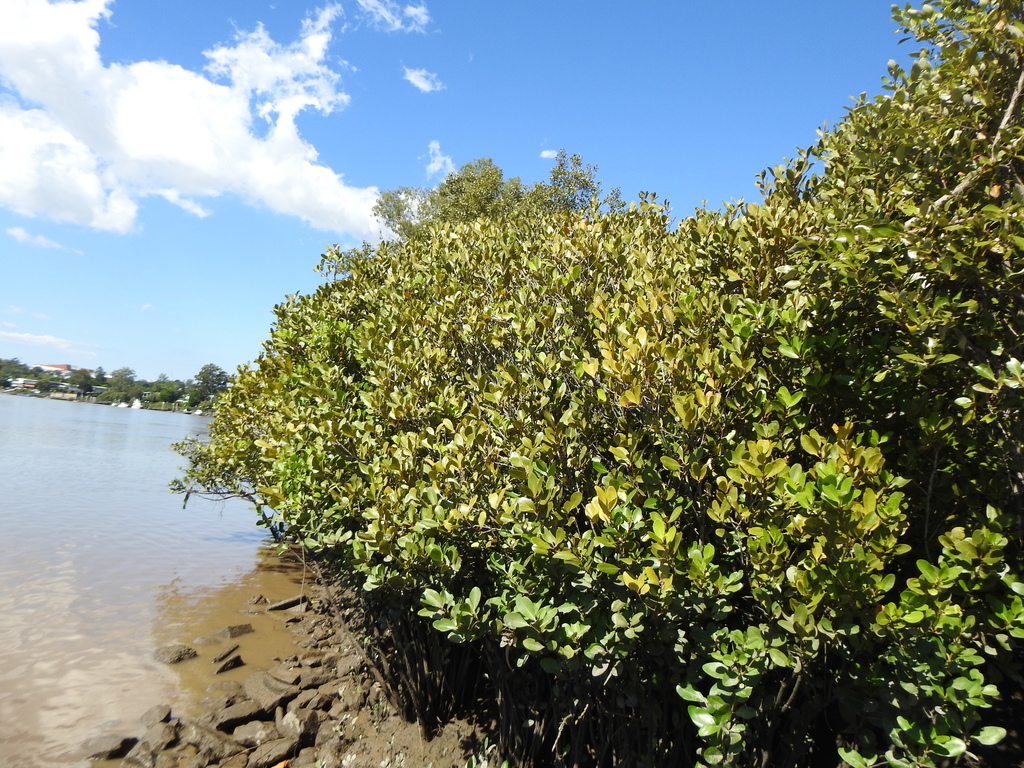
river mangrove
Aegiceras corniculatum
Aegiceras corniculatum, commonly known as black mangrove, river mangrove, goat's horn mangrove, or khalsi, is a species of shrub or tree mangrove in the primrose family, Primulaceae, with a distribution in coastal and estuarine areas ranging from India through South East Asia to southern China, New Guinea and Australia.
From the article Aegiceras corniculatum on Wikipedia (CC BY-SA), quoted section by section
Description
Aegiceras corniculatum grows as a shrub or small tree up to 7 metres (23 ft) high, though often considerably less. Its leaves are alternate, obovate, 30–100 millimetres (1.2–3.9 in) long and 15–50 millimetres (0.59–1.97 in) wide, entire, leathery and minutely dotted. Its fragrant, small, white flowers are produced as umbellate clusters of 10–30, with a peduncle up to 10 mm long and with pedicels 10–18 millimetres (0.39–0.71 in) long. The calyx is 2–4 millimetres (0.079–0.157 in) long and corolla 4–6 millimetres (0.16–0.24 in) long. The fruit is curved and cylindrical or horn-shaped, light green to pink in colour and 20–75 millimetres (0.79–2.95 in) long. It grows in mud in estuaries and tidal creeks, often at the seaward edge of the mangrove zone. The species is of interest to many moths, including species from the genera Anarsia, Archips and Phyllocnistis, as well as the species Darna trima, Gonodontis clelia and Neurozerra conferta.
At the table
Aegiceras corniculatum extract has analgesic properties which supports a fight against diabetes. The stems of the plant contain up to seven compounds, including: 2-methoxy-3-nonylresorcinol, 5-O-ethylembelin, 2-O-acetyl-5-O-methylembelin, 3,7-dihydroxy-2,5-diundecylnaphthoquinone, 2,7-dihydroxy-8-methoxy-3,6-diundecyldibenzofuran-1,4-dione, 2,8-dihydroxy-7-methoxy-3,9-diundecyldibenzofuran-1,4-dione (6), and 10-hydroxy-4-O-methyl-2,11-diundecylgomphilactone.
Wikipedia: “Medicinal uses”
Where it lives
Recorded sightings
—
geo-referenced records in GBIF, from museums, herbaria and field observers.
Drag the globe to turn it. Dots are where records exist, not a range map; darker means more records.
In the stacks
Searching the stacks…
Every page naming Aegiceras corniculatum in the Biodiversity Heritage Library →
This page is assembled live from iNaturalist, GBIF, Wikipedia, the Source Library and the Internet Archive. It is not yet part of the hand-edited codex. iNaturalist taxon 183233.