- Animals
- ›Chordates
- ›Vertebrates
- ›Birds
- ›Woodpeckers and Allies
- ›Woodpeckers
- ›Typical woodpeckers
- ›Green Woodpeckers, Flickers, and Allies
- ›Picus
On eBird ↗
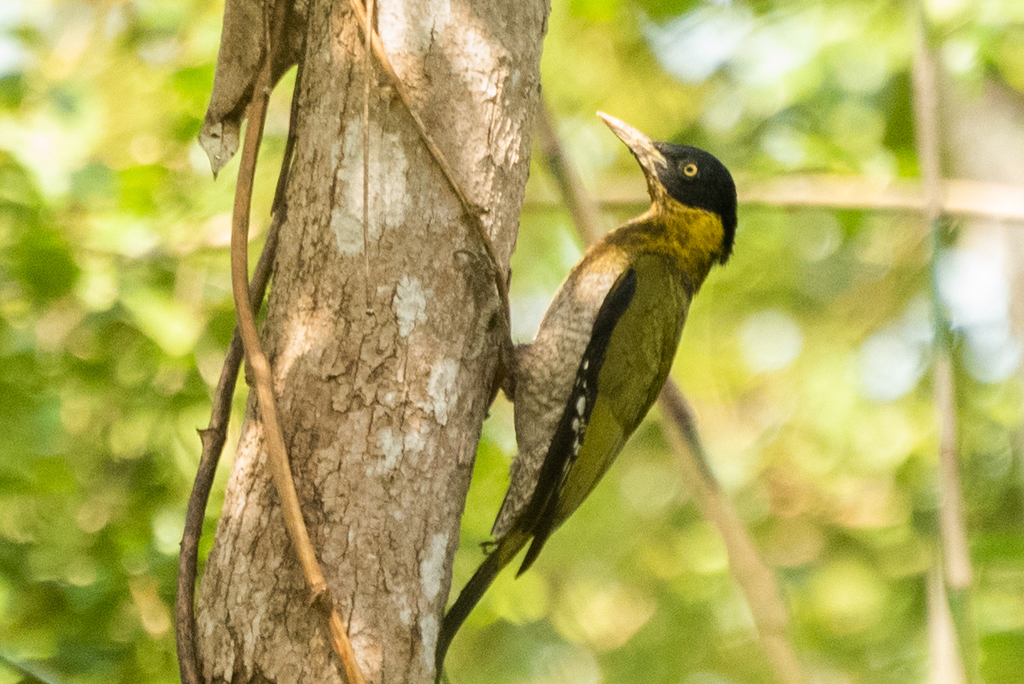
Black-headed Woodpecker
Live sightings near you, the range map, bar charts of when it is seen, and Macaulay Library photos and recordings.
Black-headed Woodpecker
Picus erythropygius
The black-headed woodpecker (Picus erythropygius) is a species of bird in the family Picidae. It typically inhabits deciduous and coniferous forests and is found in Cambodia, Laos, Myanmar, Thailand, and Vietnam.
From the article Black-headed woodpecker on Wikipedia (CC BY-SA), quoted section by section
Description
The black-headed woodpecker is a medium-sized bird at around 33 cm tall and 100-135g. Adult birds have very distinct plumage and have a black face, yellow throat, green wings, a red lower back, and a white stomach. They also have white/yellow eyes and some individuals have a thin white line from their eye to their neck. Males have a red crown, while females have a completely black crown with no red. Juveniles are less pigmented than adults and juvenile males have fewer red crown feathers on their heads.
Range & habitat
Black-headed woodpeckers are found in Cambodia, Laos, Myanmar, Thailand, and Vietnam. They are most commonly found in the mid-story and sub-canopy of deciduous and coniferous forests. They usually prefer dry dipterocarp forests, semi-evergreen forests, riverine forests, and savanna forests. They are also resident birds.
Wikipedia: “Distribution and habitat”
What it does
Black-headed woodpeckers, like most woodpeckers, are insectivorous and glean insects on the bark of trees. They most commonly consume termites, but they also eat ants and other insects and invertebrates.
Wikipedia: “Diet”
Listen
Looking for field recordings…
Where it lives
Recorded sightings
—
geo-referenced records in GBIF, from museums, herbaria and field observers.
Drag the globe to turn it. Dots are where records exist, not a range map; darker means more records.
In the stacks
Searching the stacks…
Every page naming Picus erythropygius in the Biodiversity Heritage Library →
This page is assembled live from iNaturalist, GBIF, Wikipedia, the Source Library and the Internet Archive. It is not yet part of the hand-edited codex. iNaturalist taxon 18328.