- Animals
- ›Chordates
- ›Vertebrates
- ›Birds
- ›Woodpeckers and Allies
- ›Woodpeckers
- ›Typical woodpeckers
- ›Green Woodpeckers, Flickers, and Allies
- ›Picus
On eBird ↗
Lesser Yellownape
Live sightings near you, the range map, bar charts of when it is seen, and Macaulay Library photos and recordings.
Lesser Yellownape
Picus chlorolophus
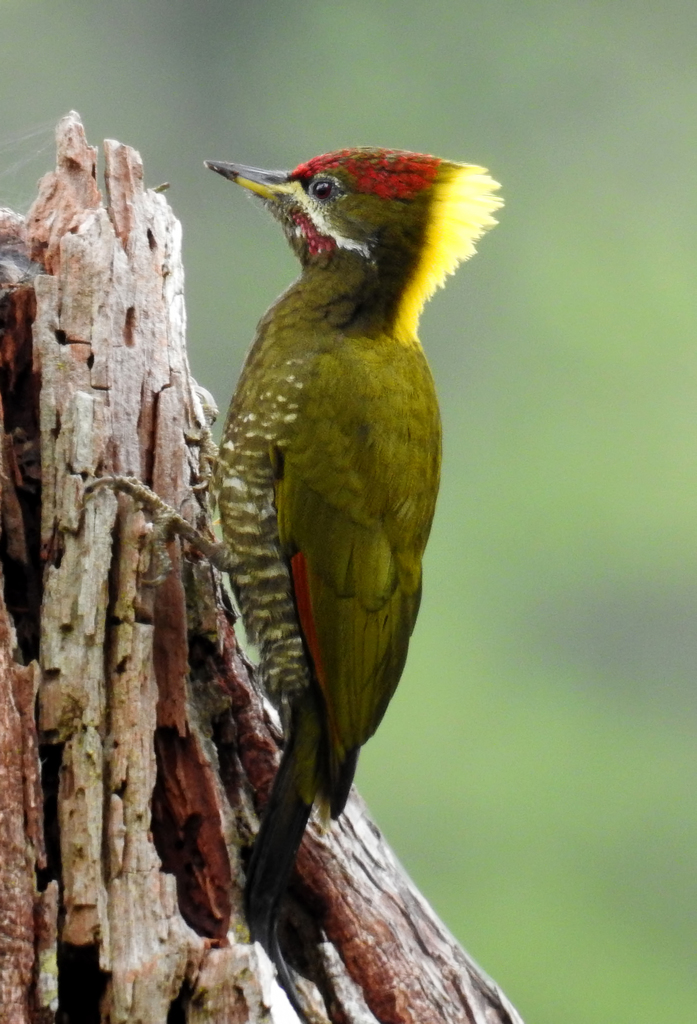
The lesser yellownape (Picus chlorolophus) is a type of woodpecker which is a widespread and often common breeder in tropical and sub-tropical Asia, primarily the Indian subcontinent and Southeast Asia. It ranges from India, Bhutan, Nepal, Bangladesh and Sri Lanka eastwards to Thailand, Burma, Cambodia, Laos, Indonesia, Malaysia and Vietnam. Much of the scientific knowledge gathered about this species is sourced from formal studies in various parts of India.
From the article Lesser yellownape on Wikipedia (CC BY-SA), quoted section by section
Description
The lesser yellownape is a largish species at 27 cm in length. It has a typical woodpecker shape. The upperparts are green apart from the bright yellow tufted nape. The neck and breast are green and the belly is whitish, finely barred with green. The rump and tail are blackish. The adult male lesser yellownape has a green head with a white throat. He has red markings above the eye and above the nape, and red moustachial stripes. Females have only a red patch above the ear coverts. Young birds are like the female, but duller. The subspecies occurring in peninsular India has a greyer head.
What it does
This is a jungle species which nests in a tree cavity, laying two to four white eggs. Like other woodpecking birds, this species has a straight pointed bill, a stiff tail to provide support against tree trunks, and zygodactyl or "yoked" feet, with two toes pointing forward, and two backward. The long tongue can be darted forward to capture insects.
Wikipedia: “Ecology”
Listen
Looking for field recordings…
Where it lives
Recorded sightings
—
geo-referenced records in GBIF, from museums, herbaria and field observers.
Drag the globe to turn it. Dots are where records exist, not a range map; darker means more records.
In the stacks
Searching the stacks…
Every page naming Picus chlorolophus in the Biodiversity Heritage Library →
This page is assembled live from iNaturalist, GBIF, Wikipedia, the Source Library and the Internet Archive. It is not yet part of the hand-edited codex. iNaturalist taxon 18337.