- Animals
- ›Chordates
- ›Vertebrates
- ›Birds
- ›Woodpeckers and Allies
- ›Woodpeckers
- ›Typical woodpeckers
- ›Green Woodpeckers, Flickers, and Allies
- ›Picus
On eBird ↗
Japanese Woodpecker
Live sightings near you, the range map, bar charts of when it is seen, and Macaulay Library photos and recordings.
Japanese Green Woodpecker
Picus awokera
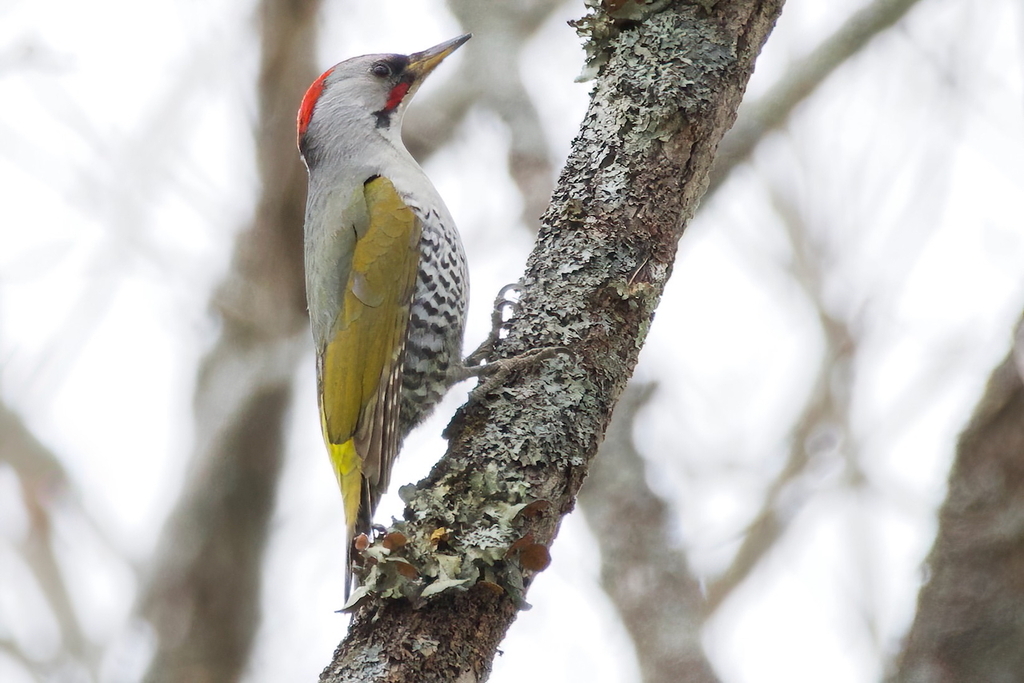
Japanese green woodpecker or Japanese woodpecker (Picus awokera) is a medium-sized woodpecker similar and closely related to the European green woodpecker, but endemic to Japan.
From the article Japanese green woodpecker on Wikipedia (CC BY-SA), quoted section by section
Description
This species reaches about 30 cm in length, with bright green wings and tail, a red or black mustache and crown (as opposed to the black face of the green woodpecker), gray head, neck, and chest, and white underparts with black markings. The bill is yellow, the legs and feet are light gray colored. The iris is red.
Range & habitat
This woodpecker is found in most big islands of Japan, and also smaller islands like Tobishima, Awashima, Sado and Tsushima. The total distribution area is as big as 281.000 km2. Japanese green woodpeckers live in the north in open mixed forests, in the south in warm-temperate evergreen forests, but also in parks and gardens. They avoid older coniferous monocultures. The species is in their occurrence limited to hilly landscapes and lower mountain regions and most frequently seen in altitudes between 300 and 1400m, sometimes it's found in lowlands or in altitudes of up to 2000m.
Wikipedia: “Distribution and habitat”
What it does
The foraging is mostly in the middle tree layer at heights between 2 and 10m on larger branches, but also on twigs, sometimes also on the ground. This species eats ants from the genera Lasius, Formica, Camponotus and Crematogaster, in addition to bugs, beetles, beetle larvae and spiders. Its menu also includes fruits, berries, seeds, resin and nectar.
Wikipedia: “Food and feeding”
Listen
Looking for field recordings…
Where it lives
Recorded sightings
—
geo-referenced records in GBIF, from museums, herbaria and field observers.
Drag the globe to turn it. Dots are where records exist, not a range map; darker means more records.
In the stacks
Searching the stacks…
Every page naming Picus awokera in the Biodiversity Heritage Library →
This page is assembled live from iNaturalist, GBIF, Wikipedia, the Source Library and the Internet Archive. It is not yet part of the hand-edited codex. iNaturalist taxon 18367.