Cadaba farinosa
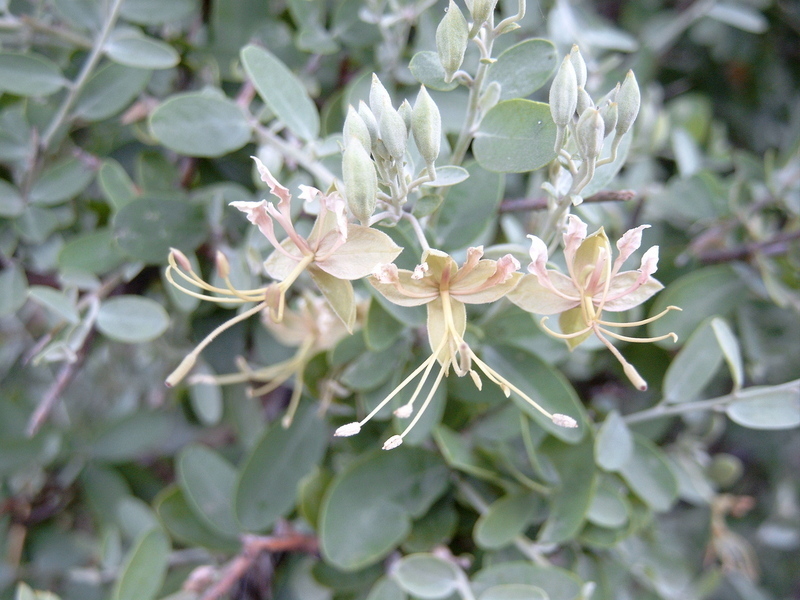
Cadaba farinosa is a 2–8 m (6.6–26.2 ft) high evergreen shrub or small tree that belongs to the caper family. It has simple ovate leaves with entire margins, zygomorphic, spidery, greenish, yellowish, whitish or pinkish flowers, and is covered in powdery hairs or scales, particularly the younger parts. It can be found in a zone from Senegal to India between the desert and the savanna.
From the article Cadaba farinosa on Wikipedia (CC BY-SA), quoted section by section
Description
Cadaba farinosa is a usually much branched shrub, mostly 2–3 m (7–10 ft) high, but under favorable circumstances a shrub of 5 m (16 ft) or a tree up to 8 m (26 ft). It has a smooth, reddish brown bark, while young branches appear powdery due to scales or short spreading hairs. The simple and entire leaves are alternate set along the branches, and have narrow, persistent stipules of up to 1½ mm (0.06 in) long, at both sides of an up to 3 mm (0.12 in) long leaf stalk, which carries an oblong or elliptical leaf blade of 5–50 mm (0.20–1.97 in) long and 3–30 mm (0.12–1.18 in) wide, rounded or pointed with a short stiff tip. When young, the leaves appear powdery, but they become gradually hairless. The central vein that branches feather-like into four to five pairs of side veins. The bilaterally symmetric flowers are arranged individually or with a few together in small inflorescences at the tip of the side branches. The flowers have both stamens and a pistel. Each sits on a 5–15 mm (0.20–0.59 in) long flower stalk, has four, somewhat unequal, elliptical sepals that fall after flowering. The outer sepals are 5–14 mm (0.20–0.55 in) long, concave particularly near the tip, that appears pointed because the margins are folded against each other. The inner sepals are almost flat and have a stump tip. …
Range & habitat
This plant can be found in the Sahel and northern Sudanian Savanna between Mauritania and Senegal in the West, along the Red Sea, through the Arabian Peninsula, and the coast of the Indian Ocean all the way to India in the East. It is widespread in Africa, and may grow up to an altitude of 1,600 m (5,200 ft). It is often found on termite mounds and grows together with Maerua species. This species grows in areas with a mean annual precipitation between 200 mm (7.9 in) and 500 mm (20 in), and a temperature of approximately 29 °C (84 °F), and prefers heavy soils, although it also grows on stony scree and sand. The foliage is eaten by black rhinos, buffalos and hartebeests. Butterflies of the genus Colotis feed on the leaves of Capparaceae, including those of Cadaba farinosa.
Wikipedia: “Distribution, habitat and ecology”
At the table
The wood of the plant is used for fuel. The leaves and young twigs of Cadaba farinosa are edible. In western Africa, leaves are squashed, boiled and eaten as a gruel, sometimes mixed with couscous. In northern Nigeria pounded leaves are mixed with cereals and dried to make irregularly shaped chocolate-brown cake, which is sold on markets called farsa, balambo, baleno, tsawa (in Hausa), or tigiraganda. Macerated flowers are added to dough to make it sweeter. It is used as fodder by different types of husbandry and is one of the species preferred by camels in the North of Kenya. Leaves are reported to contain 15.2–18.2% crude protein, about 60-80% fibre and 7-8% ash. It is also particularly relished by goats which browse its leaves year-round. In traditional medicine in different parts of Africa and India, several parts of the plant are reported to be used, against infections such as of the skin and the intestines, food-poisoning, anthrax, dysenteria, intestinal worms, and against pain such as rheumatism.
== References ==
Wikipedia: “Uses”
In human culture
The genus name Cadaba is derived from the Arab word "kadhab", a local name for Cadaba rotundifolia. The species epithet is a contraction of the Latin words farīna meaning "flour" or "meal”, and -ōsos, a deflection meaning "full off".
Wikipedia: “Etymology”
Where it lives
Recorded sightings
—
geo-referenced records in GBIF, from museums, herbaria and field observers.
Drag the globe to turn it. Dots are where records exist, not a range map; darker means more records.
In the stacks
Searching the stacks…
Every page naming Cadaba farinosa in the Biodiversity Heritage Library →
This page is assembled live from iNaturalist, GBIF, Wikipedia, the Source Library and the Internet Archive. It is not yet part of the hand-edited codex. iNaturalist taxon 184346.