- Animals
- ›Chordates
- ›Vertebrates
- ›Birds
- ›Woodpeckers and Allies
- ›Woodpeckers
- ›Typical woodpeckers
- ›short-tailed woodpeckers
- ›Hemicircus
On eBird ↗
Heart-spotted Woodpecker
Live sightings near you, the range map, bar charts of when it is seen, and Macaulay Library photos and recordings.
Heart-spotted Woodpecker
Hemicircus canente
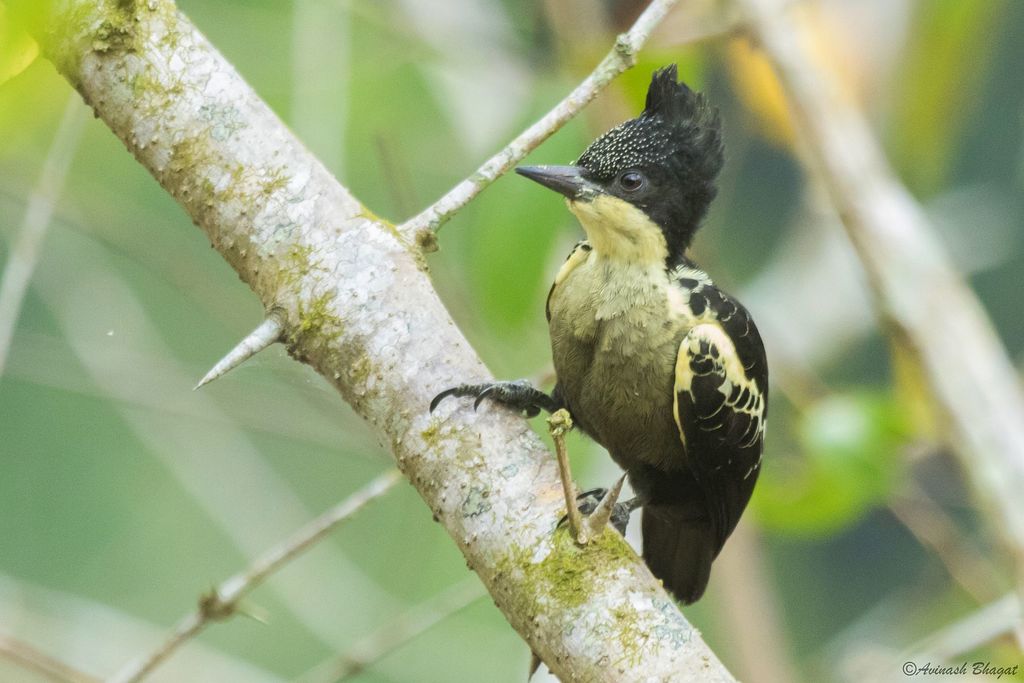
The heart-spotted woodpecker (Hemicircus canente) is a species of bird in the woodpecker family. It has a contrasting black and white plumage, a distinctively stubby body and a large wedge-shaped head making it easy to identify while its frequent calling make it easy to detect as it forage for invertebrates under the bark of the slender outer branches of trees. They move about in pairs or small groups and are often found in mixed-species foraging flocks. They have a wide distribution across Asia with populations in the forests of southwestern and central India which are slightly separated from their ranges in the Himalayas and Southeast Asia.
From the article Heart-spotted woodpecker on Wikipedia (CC BY-SA), quoted section by section
Description
A small, uniquely shaped, black and buff woodpecker with a large crest making the head look large for the short body and tail. Both males and females are predominantly black with heart-shaped black spots on white shoulders with broad white scapular patches and barring of flight feathers. The female has the forehead and crown buffy white while on males it is black with small white dots. The throat is whitish and the underparts are dark olive grey. A tuft of feathers on the back are specialized and are lipid rich which causes the feathers to stick together in preserved specimens. These special feathers or "fat quills" sometimes make the rump feathers appear buff and may be a form of "cosmetic colouration" and the secretion is said to have a pleasant smell but the functional significance is unknown.
Range & habitat
Its natural habitat is subtropical or tropical moist lowland forests. They are found in the Himalayan forests of India, and extend into Bangladesh, Myanmar, Thailand, Laos, Cambodia and Vietnam. Within India, they are also found in the Western Ghats and the forests of central India. A subspecies cordatus based on the description by Thomas C. Jerdon from a specimen from the Western Ghats is not considered distinct and the populations differ slightly in plumage colour and vary clinally in size (the northern birds being larger than those closer to the equator).
Wikipedia: “Habitat and distribution”
What it does
These woodpeckers forage in pairs, sometimes joining mixed-species foraging flocks. They fly from tree to tree in a sharply bounding flight giving a head-heavy appearance. They forage on thin branches and call often. They feed mainly on insects under bark but have been known to peck the pods of Cassia fistula to obtain insect larvae. The calls include a sharp twee-twee-twee (duet call) sometimes leading to a trill of several notes, a nasal ki-yeew and repeated su-sie calls. They drum infrequently during the breeding season, mainly during winter and before the Monsoons. The nest is bored in a dead branch with a narrow 3 to 4 cm diameter opening and the tunnel going down obliquely about 20 cm before widening into a chamber. Nests may sometimes be built in fence posts. The usual clutch is two or three eggs, which are unmarked white. Ticks of the species Haemaphysalis spinigera have been noted on these birds.
Wikipedia: “Behaviour and ecology”
Listen
Looking for field recordings…
Where it lives
Recorded sightings
—
geo-referenced records in GBIF, from museums, herbaria and field observers.
Drag the globe to turn it. Dots are where records exist, not a range map; darker means more records.
In the stacks
Searching the stacks…
Every page naming Hemicircus canente in the Biodiversity Heritage Library →
This page is assembled live from iNaturalist, GBIF, Wikipedia, the Source Library and the Internet Archive. It is not yet part of the hand-edited codex. iNaturalist taxon 18481.