- Plants
- ›Vascular Plants
- ›flowering plants
- ›Dicots
- ›saxifrages, stonecrops, and allies
- ›witch-hazel family
- ›Trichocladus
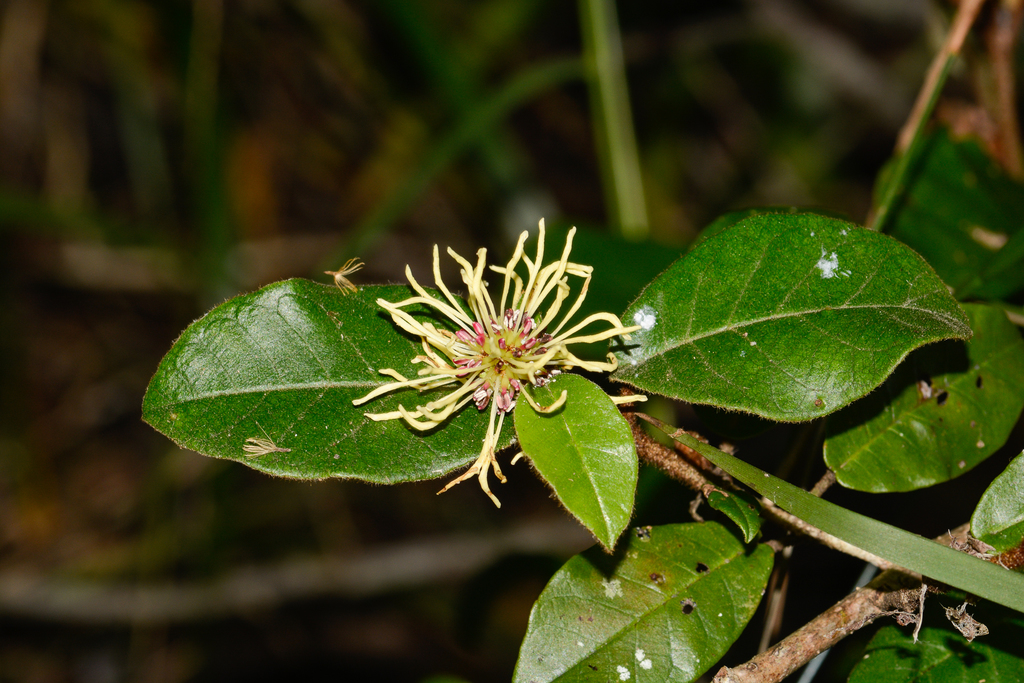
Onderbos
Trichocladus crinitus
Trichocladus crinitus (syn. Trichocladus peltatus and Trichocladus vittatus) is a species of the genus Trichocladus, in the family Hamamelidaceae. It is also called Black Witch-hazel.
From the article Trichocladus crinitus on Wikipedia (CC BY-SA), quoted section by section
Description
Ranging in size from subshrub, shrub, to small tree 3–4 m in height, Trichocladus crinitus is often found growing in the understory of evergreen forests along the Garden Route in South Africa, where it is endemic. Leaves: Its leaves, which grow opposite one another, are elliptic, with a tapering apex and slightly lobed or square base. They are a dark, shiny green above with dark brown velvety hairs beneath, particularly along the midrib. Adult leaves tend to be between 2.5 cm and 10 cm in length, and 1.5–7 cm wide, though they may occasionally grow slightly larger. Short, thick petiole is peltate. Bark: Deep brown to pale grey and smooth. Wood: White in colour and very hard. Flowers: Range in colour from green to yellow or orange, and closely resemble Hamamelis in shape. Male and female parts are borne on separate flowers, either on the same specimen or different specimens (may be either monoecious or dioecious). Flowers from April to August. Fruit: Small, hairy capsules are borne in clusters and range in colour from red to brown, depending upon their stage of ripeness. Fruits are typically between 5 and 7mm in length, and ripen between October and November.
Wikipedia: “Description and range”
How it is grown
Grows well in cool (temperate) greenhouses. Compost and care similar to that of Gardenia.
Wikipedia: “Cultivation”
In human culture
Trichocladus is derived from Greek and means 'hairy-branched', while crinitus comes from Latin and means 'with a long tuft of fine hairs.'
Wikipedia: “Etymology”
Where it lives
Recorded sightings
—
geo-referenced records in GBIF, from museums, herbaria and field observers.
Drag the globe to turn it. Dots are where records exist, not a range map; darker means more records.
In the stacks
Searching the stacks…
Every page naming Trichocladus crinitus in the Biodiversity Heritage Library →
This page is assembled live from iNaturalist, GBIF, Wikipedia, the Source Library and the Internet Archive. It is not yet part of the hand-edited codex. iNaturalist taxon 186718.