- Plants
- ›Vascular Plants
- ›flowering plants
- ›Dicots
- ›Mallows, Rock Roses, and Allies
- ›Stringbarks
- ›Aquilaria
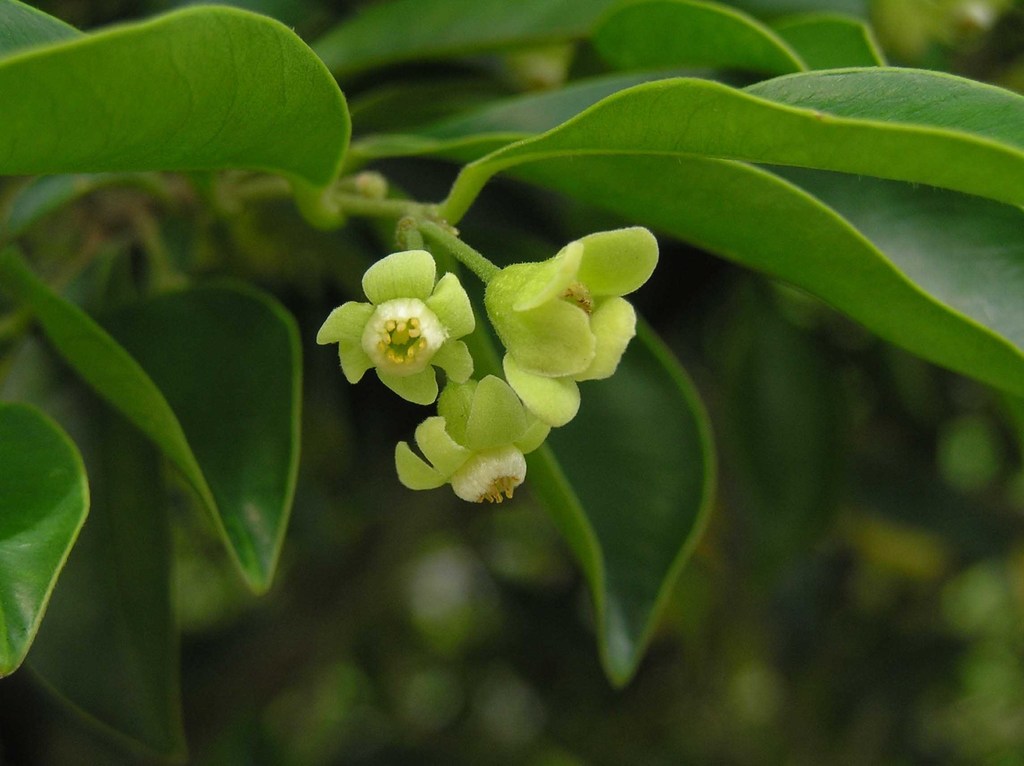
Chinese Eaglewood
Aquilaria sinensis
Aquilaria sinensis is a species of plant in the Thymelaeaceae family. It is endemic to China. It is threatened by habitat loss. This medicinal plant is a source of fragrant wood, formed under a pathological condition, called Chen Xiang (Chinese: 沈香) or agarwood.
From the article Aquilaria sinensis on Wikipedia (CC BY-SA), quoted section by section
Description
Aquilaria sinensis is an evergreen tree, 6 to 20 m tall. The smooth bark is grayish to dark grey, and the wood is white to yellowish – so giving it another Chinese name "Pak Muk Heung" (White Wood Incense). Its branchlets are sparsely covered with hairs when young. Its leaves are alternate, leathery, obovate to elliptic, generally 5 to 11 cm (2.0 to 4.3 in) long and 2 to 4 cm (0.79 to 1.57 in) wide, with 15 to 20 pairs of inconspicuous and nearly parallel lateral veins which is a helpful diagnostic feature in the field. The apex of each leaf is short acuminate and the base is broadly cuneate, with entire and smooth margins. Its flowers are yellowish green, fragrant, in a terminal or axillary umbel. The fruit is a woody obovoid capsule with an outer covering of short grey hairs, 2.5 to 3 cm (0.98 to 1.18 in) long, opening in two flat valves when ripen. When the fruit is open, a silky thread from the base of the fruit holds the single seed (or two) in the air.
Range & habitat
It is endemic to Southeast China including Hainan and found as an introduced species in Vietnam. It is threatened by habitat loss.
Wikipedia: “Distribution”
At the table
The tree produces agarwood, a valuable fragrant wood used for incense and medicine. Previously, the wood was used to make joss sticks and incense, but in Hong Kong this industry has died out. The balm (resin) produced and accumulated from the wood is used as a valuable Chinese medicine called "Chen Xiang" (沉香). According to Chinese medicinal literature, the resin can be extracted in large quantities by natural fungal infection or by external wounding (up to 5 cm into the bark). Sustainable harvesting of the resin of one tree can be induced by opening a wound 3 to 4 cm into the bark, and with the resin collected a few years later after accumulation. Or a small quantity of resin can be extracted from wood blocks by heating or burning, so that the resin liquefies and seeps from the wood blocks. Sections of trees trunks or branches that contain patches of fragrant, resinous wood enter into the trade under the name "agarwood". The resin is probably produced by the plant as a reaction against fungal infection or external wounding. Resin impregnated fragrant wood is usually found in trees older than 20 years. Although not all trees are infected, with increasing harvest pressure, harvesters in some regions often fell trees indiscriminately in search of infected wood. …
Wikipedia: “Traditional uses”
Where it lives
Recorded sightings
—
geo-referenced records in GBIF, from museums, herbaria and field observers.
Drag the globe to turn it. Dots are where records exist, not a range map; darker means more records.
In the stacks
Searching the stacks…
Every page naming Aquilaria sinensis in the Biodiversity Heritage Library →
This page is assembled live from iNaturalist, GBIF, Wikipedia, the Source Library and the Internet Archive. It is not yet part of the hand-edited codex. iNaturalist taxon 189373.