- Plants
- ›Vascular Plants
- ›flowering plants
- ›Dicots
- ›Mints, Plantains, Olives, and Allies
- ›Acanthus Family
- ›Avicennioideae
- ›Avicennia
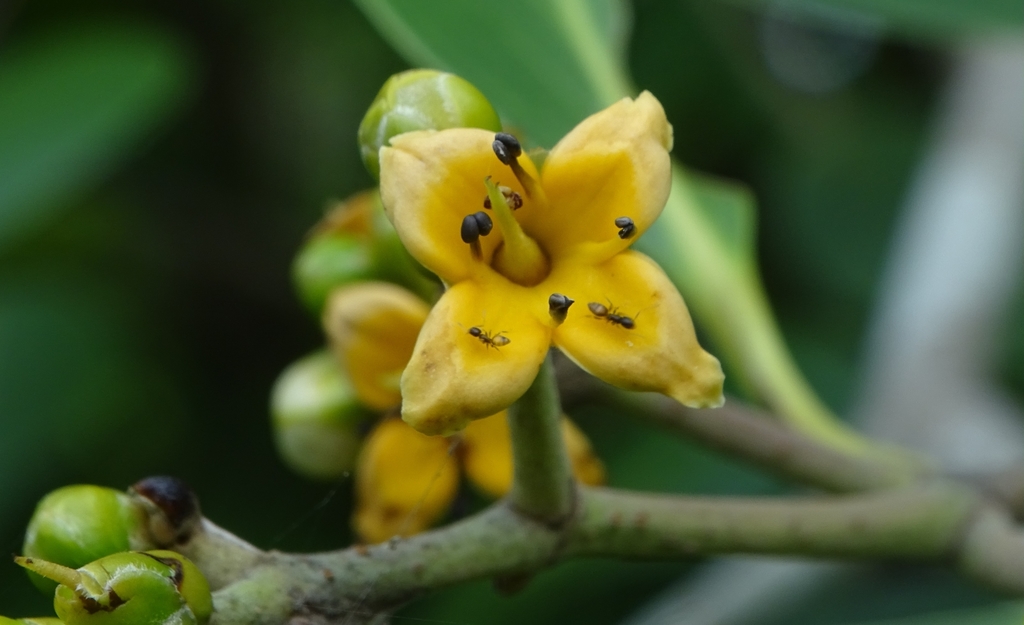
Indian Mangrove
Avicennia officinalis
Avicennia officinalis is a species of mangrove also known as Indian mangrove. The young tree forms a low, dense bushy crown. When it matures, it forms a columnar tree up to 15 m and may grow up to 30 m. The shiny green leaves, 10 cm long by 5 cm wide, have rounded apexes and golden-brown under leaf and grow in opposites. The flower, the largest among the Avicennia species has a diameter of 6 to 10 mm when...
From the article Avicennia officinalis on Wikipedia (CC BY-SA), quoted section by section
Description
The young tree forms a low, dense bushy crown. When it matures, it forms a columnar tree up to 15 m and may grow up to 30 m. The shiny green leaves, 10 cm long by 5 cm wide, have rounded apexes and golden-brown under leaf and grow in opposites. The flower, the largest among the Avicennia species has a diameter of 6 to 10 mm when expanded. It is orange yellow to lemon yellow in color. The bark is smooth, dirty green to dark gray in color. It is slightly fissured and does not flake. The fruit is green or brown, heart-shaped abruptly narrowed to a short beak, is 2.5 cm long or more.
Range & habitat
Avicennia officinalis ranges from the eastern Indian Ocean to the western Pacific, along the shores of India, Sri Lanka, Bangladesh, Myanmar, Thailand, Cambodia, Vietnam, Indonesia, Malaysia, Brunei, Timor Leste, New Guinea, and northern and eastern Australia (Northern Territory, Queensland, and New South Wales). Avicennia officinalis is found sporadically on the banks of rivers and rarely found near the sea. It prefers clay soil and usually found inland.
Wikipedia: “Range and habitat”
At the table
The 1889 book The Useful Native Plants of Australia records "mangrove egaie of the Cleveland Bay aboriginals; tagontagon of the Rockhampton aboriginals, baa-lunn, and ttchoonche are other aboriginal names. The fruit is heart-shaped, with two thick cotyledons. The aboriginals of Cleveland Bay dig a hole in the ground, where they light a good fire; when well ignited, they throw stones over it, which when sufficiently heated, they arrange horizontally at the bottom, and lay on the top the egaie fruit, sprinkling a little water over it; they cover it with bark, and over the whole, earth is placed to prevent the steam from evaporating too freely. During the time required for baking (about two hours), they dig another hole in the sand; the softened egaie is put into it, they pour water twice over it, and the midamio is now fit for eating. They resort to that sort of food during the wet season when precluded from searching for any other." (Murrell's testimony,* quoted by Mens. Thozet.) In Salt-water estuaries all round the coast. * Murrell was a shipwrecked sailor, who lived for 17 years with the aboriginals of Cleveland Bay, Queensland.".
Wikipedia: “Uses”
Where it lives
Recorded sightings
—
geo-referenced records in GBIF, from museums, herbaria and field observers.
Drag the globe to turn it. Dots are where records exist, not a range map; darker means more records.
In the stacks
Searching the stacks…
Every page naming Avicennia officinalis in the Biodiversity Heritage Library →
This page is assembled live from iNaturalist, GBIF, Wikipedia, the Source Library and the Internet Archive. It is not yet part of the hand-edited codex. iNaturalist taxon 189587.