- Plants
- ›Vascular Plants
- ›flowering plants
- ›Dicots
- ›pinks, cactuses, and allies
- ›Amaranth family
- ›Betoideae
- ›Beteae
- ›Beta
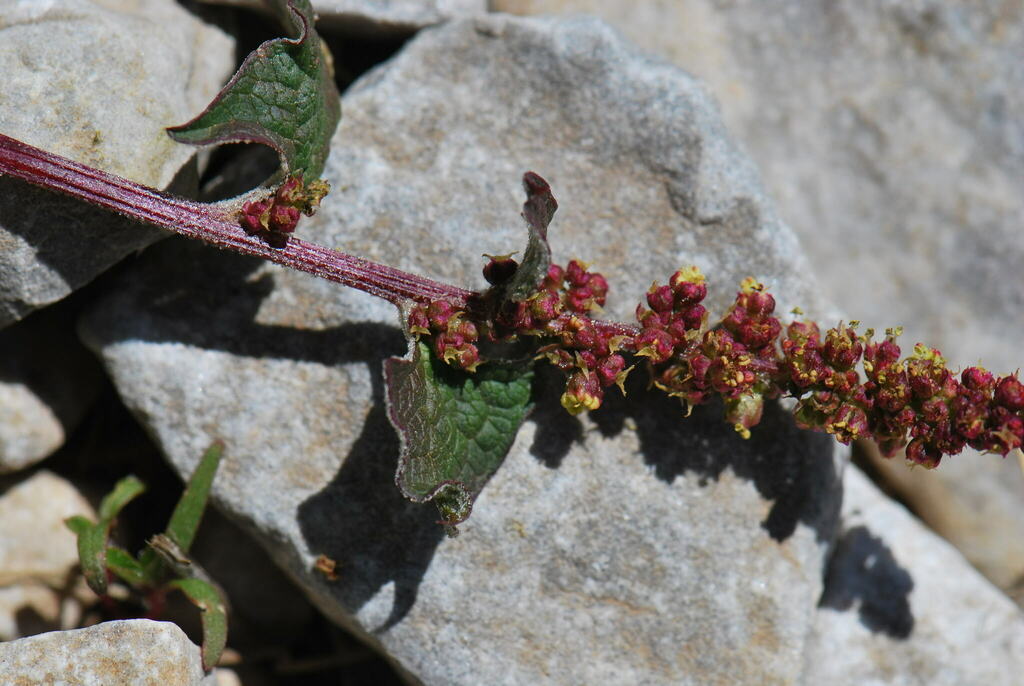
Beta nana
Beta nana, the dwarf beet, is a species of flowering perennial plant in the family Amaranthaceae endemic to the mountains of central and southern Greece.
From the article Beta nana on Wikipedia (CC BY-SA), quoted section by section
Description
B. nana is a small, diploid perennial plant with a prostrate growth habit and a rosette of leaves 10–20 cm in diameter, depending on the fertility of the soil. The inflorescences are procumbent, meaning they lie flat on the ground, and they hold 10–25 flowers each. The inflorescence is covered in small orbicular bracts, and flowers arise from the axils of these bracts. The flowers are hermaphrodite and able to self-pollinate. The fruit is a hard, monogerm seedball that dehisces while still green.
Range & habitat
B. nana is endemic to the mountains of central and southern Greece. It mostly grows on the east and northeast slopes of mountains at elevations of 1700–2800 meters, where the climate is cool and moist. It grows on limestone soils in open areas dominated by short plants, in disturbed areas, and in rocky crevices. In 2009, it was estimated that the population was stable with a total of 5,000 plants, but its habitat is potentially vulnerable to climate change.
Wikipedia: “Distribution and habitat”
What it does
Most sites inhabited by B. nana are grazed by goats and sheep. A small degree of grazing keeps nearby plants short, which may help the smaller B. nana to survive. The plant flowers from June to August. Its seeds are dispersed by meltwater flows, grazing animals, and birds.
Wikipedia: “Ecology”
At the table
B. nana is edible. Its resistance to cold has potential in efforts to improve the sugar beet.
== References ==
Wikipedia: “Uses”
Where it lives
Recorded sightings
—
geo-referenced records in GBIF, from museums, herbaria and field observers.
Drag the globe to turn it. Dots are where records exist, not a range map; darker means more records.
In the stacks
Searching the stacks…
Every page naming Beta nana in the Biodiversity Heritage Library →
This page is assembled live from iNaturalist, GBIF, Wikipedia, the Source Library and the Internet Archive. It is not yet part of the hand-edited codex. iNaturalist taxon 189794.