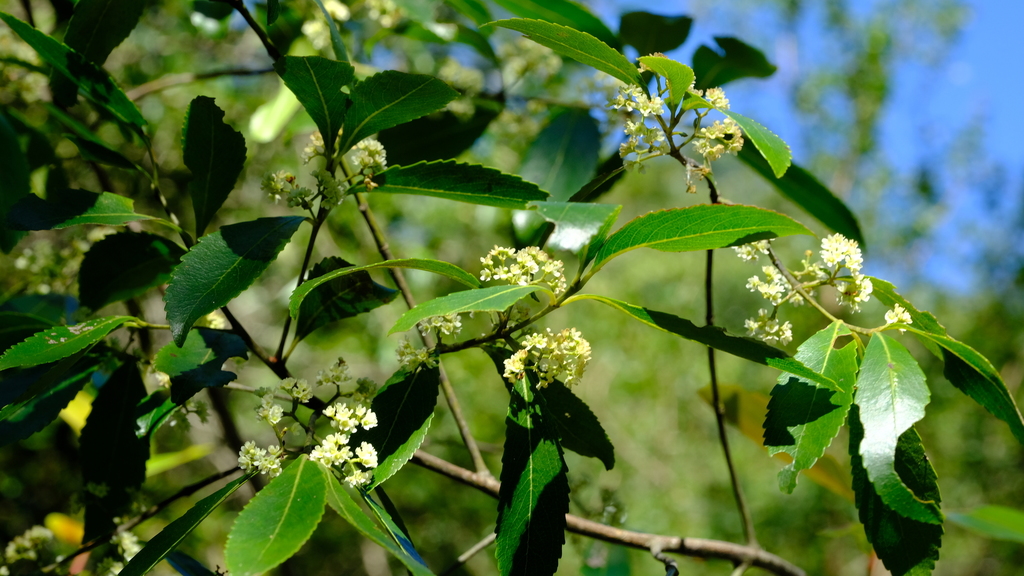
Khat
Catha edulis
Khat or qat (Catha edulis), also known as Bushman's tea in South Africa, is a species of flowering plant in the family Celastraceae, and the sole species in the genus Catha. It is a shrub or tree native to eastern and southern Africa, ranging from Ethiopia and South Sudan to Angola and the Cape Provinces of South Africa. It grows in montane riverine and evergreen forests from 1,100 to 2,400 metres (3600 to 7900 feet) elevation.
It has a history of cultivation originating in the Harar region of Ethiopia, and it was subsequently introduced at different times to countries nearby in East Africa and South Arabia, notably Somalia and Yemen. Cultivated by farmers, its leaves are sold on the market to be chewed as a recreational stimulant. The world's largest consumers are East Africans, particularly Somalis, and nearby Yemen, with the largest producers/exporters being Ethiopia and Kenya.
From the article Khat on Wikipedia (CC BY-SA), quoted section by section
Description
Khat is a slow-growing shrub or tree that typically attains a height of 1–5 meters (3 feet 3 inches – 16 feet 5 inches). However, it can reach heights of up to 10 m (33 ft) in equatorial areas. The plant usually grows in arid environments, at a temperature range of 5–35 degrees Celsius (41–95 degrees Fahrenheit). It has evergreen leaves, which are 5–10 centimeters (2–4 inches) long and 1–4 cm (0.39–1.6 in) broad.
It takes seven to eight years for the khat plant to reach its full height. Other than access to sun and water, khat requires little maintenance. Ground water is often pumped from deep wells by diesel engines to irrigate the crops, or brought in by water trucks. The plants are watered heavily starting around a month before they are harvested to make the leaves and stems soft and moist. A good khat plant can be harvested four times a year, providing a year-long source of income for the farmer. The shrub's flowers are produced on short axillary cymes that are 4–8 cm (1.6–3.1 in) in length. Each flower is small, with five white petals. The samara fruit is an oblong, three-valved capsule, which contains one to three seeds.
Range & habitat
In recent years, improved roads, off-road motor vehicles, and air transportation have increased the global distribution of this perishable commodity and, as a result, the plant has been found in places such as Australia, Netherlands, Canada, the United Kingdom, the Levant, Italy, New Zealand and the United States. In the US, freshly-packed khat leaves are sold in the African and Middle Eastern markets of Boston, Dallas, Los Angeles, and New York City, where the demand is highest.
Wikipedia: “Distribution”
At the table
Although the practice of khat-chewing is still primarily restricted to its original area of cultivation in the Red Sea area, the khat plant is native to the whole of the eastern side of Africa from Kenya southwards to Tanzania, Malawi, Zambia, Zimbabwe, where it grows on rocky outcrops and around the fringes of woodlands. In southern Africa the shrub's range is scattered but still grows in the KwaZulu-Natal, Eastern Cape, Western Cape and Mpumalanga provinces of South Africa, in addition to Eswatini and Mozambique. Traditionally, khat is used as a socialising drug as in Yemen, where khat-chewing is predominantly a male habit combined with conversation, hookah smoking, and tea drinking. Khat is so popular in Yemen that its cultivation consumes much of the country's agricultural resources. An estimated 40% of Yemen's water supply goes towards irrigating it, with production increasing by about 10% to 15% every year. One "daily bag" of khat requires an estimated 500 litres (130 US gal) of water to produce. In countries outside the core area of growth and consumption, khat is sometimes chewed at parties or social functions. …
Wikipedia: “Uses”
In medicine
The stimulant effect of the plant was originally attributed to "katin", cathine, a phenethylamine-type substance isolated from the plant. However, the attribution was disputed by reports showing the plant extracts from fresh leaves contained another substance more behaviourally active than cathine. In 1975, the related alkaloid cathinone was isolated, and its absolute configuration, (S)-2-Amino-1-phenylpropan-1-one, was established in 1978. Cathinone is not very stable and breaks down to produce cathine and norephedrine. These chemicals belong to the PPA (phenylpropanolamine) family, a subset of the phenethylamines related to amphetamines and the catecholamines epinephrine and norepinephrine. In fact, cathinone and cathine have a very similar molecular structure to amphetamine. Khat is sometimes confused with methcathinone (also known as cat), a Schedule I substance that possesses a similar chemical structure to the khat plant's cathinone active component. However, both the side effects and the addictive properties of methcathinone are much stronger than those associated with khat use. When khat leaves dry, the more potent chemical, cathinone, decomposes within 48 hours, leaving behind the milder chemical, cathine. …
Wikipedia: “Chemistry and pharmacology”
How it is grown
Khat has been grown for use as a stimulant for centuries in the Horn of Africa and the Arabian Peninsula. There, chewing khat predates the use of coffee and is used in a similar social context. Its fresh leaves and tops are chewed or, less frequently, dried and consumed as tea, to achieve a state of euphoria and stimulation. The leaves or the soft part of the stem can be chewed with either chewing gum or fried peanuts to make it easier to chew. In Uganda, it is grown in the central region, especially in Kasenge (Wakiso), Butambala District, Mabira Forest, and in some parts of the western region of the country. In Kenya, it is grown in Meru County and Embu County. One reason for the widespread cultivation of khat in Yemen is the high income that it provides for farmers. Some studies done in 2001 estimated that the income from cultivating khat was about 2.5 million Yemeni rials per hectare (1 million per acre), while fruits brought only 0.57 million rials per hectare (0.23 million per acre). Between 1970 and 2000, the area on which khat was cultivated was estimated to have grown from 8,000 to 103,000 hectares (30 to 400 sq. mi.). In 2000, according to a World Bank estimate, khat accounted for 30% of Yemen's economy.
Wikipedia: “Cultivation”
In human culture
The inhabitants of Ifat Sultanate were the first to be recorded using khat in the 14th century by Arab historian Ibn Fadlallah al-Umari. The khat plant likely originated in the Horn of Africa specifically Ethiopia-Somali area, from there it spread to Kenya and the Arabian Peninsula. According to nineteenth century British explorer Richard Burton, khat originated in the Emirate of Harar. Muslim Sufis in the surrounding areas also used it to intensify their mystical experience and to facilitate a sense of union with God. The earliest known documented description of khat is found in the Kitab al-Saidala fi al-Tibb كتاب الصيدلة في الطب, an 11th-century work on pharmacy and materia medica written by Abū Rayhān al-Bīrūnī, a Persian scientist and biologist. Unaware of its origins, al-Bīrūnī wrote that khat is:
[A] commodity from Turkestan. It is sour to taste and slenderly made in the manner of batan-alu. But khat is reddish with a slight blackish tinge. It is believed that batan-alu is red, coolant, relieves biliousness, and is a refrigerant for the stomach and the liver. It is mentioned again in a 13th-century publication by the physician Naguib Ad-Din. In 1854, Malay author Abdullah bin Abdul Kadir noted that the custom of chewing khat was prevalent in Al Hudaydah in Yemen:
You observed a new peculiarity in this city – everyone chewed leaves as goats chew the cud. …
Wikipedia: “History”
Where it lives
Recorded sightings
—
geo-referenced records in GBIF, from museums, herbaria and field observers.
Drag the globe to turn it. Dots are where records exist, not a range map; darker means more records.
In the stacks
Searching the stacks…
Every page naming Catha edulis in the Biodiversity Heritage Library →
This page is assembled live from iNaturalist, GBIF, Wikipedia, the Source Library and the Internet Archive. It is not yet part of the hand-edited codex. iNaturalist taxon 190367.