- Plants
- ›Vascular Plants
- ›flowering plants
- ›Dicots
- ›Sunflowers, Bellflowers, Fanflowers, and Allies
- ›Sunflowers, Daisies, Asters, and Allies
- ›Thistles and Allies
- ›Cardueae
- ›Knapweeds and Allies
- ›Centaurea
- ›Centaurea
- ›Centaurea
- ›Centaurea cineraria
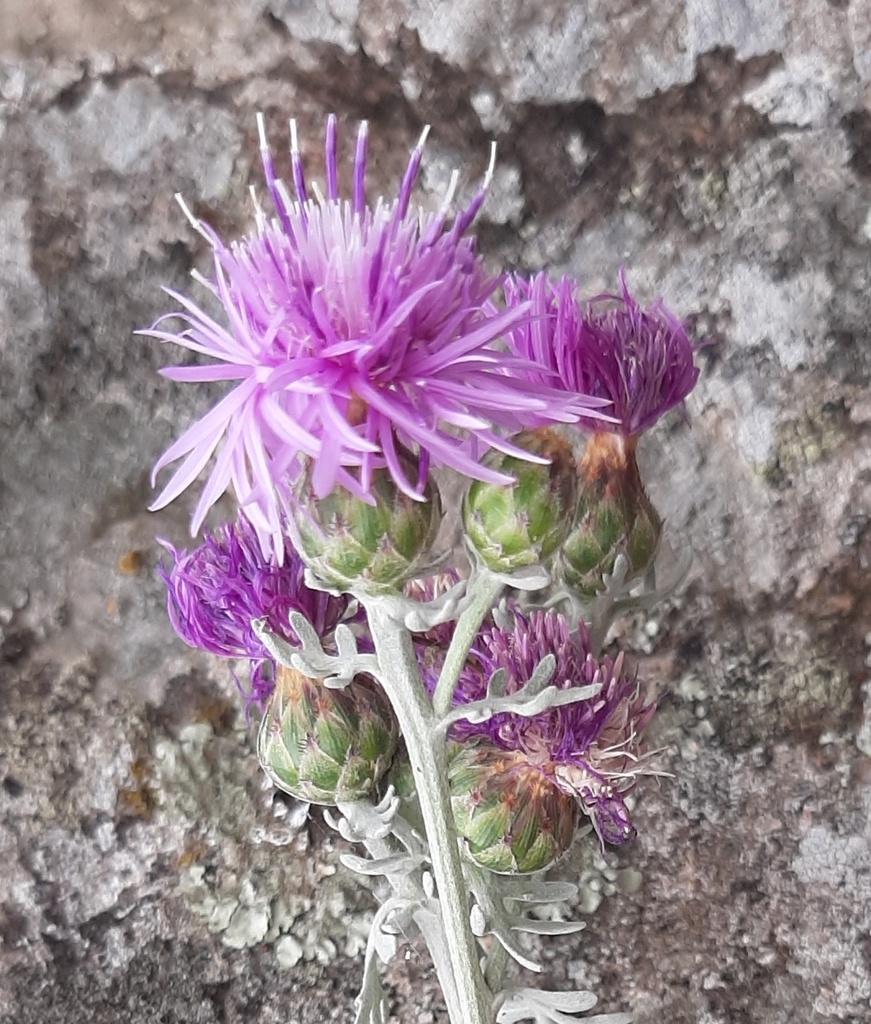
Centaurea gymnocarpa
Centaurea gymnocarpa, also known as Capraian cornflower (Italian: fiordaliso di Capraia) or centaury of Capraia, is a species of flowering plant in the family Asteraceae. It is a rare species endemic to Italy found only on Capraia, a small island located in the Tuscan Archipelago, with the species being distributed across eight subpopulations on the island's surface. Its natural habitats are Mediterranean-type shrubby vegetation and rocky areas, colonizing in the cracks and fissures of cliffs.
From the article Centaurea gymnocarpa on Wikipedia (CC BY-SA), quoted section by section
Description
This perennial plant has a woody base and long stem that reaches a height between 80 and 100 cm (27.5 and 39.3 inches). The plant is covered with dense short hairs, giving a greyish-white appearance to the plant. The leaves are somewhat fleshy and appear green above and greyish-white below, with old leaves persisting at the base. C. gymnocarpa blooms in May, producing tiny pink flowers in a compact flower head. A hybrid with the related species Centaurea cineraria is sometimes used in gardens as an ornamental plant.
Range & habitat
Centaurea gymnocarpa is endemic to Italy found only on Capraia, a small island located in the Tuscan Archipelago, with the species being distributed across eight subpopulations on the island's surface. Its natural habitats are Mediterranean-type shrubby vegetation and rocky areas, colonizing in the cracks and fissures of cliffs.
Wikipedia: “Distribution and habitat”
Where it lives
Recorded sightings
—
geo-referenced records in GBIF, from museums, herbaria and field observers.
Drag the globe to turn it. Dots are where records exist, not a range map; darker means more records.
In the stacks
Searching the stacks…
Every page naming Centaurea gymnocarpa in the Biodiversity Heritage Library →
This page is assembled live from iNaturalist, GBIF, Wikipedia, the Source Library and the Internet Archive. It is not yet part of the hand-edited codex. iNaturalist taxon 190390.