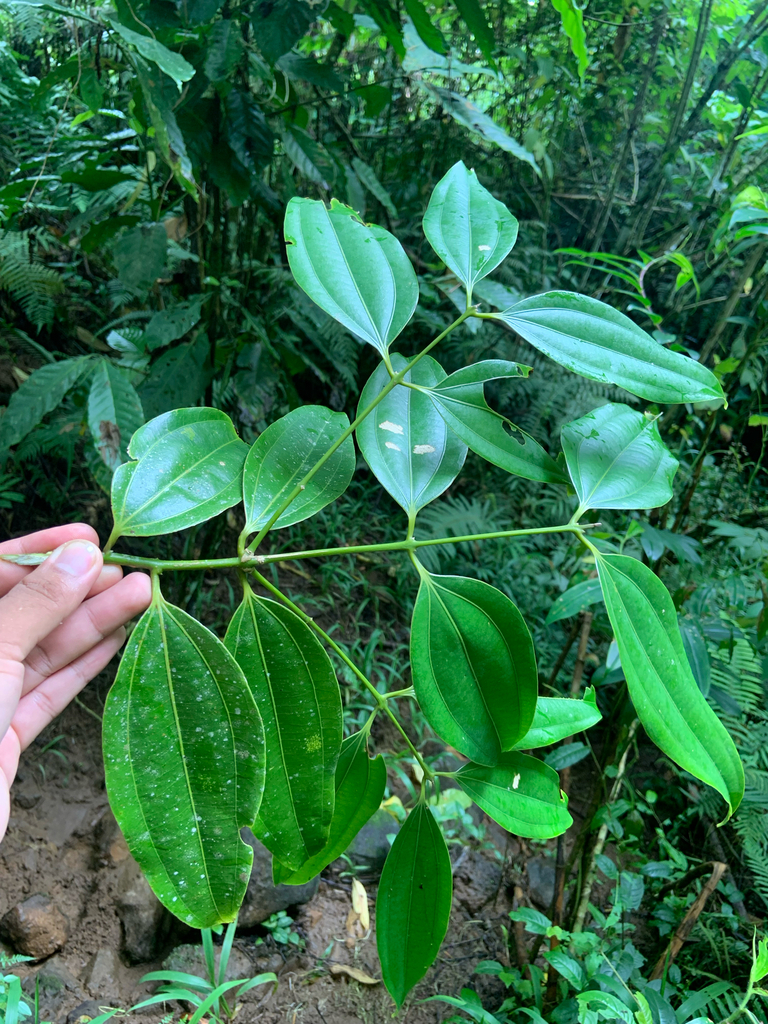
Cinnamomum mercadoi
Cinnamomum mercadoi (kalingag) is a small tree, about 6 to 10 metres (20 to 33 ft) high, with a thick, aromatic bark. The plant part of the family Lauraceae, which contains about 45 genera and 2000-2500 species, and is related to the culinary cinnamon, sassafras, and bay tree. The plant is indigenous to the Philippines, where it grows best in forests at low and medium altitudes that sometimes ascend to 2,000 metres (6,600 ft). C. mercadoi is unusual in the cinnamon family in that its essential oil consists large amounts of safrol, whereas other oils of cinnamon contain cinnamaldehyde. Previously listed in the International Union for Conservation of Nature (IUCN) Red List as vulnerable due to the overharvesting and the continuous loss of the Philippine forests, it is now listed as least concern, although habitat loss and degradation remain threats.
From the article Cinnamomum mercadoi on Wikipedia (CC BY-SA), quoted section by section
Description
The leaves of the C. mercadoi are simple, opposite or subopposite, smooth, pale green, ovately-oblong or broadly lanceolate. The leaves are also sometimes subelliptic, usually 8 to 20 centimeters long and 4 to 6 centimeters wide, and are pointed at both ends, with petioles 5 to 15 millimeters long. The inflorescence is erect and grows from the uppermost leaf axils, about 10 centimeters long. The petals are smooth and rarely exerted. The calyx is canescent and turbinate. Finally, the bark is gray and does not have any fissures or cracks. It is covered irregularly with corky pustules and thus giving the bark a slightly rough appearance.
Range & habitat
Cinnamomum mercadoi is endemic to the Philippines, where it is found from the Babuyan Islands and northern Luzon to Mindanao.
Wikipedia: “Distribution”
What it does
Cinnamomum mercadoi plants are monoecious and are variable in the height, shape, size, and texture of the leaves. They typically grow in primary and secondary forests at elevations of about 300 to 700 metres (980 to 2,300 ft) but are able to ascend to 2,000 metres (6,600 ft). They grow best in subtropical and mild temperate forest conditions where high humidity and relatively stable, mild temperatures are found. They also grow best in pH levels of about 4 to 5 and their seeds are mainly dispersed via birds such as the fruit-specialized hornbills which account for the scattered distribution and regeneration of the tree species across the island.
Wikipedia: “Habitat and ecology”
At the table
The sassafras aroma and taste that the leaves and bark of the C. mercadoi may be added to root beers to give them flavor.
Wikipedia: “Food”
In medicine
There are several medicinal properties of C. mercadoi including its usage as a(n) diaphoretic, parasiticide, antispasmodic, aphrodisiac, analgesic, and diuretic. The bark of C. mercadoi has traditionally been used in medicine in the Philippines. In 1668, the Jesuit Ignatio Francisco Alzina reported that eating it aided digestion and since then, it has been employed to treat digestive troubles. It was also employed as a treatment for headaches and rheumatism and has been used as a rubefacient. Furthermore, the bark is used as a(n) carminative, stimulant, astringent, antiseptic, antifungal, and antiviral property. Finally, the decoction of the leaves is a remedy for flatulence and menstrual problems in women.
Wikipedia: “Medicinal”
Where it lives
Recorded sightings
—
geo-referenced records in GBIF, from museums, herbaria and field observers.
Drag the globe to turn it. Dots are where records exist, not a range map; darker means more records.
In the stacks
Searching the stacks…
Every page naming Cinnamomum mercadoi in the Biodiversity Heritage Library →
This page is assembled live from iNaturalist, GBIF, Wikipedia, the Source Library and the Internet Archive. It is not yet part of the hand-edited codex. iNaturalist taxon 190591.