- Plants
- ›Vascular Plants
- ›flowering plants
- ›Dicots
- ›Mustards, Capers, and Allies
- ›mustard family
- ›Brassicoideae
- ›Cochlearieae
- ›Cochlearia
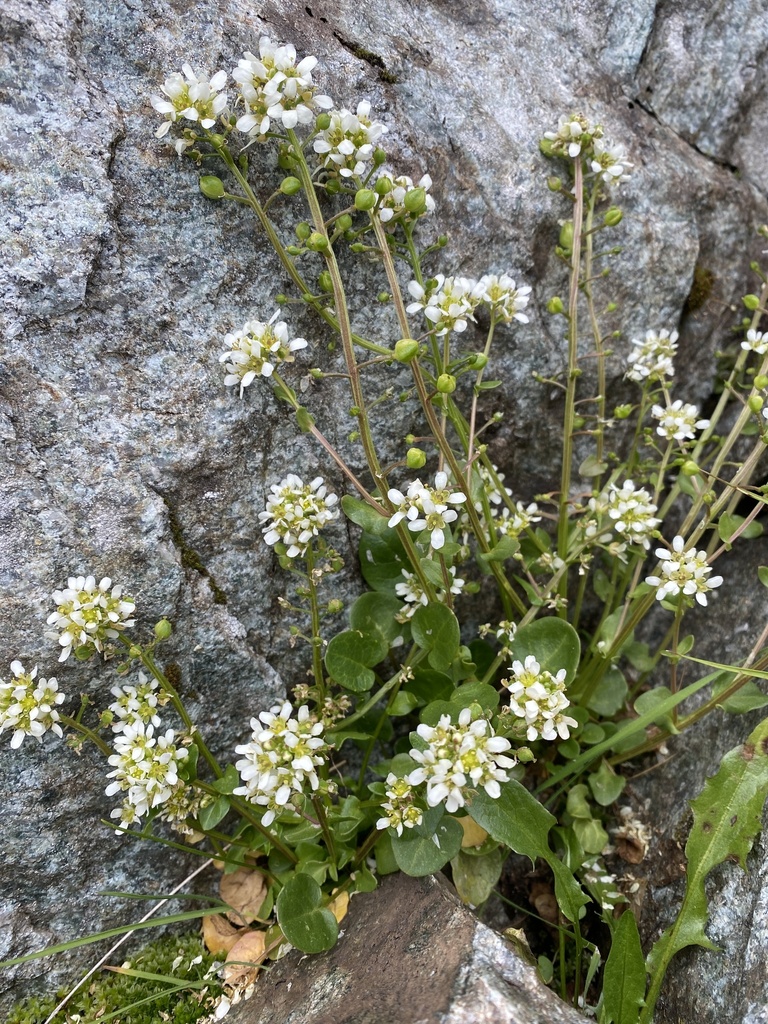
Cochlearia tatrae
Cochlearia tatrae, the Tatra scurvy-grass, is a flowering plant of the genus Cochlearia in the family Brassicaceae. The plant is endemic to and named after the Tatra Mountains, which in northern Slovakia and southern Poland.
The plant blooms from April to September.
From the article Cochlearia tatrae on Wikipedia (CC BY-SA), quoted section by section
Range & habitat
The species is a subnival (upper alpine dwarf scrub) and alpine plant. It is found in moist rock scree and crevices, and around springs and streams. In Poland the plant is restricted to a dozen sites in the Morskie Oko Lake area of the High Tatra Mountains, at 1,595–2,390 metres (5,233–7,841 ft) in elevation. The population is estimated at 600 individuals. In Slovakia the populations are found in thirty sites, at elevations up to 2,605 metres (8,547 ft). It is found on Mięguszowiecki Szczyt Mountain (Slovak: Veľký Mengusovský štít), which is on the Slovak-Polish border. Cochlearia tatrae is an IUCN Red List vulnerable species.
== References ==
Wikipedia: “Distribution”
Where it lives
Recorded sightings
—
geo-referenced records in GBIF, from museums, herbaria and field observers.
Drag the globe to turn it. Dots are where records exist, not a range map; darker means more records.
In the stacks
Searching the stacks…
Every page naming Cochlearia tatrae in the Biodiversity Heritage Library →
This page is assembled live from iNaturalist, GBIF, Wikipedia, the Source Library and the Internet Archive. It is not yet part of the hand-edited codex. iNaturalist taxon 190736.