- Plants
- ›Vascular Plants
- ›flowering plants
- ›Dicots
- ›Legumes, Milkworts, and Allies
- ›Legumes
- ›Faboideae
- ›Dalbergieae
- ›Dalbergia
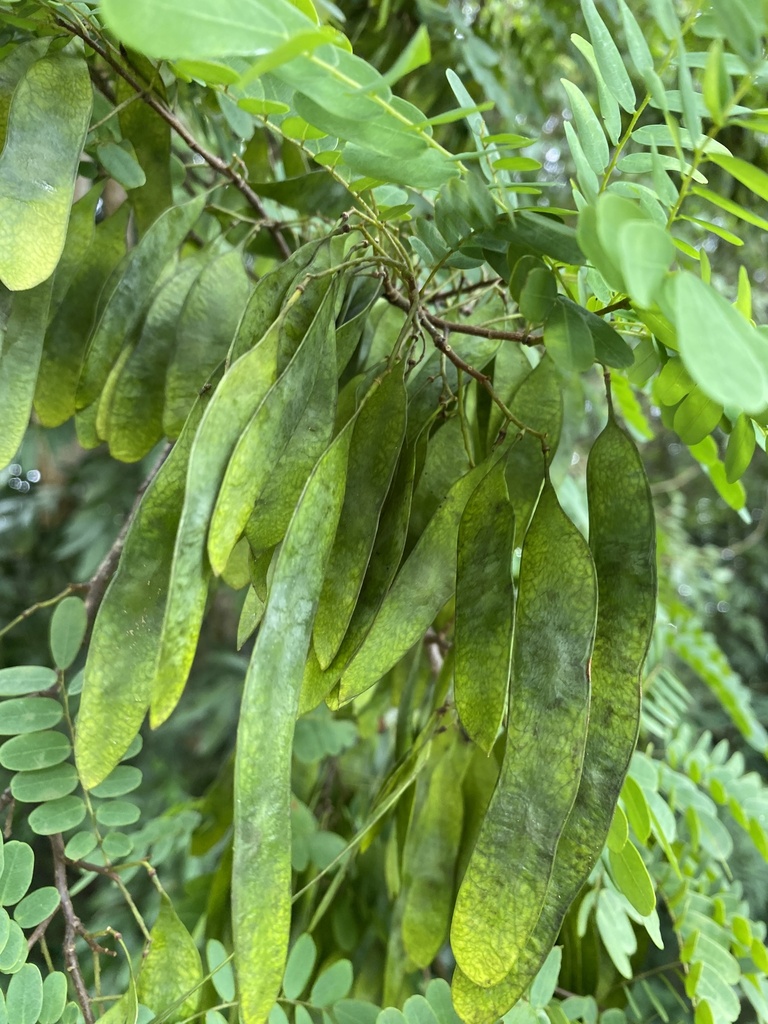
Dalbergia nigra
Dalbergia nigra, commonly known as the Bahia rosewood, jacarandá-da-bahia, Brazilian rosewood, Rio rosewood, jacarandá-do-brasil, pianowood, caviúna, graúna, jacarandá-una or obuina is a species of legume in the Fabaceae family.
From the article Dalbergia nigra on Wikipedia (CC BY-SA), quoted section by section
Description
Dalbergia nigra produces a very hard and heavy wood, characteristically varied in colour from brick red through various shades of brown (medium to nearly black). Pieces that feature veins of black colouration called spider webbing or landscape grain are especially prized. Another distinguishing feature is its outstanding resonance. An evenly cut piece that is tapped emits a bright metallic ring that sustains. This property, combined with its beauty, has made Brazilian rosewood a favourite of musical instrument makers for centuries. Brazilian rosewood is highly resistant to insect attacks. There are many species in the genus Dalbergia that can be confused with Dalbergia nigra, but the latter can be recognised by its colour and resin. It may also be confused with Machaerium, which has a more compact parenchyma and lack large pores. Very little is known about the ecology and reproduction of the Brazilian rosewood.
Range & habitat
Dalbergia nigra is endemic to Brazil, and native to the Bahia interior forests ecoregion. It is endemic to the Atlantic Forest biome of southeastern Brazil, and found only in southern Bahia, Espírito Santo, Minas Gerais, and Rio de Janeiro states. It needs a habitat of wet and damp forest on rich soils to thrive.
Wikipedia: “Habitat and distribution”
At the table
The wood of this species has been much sought after since it was first introduced to the European and subsequently the world market, hundreds of years ago. Dalbergia nigra became popular in high grade furniture, such as that produced during the Regency period of late 18th and early 19th centuries—and more recently by Scandinavian makers, who produced furniture in the Danish Modern style. This species has also been used in various musical instruments, decorative wood-ware, knife handles and turnery. Much of the most highly figured material was sliced into veneers, which decorated items such as domestic and office furniture, wall panels, and piano cases; it was also a favourite of marquetry artists. Old growth Brazilian rosewood remains highly prized by classical and steel string guitar makers, who regard it as perhaps the best sounding wood for guitar backs and sides. It was used in instruments as long ago as the late Renaissance and Baroque eras, when luthiers used it for lute backs (ribs) and various parts of other stringed musical instruments. It was also used in woodwind instruments, such as bassoons, flutes, and recorders.
Wikipedia: “Former uses”
Where it lives
Recorded sightings
—
geo-referenced records in GBIF, from museums, herbaria and field observers.
Drag the globe to turn it. Dots are where records exist, not a range map; darker means more records.
In the stacks
Searching the stacks…
Every page naming Dalbergia nigra in the Biodiversity Heritage Library →
This page is assembled live from iNaturalist, GBIF, Wikipedia, the Source Library and the Internet Archive. It is not yet part of the hand-edited codex. iNaturalist taxon 191300.