- Fungi Including Lichens
- ›Basidiomycete Fungi
- ›Higher Basidiomycetes
- ›Mushrooms, Bracket Fungi, Puffballs, and Allies
- ›Russulales
- ›Milkcaps, Brittlegills and Allies
- ›Russula
- ›Heterophyllidiae
- ›Cyanoxanthinae
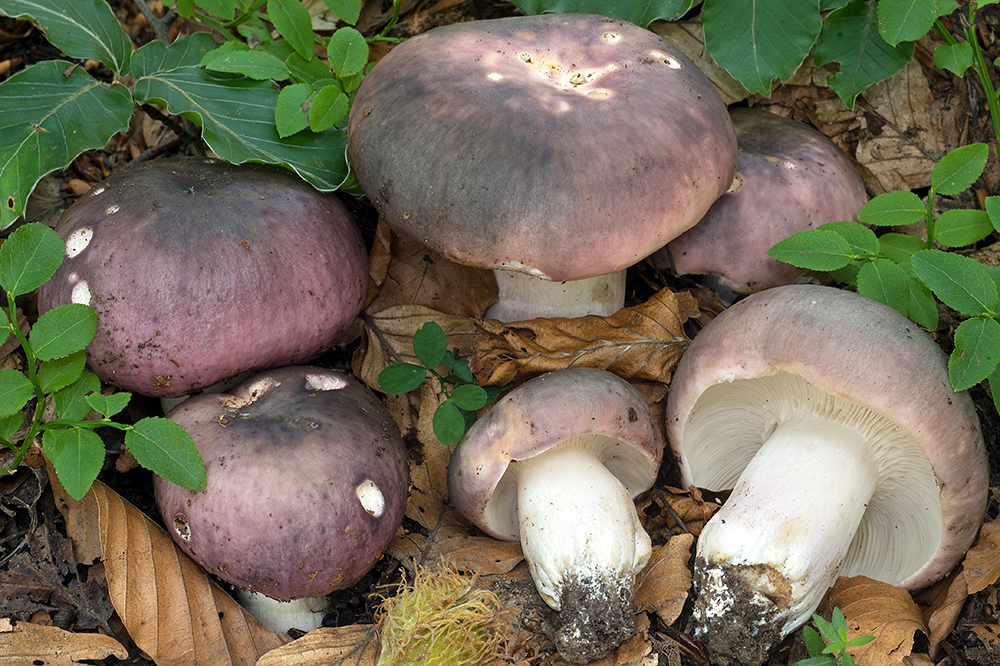
Charcoal Burner
Russula cyanoxantha
Russula cyanoxantha, synonymous with R. xyanoxantha, commonly known as the charcoal burner, is a basidiomycete mushroom, distinguished from most other members of the Russula genus by the fact that its gills do not split, but are soft and flexible. It is one of the most common species of Russula in Europe.
From the article Russula cyanoxantha on Wikipedia (CC BY-SA), quoted section by section
Description
The most salient characteristic is the weak gills, which feel greasy to the touch, are flexible and do not break. The cap is 4–18 cm (1+1⁄2–7 in) wide, convex at first and later flattened, and greenish to bright brown; they vary considerably in color. The white-to-cream gills are sometimes forked and are not as brittle as most other members of the genus. The stipe is pure white, slightly convex underneath, from 2.5–12 cm (1–4+3⁄4 in) in height and 1–5 cm (1⁄2–2 in) in diameter. The spores are white, as is the spore print. The stipe does not produce a salmon reaction when rubbed with ferrous sulphate.
Similar species. The cap of the grey-green Russula grisea is more blue-grey but has violet or green hues with light cream gills; it also grows in mixed forests, particularly under beech, and more rarely in coniferous forests. Russula olivacea also may have a variegated cap, but produces yellow spores. R. aeruginea is greenish and has forked gills. R. variata is frequently forked and found in the east. R. versicolor has yellowish, unforked gills.
Range & habitat
Russula cyanoxantha grows in slightly acidic, but nutrient-rich soil. Like all Russulas, it is a mycorrhizal fungus. It is found most commonly in beech forests, and often in deciduous or mixed forests. It is possible that only European specimens are actually R. cyanoxantha. It has been described as appearing from July to October in eastern North America and the Mountain states, and from October to January further west.
Wikipedia: “Habitat and distribution”
At the table
This mushroom is edible, being suitable for many kinds of preparation; the flesh is not as hard as that of many other edible Russulas. It has a mild, nutty taste, but the mushroom is often infested with maggots.
Wikipedia: “Uses”
In human culture
It was designated "Mushroom of the Year" in 1997 by the German Association of Mycology.
Wikipedia: “In culture”
Where it lives
Recorded sightings
—
geo-referenced records in GBIF, from museums, herbaria and field observers.
Drag the globe to turn it. Dots are where records exist, not a range map; darker means more records.
In the stacks
Searching the stacks…
Every page naming Russula cyanoxantha in the Biodiversity Heritage Library →
This page is assembled live from iNaturalist, GBIF, Wikipedia, the Source Library and the Internet Archive. It is not yet part of the hand-edited codex. iNaturalist taxon 194437.