- Fungi Including Lichens
- ›Basidiomycete Fungi
- ›Higher Basidiomycetes
- ›Mushrooms, Bracket Fungi, Puffballs, and Allies
- ›Agaricomycetidae
- ›Common Gilled Mushrooms and Allies
- ›Agaricineae
- ›Verrucosporaceae
- ›Lepiota
- ›Lepiota
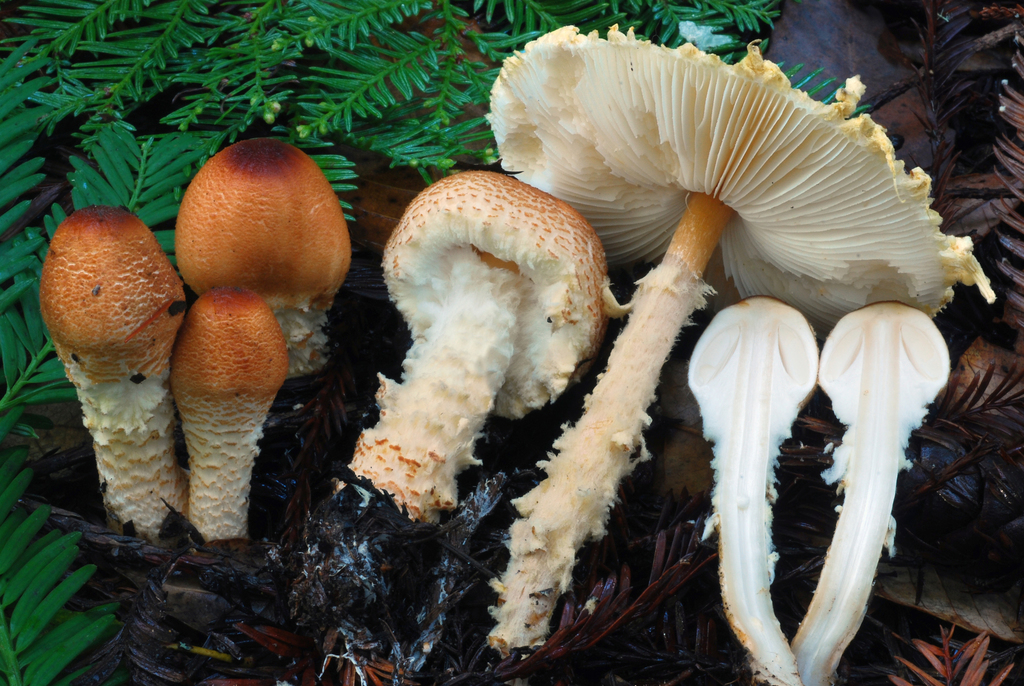
yellowfoot dapperling
Lepiota magnispora
Lepiota magnispora, commonly known as the fluffstem parasol or yellowfoot dapperling, is a species of mushroom in the genus Lepiota. It was first described by William Murrill in 1912.
From the article Lepiota magnispora on Wikipedia (CC BY-SA), quoted section by section
Description
The cap of Lepiota magnispora is around 1.5 to 6 centimeters across. It starts out round to egg-shaped, before becoming flatter with age. The cap is dry, smooth when young, and develops scales as the mushroom gets older. The stipe is 5-12 centimeters long and 0.6-1.5 centimeters wide. It is shaggy towards the base and often has a ring which can disappear with age. The gills are white, and become brownish as the mushroom gets older. The spore print is white.
Similar species. Lepiota magnispora is morphologically very similar to L. clypeolaria, and was previously considered to be the same species. However, the former is more brightly colored and has larger spores. L. cristata is also similar, but its scales are more pale, and it has an odor described as "unpleasant" and "rubbery." L. ingivolvata has an orange to reddish brown second ring near the base of the stipe.
Range & habitat
Lepiota magnispora is saprotrophic and found in a wide variety of habitats, growing under both hardwoods and conifers, including western redcedar. It is found in North America, but its distribution on the continent is not fully known due to similar species.
== References ==
Wikipedia: “Habitat and ecology”
Where it lives
Recorded sightings
—
geo-referenced records in GBIF, from museums, herbaria and field observers.
Drag the globe to turn it. Dots are where records exist, not a range map; darker means more records.
In the stacks
Searching the stacks…
Every page naming Lepiota magnispora in the Biodiversity Heritage Library →
This page is assembled live from iNaturalist, GBIF, Wikipedia, the Source Library and the Internet Archive. It is not yet part of the hand-edited codex. iNaturalist taxon 194663.