- Fungi Including Lichens
- ›Ascomycete Fungi
- ›Sac Fungi and Lichens
- ›Common Lichens
- ›Shield Lichens, Sunburst Lichens, Rosette Lichens, and Allies
- ›button lichens, rosette lichens, and allies
- ›rosette lichens, frost lichens, and allies
- ›Physcia
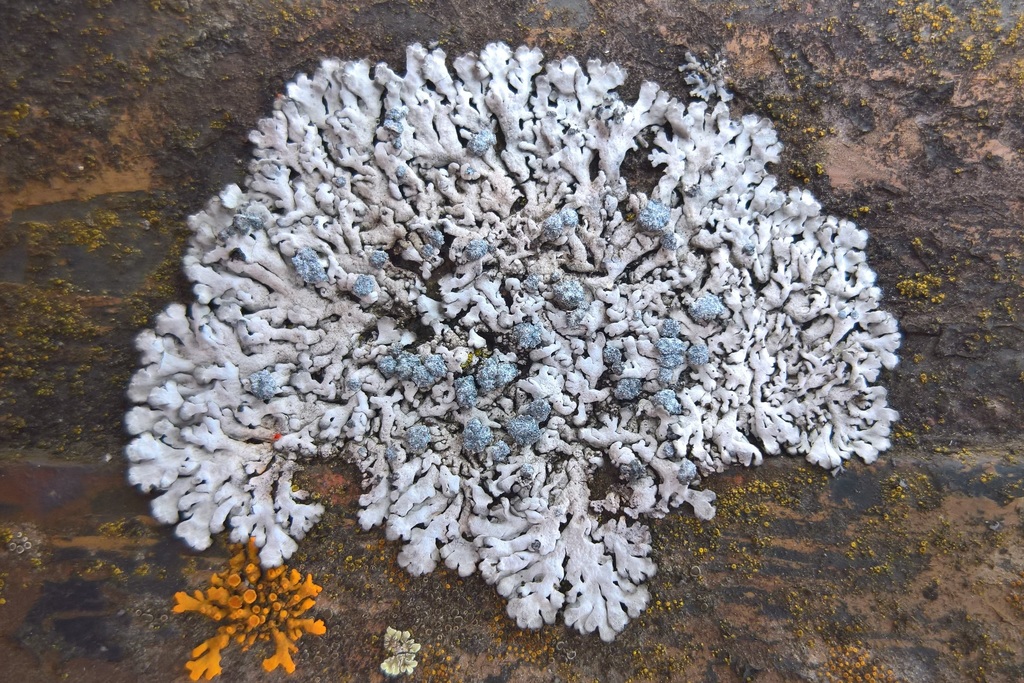
Blue-gray Rosette Lichen
Physcia caesia
Physcia caesia, known colloquially as blue-gray rosette lichen and powder-back lichen, is a species of foliose lichenized fungus. First described by Georg Franz Hoffmann in 1784, it is common across much of Europe, North America and New Zealand, and more patchily distributed in South America, Asia, Australia and Antarctica. There are 2 subspecies: P. c. caesia and P. c. ventosa, as well as a number of distinct forms and varieties. Molecular studies suggest that the species as currently defined may be polyphyletic. It is typically pale gray shading to darker gray in the center (though some forms are considerably darker), and grows in a small rosette, usually some 2–3 cm (0.79–1.18 in) across at maturity. It only rarely has apothecia, instead reproducing most often vegetatively via soredia, which are piled in round blue-gray mounds across the thallus's upper surface. It grows most often on rock—principally calcareous, but also basaltic and siliceous—and also occurs on bone, bark and soil. It is nitrophilic and is particularly common on substrates where birds perch.
Capable of growing at a multitude of angles on a variety of surfaces, Physcia caesia also tolerates a wide range of environmental extremes from the high temperatures of desert locations to the low temperatures of the Antarctic. It grows on both dry stone and that moistened by seepage, and can survive being irregularly submerged for extended periods underwater.
From the article Physcia caesia on Wikipedia (CC BY-SA), quoted section by section
Description
Physcia caesia is a foliose lichen that forms small rosettes, typically measuring 2–3 cm (0.79–1.18 in) across at maturity, though it can reach diameters of up to 7 cm (2.8 in). The thallus is pale gray shading to darker gray in the center, and adheres closely to the substrate on which it grows. Its convex lobes are linear, typically measuring 0.5–1.0 mm (0.02–0.04 in) in width, though occasionally as wide as 2 mm (0.08 in). Forms in some areas, including Greenland, can be considerably darker, with a thallus ranging from gray to dark gray; they can also have broader or narrower lobes. The lichen's surface is white-spotted, though this is not always obvious. It has blue-gray soredia, which are piled in round mounds (such aggregations are known as soralia) across the thallus's upper surface. The lower surface is white to brown with short, dark rhizines. Physcia caesia only rarely has apothecia. Where present, these are black discs measuring up to 2 millimetres (0.08 in) across, with prominent thalline margins (which means the thallus extends up around the edges of the apothecia) and a grayish pruinescence. Each ascus contains 8 spores, which are thick-walled and brown, measuring 18–25 μm (0.00071–0.00098 in) x 6–10 μm (0.00024–0.00039 in). …
Range & habitat
Physcia caesia is widespread across much of the world, found in Arctic, boreal and temperate vegetation zones. Widely distributed across Europe, it is one of the most common species of Physcia in Greenland, and is abundant throughout Britain. Though found across much of North America, it is absent from central and southeastern United States, parts of the Great Basin, and northern Alaska. In South America, it is found in Argentina, Chile, and Peru; common and widespread in temperate areas, it occurs only rarely and only at elevations above 3,700 m (12,100 ft) in tropical regions. It occurs patchily across Asia—in India, Bhutan, Nepal and Japan—as well as in East Africa. It is described as "cosmopolitan" in New Zealand, has been reported from a number of sites in southeastern Australia and Tasmania, and also occurs in Antarctica. It is common on calcareous substrates, growing on limestone (including tufa) and concrete. It also grows on basaltic and siliceous rock, as well as on bone. It is particularly common on rocks where birds perch and defecate. It is uncommon on bark; however, in the Colorado Rocky Mountains, it is one of the predominant lichens on juniper trees, growing primarily within 0.1 m (3.9 in) of the ground on the northern and eastern side of trunks. …
Wikipedia: “Distribution and habitat”
What it does
Physcia caesia tolerates a variety of locations, occurring on vertical, angled and horizontal surfaces, as well as rocky overhangs. It is found on both dry stone and stone moistened by seepage, and can tolerate being irregularly submerged underwater. It survives in hot desert conditions, primarily on the north side of slopes. It also thrives in cold conditions, and is able to photosynthesize at temperatures as low as −14 °C (7 °F). Like many lichens that grow on rocky substrates, Physcia caesia is able to accumulate a number of necessary nutrients—including nitrogen, phosphorus, potassium and iron—from the substrate upon which it grows, as well as from rainwater and atmospheric dust. Its hyphae can extend into substrate as much as 17 mm (0.67 in). It is a nitrophyte and can tolerate higher levels of atmospheric ammonia than can many other species of lichen, because it can survive on substrates with a higher pH. It has been recorded growing on a lead surface (probably a weathered oxide). Physcia caesia is known to accumulate high concentrations of heavy metals, including chromium, zinc, copper and iron. …
Wikipedia: “Ecology”
Where it lives
Recorded sightings
—
geo-referenced records in GBIF, from museums, herbaria and field observers.
Drag the globe to turn it. Dots are where records exist, not a range map; darker means more records.
In the stacks
Searching the stacks…
Every page naming Physcia caesia in the Biodiversity Heritage Library →
This page is assembled live from iNaturalist, GBIF, Wikipedia, the Source Library and the Internet Archive. It is not yet part of the hand-edited codex. iNaturalist taxon 194681.