- Animals
- ›Chordates
- ›Vertebrates
- ›Ray-finned Fishes
- ›Spiny-rayed fishes
- ›Cods and Hakes
- ›Macrouroidei
- ›Grenadiers
- ›Coryphaenoides
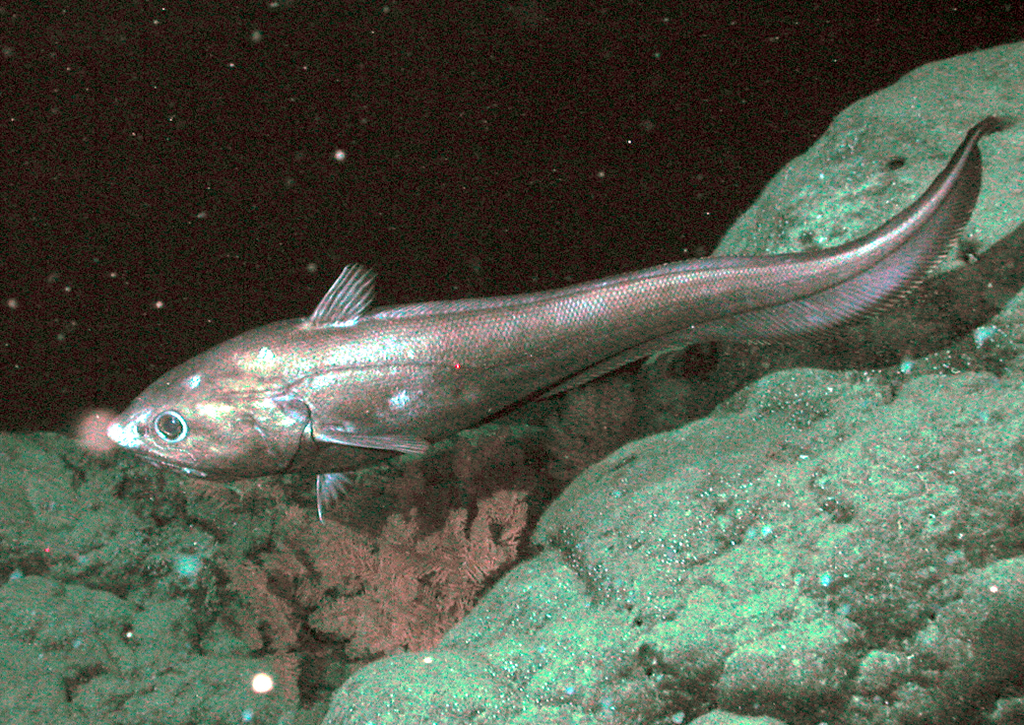
Russet Grenadier
Coryphaenoides armatus
The abyssal grenadier, Coryphaenoides armatus, is an abyssal fish of the genus Coryphaenoides, found in all the world's oceans, at depths between 800 and 5,493 metres (2,625 and 18,022 ft). Its adult length is 20 to 40 centimetres (8 to 16 in), although Fishbase gives lengths up to 1 metre (3 ft 3 in). The abyssal grenadier's body is unique in that it contains two dorsal spines and about 124 dorsal soft rays, which are the flexible jointed rays supporting a fin nearest to the back in the spinal column. It has no anal spines, but has 115 anal soft rays along its body. The head and eyes of this fish are very large, while the mouth is very small. The color of the abyssal grenadier is brown apart from the abdomen, which is bluish.
From the article Abyssal grenadier on Wikipedia (CC BY-SA), quoted section by section
What it does
C. armatus' diet is mainly composed of mid-water cephalopods and fishes, but it can also consume echinoderms. Examination of the stomach contents of specimens collected by trawling below 2,600 m deep in the Hudson Canyon showed that an important proportion of the diet of C. armatus is caught in the deep mesopelagic and bathypelagic regions. Though the diet of C. armatus largely consists of animals, these fish have been observed to opportunistically consume phytodetritus, especially in regions where phytodetritus falls are more common. This finding was supported by researchers who found a positive correlation between increased swim speed in months with increased levels of benthic nutrient enrichment via marine snow. Research studies focused on the feeding and foraging habits of C. armatus has revealed that this species follows an active foraging strategy consistent with the optimal foraging theory. C. armatus has been observed to maintain low metabolic rates and slow aerobic activity in their foraging; these behaviors are thought to reflect a need to conserve energy due to the extreme environmental conditions and food scarcity that exists in C. armatus' natural habitats.
Wikipedia: “Feeding and hunting behavior”
Where it lives
Recorded sightings
—
geo-referenced records in GBIF, from museums, herbaria and field observers.
Drag the globe to turn it. Dots are where records exist, not a range map; darker means more records.
In the stacks
Searching the stacks…
Every page naming Coryphaenoides armatus in the Biodiversity Heritage Library →
This page is assembled live from iNaturalist, GBIF, Wikipedia, the Source Library and the Internet Archive. It is not yet part of the hand-edited codex. iNaturalist taxon 194844.