- Plants
- ›Vascular Plants
- ›flowering plants
- ›Dicots
- ›Gentians, Dogbanes, Madders, and Allies
- ›Dogbane Family
- ›milkweeds
- ›Ceropegieae
- ›Leptadeniinae
- ›Leptadenia
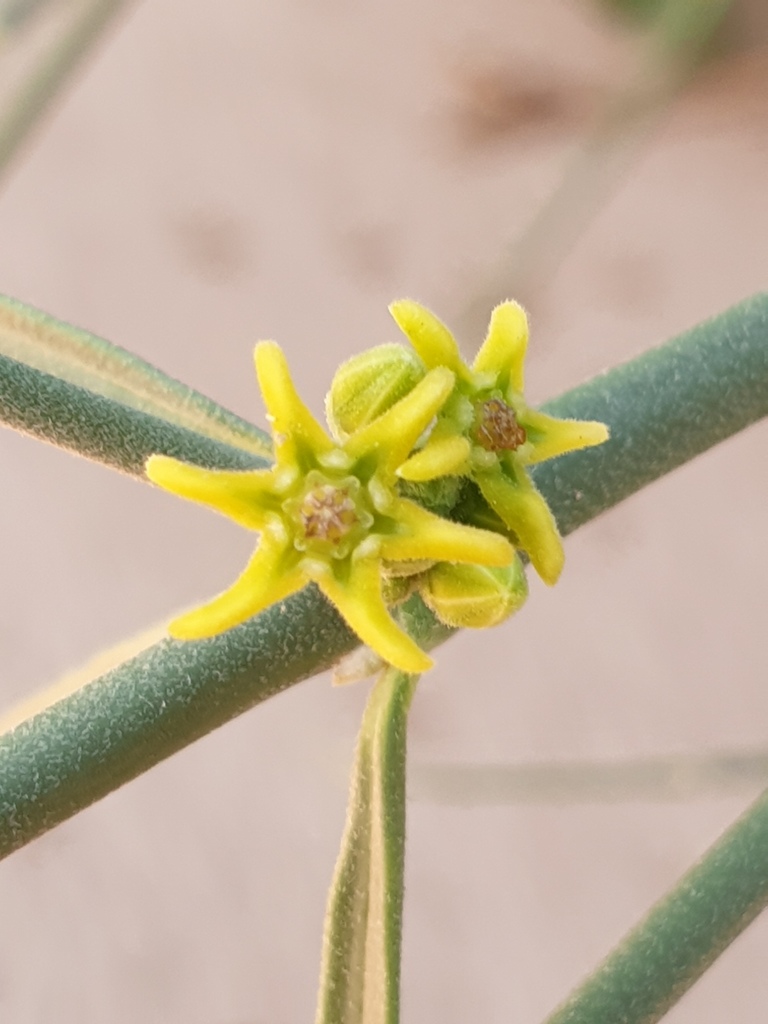
kheep
Leptadenia pyrotechnica
Leptadenia pyrotechnica (Rajasthani: खींप/खीप; Punjabi: ਖਿੱਪ) is the botanical name of a desert herb of the family Apocynaceae. It is widespread from Senegal to India. It is known as khimp/khip in Rajasthani, and khipp in Punjabi.
Being highly drought-resistant, Leptadenia pyrotechnica has played an important role in the desert afforestation programs. The herb khimp is a strong soil binder and, as such, is one of the pioneer species in sand dune fixation.
From the article Leptadenia pyrotechnica on Wikipedia (CC BY-SA), quoted section by section
Description
Leptadenia pyrotechnica is heavily branched and reaches heights of up to 3 metres. The shrub's long roots reach up to 12 metres below the surface. The leaves of the green to grey-green branches tend to fall off early. When present, they are opposite, sessile, elongated to linear, glabrous and about 2 cm long and 3 mm wide. The very small, greenish-yellow, hermaphrodite and five-fold, short-stalked flowers with a double inflorescence have a diameter of 2 mm and stand in axillary, small cymous inflorescences. The flowers are fine-haired and have a minimal, fleshy corolla. The two ovaries are on top, whilst the stigma and stamens are fused into a very short gynostegium. The narrow, many-seeded, green, follicular fruits reach 8–11 cm in length. When ripe (like those of the related milkweeds) they dehisce to liberate pappus-tufted seeds, which are carried off by the wind.
At the table
The plant is used in thatching huts. The unripe 'pods' (actually follicles) of this shrub (known in Rajasthani as khimpoli (खींपोळी)) which ripen in the month of March, are of medicinal value and are also used as a vegetable. The fibre from the plant is used for making ropes. The plant itself is browsed by all stock, but most especially by camels for which it is considered a good fodder.
Use in traditional medicine. A review in 2016 of the literature devoted to the species presented it as possessing antifungal, antibacterial, anticancer, antioxidant, wound healing, anthelmintic, antiatherosclerotic, hypolipidemic, antdiabetic and hepatoprotective properties coupled with other multifarious uses. Almost all parts of the plant are used in the traditional medicinal systems of the various countries in which it grows.
Possible ritual use in ancient Judaism. Rabbi Adin Steinsaltz tentatively identifies this species as the lost ma'aleh ashan, which formed a key ingredient of the incense (ketoret) offered daily by the priests on the altar in the Holy Temple in Jerusalem. The shrub is known for its flammability - whence the specific name pyrotechnica, bestowed on it because it was used both as a tinder and as an inextinguishable slow match. …
Wikipedia: “Uses”
Where it lives
Recorded sightings
—
geo-referenced records in GBIF, from museums, herbaria and field observers.
Drag the globe to turn it. Dots are where records exist, not a range map; darker means more records.
In the stacks
Searching the stacks…
Every page naming Leptadenia pyrotechnica in the Biodiversity Heritage Library →
This page is assembled live from iNaturalist, GBIF, Wikipedia, the Source Library and the Internet Archive. It is not yet part of the hand-edited codex. iNaturalist taxon 199299.