- Plants
- ›Vascular Plants
- ›flowering plants
- ›Dicots
- ›Legumes, Milkworts, and Allies
- ›Legumes
- ›Acacias, Mimosas, Mesquites, and Allies
- ›Acacia
- ›Alatae
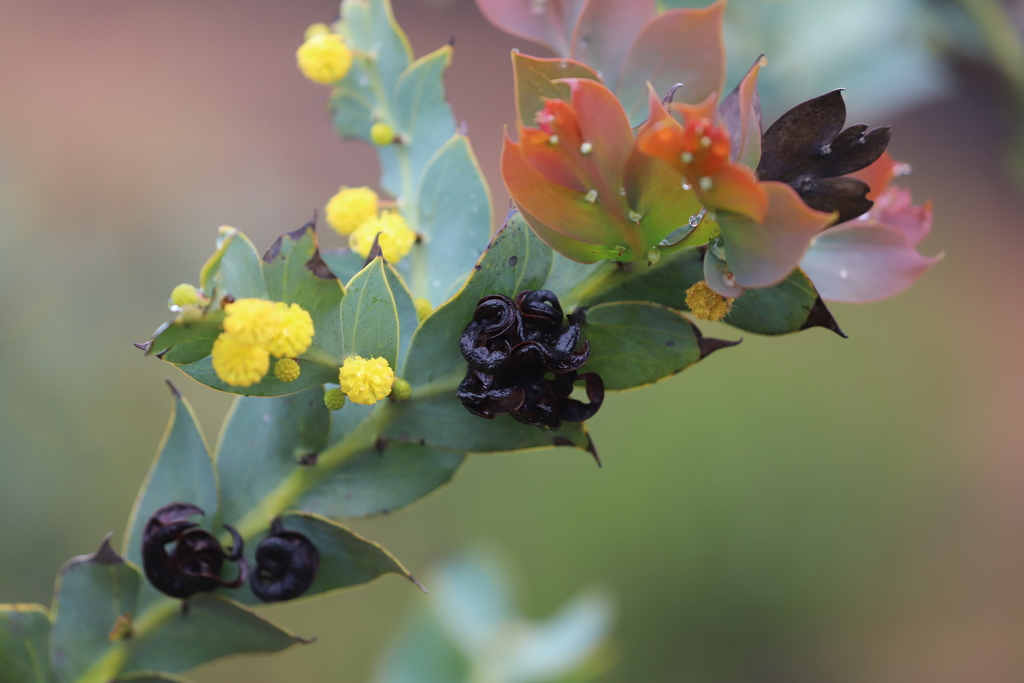
Flat Wattle
Acacia glaucoptera
Acacia glaucoptera, commonly known as clay wattle, flat wattle or claybush wattle, is a species of flowering plant in the family Fabaceae and is endemic to the south-west of Western Australia. It is a prostrate, sprawling or erect shrub with glabrous, straight branchlets, winged, leathery phyllodes continuous with the branchlets, spherical heads of golden yellow flowers and coiled and twisted, thinly crust-like black pods.
From the article Acacia glaucoptera on Wikipedia (CC BY-SA), quoted section by section
Description
Acacia glaucoptera is a prostrate or semi-prostrate, sprawling to erect shrub that typically grows to a height of 0.3–1.5 m (1 ft 0 in – 4 ft 11 in) and often has somewhat gangling branches. The branchlets are glabrous and straight to slightly winding. The phyllodes are continuous with the branchlets, forming wings on alternate sides, each wing extending to the one below, usually 25–70 mm (0.98–2.76 in) long and 6–20 mm (0.24–0.79 in) wide, the free part of the phyllode usually 10–40 mm (0.39–1.57 in) long. The flowers are borne in a spherical head in leaf axils on a peduncle 3–18 mm (0.12–0.71 in) long, the heads 5–6 mm (0.20–0.24 in) in diameter with 30 to 80 golden yellow flowers. Flowering mainly occurs between August and December with the main flush between August and October. The pods are irregularly coiled and twisted, up to 20 mm (0.79 in) long and 2–3 mm (0.079–0.118 in) wide, thinly crusty, black and glabrous. The seeds are more or less oblong, 2.5–3.5 mm (0.098–0.138 in) long with a conical aril on the end.
Range & habitat
Clay wattle grows in clay and gravelly soils in woodland, shrubland and mallee from near Narrogin, south to near Manypeaks and east to Israelite Bay in the Avon Wheatbelt, Esperance Plains, Jarrah Forest and Mallee bioregions of south-western Western Australia.
Wikipedia: “Distribution and habitat”
How it is grown
This species is often grown for its unusual wing-like phyllodes. It requires good drainage and occasional pruning to remove dead wood. It will withstand temperatures down to −7 °C.
Wikipedia: “Use in horticulture”
Where it lives
Recorded sightings
—
geo-referenced records in GBIF, from museums, herbaria and field observers.
Drag the globe to turn it. Dots are where records exist, not a range map; darker means more records.
In the stacks
Searching the stacks…
Every page naming Acacia glaucoptera in the Biodiversity Heritage Library →
This page is assembled live from iNaturalist, GBIF, Wikipedia, the Source Library and the Internet Archive. It is not yet part of the hand-edited codex. iNaturalist taxon 200010.