 NL·0714
Herbarium of the Nature Library
- Name
- Athene brama
- Family
- Strigidae
- Native to
- Southern Iran through Pakistan, India, Nepal and Bangladesh to Myanmar and Indochina (absent from Sri Lanka)
- Habitat
- Farmland, Urban, Open woodland, Semi-desert
On eBird ↗
Spotted Owlet
Live sightings near you, the range map, bar charts of when it is seen, and Macaulay Library photos and recordings.
Spotted owlet
Athene brama
Also calledHéng bān fù xiǎo xiāo 横斑腹小鸮 (Chinese)
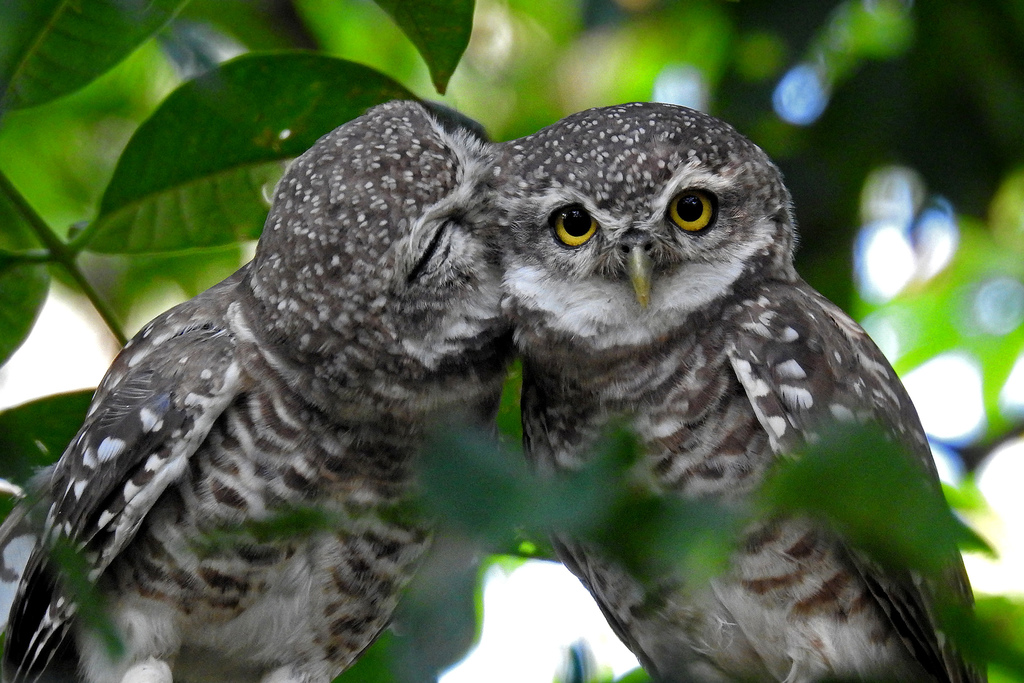
A small, white-spotted owl with staring yellow eyes that lives in pairs and family groups in old trees, ruins and buildings across South Asia. It bobs its head comically when curious and chatters loudly at dusk.
The spotted owlet is a small owl which breeds in tropical Asia from North Pakistan to Southeast Asia. A common resident of open habitats including farmland and human habitation, it has adapted to living in cities. They roost in small groups in the hollows of trees or in cavities in rocks and buildings. It nests in a hole in a tree or building, laying 3–5 eggs. The species shows great variation including clinal variation in size and forms a superspecies with the very similar little owl. Wikipedia
What it can do
- iHunts beetles, moths and rodents around street lights and villages
- iiNests in tree holes, wall crevices and old buildings
- iiiActive at dusk and sometimes by day
In the field
Field marks
- aSmall, round-headed owl without ear-tufts
- bGrey-brown upperparts heavily spotted with white
- cWhite underparts barred with brown
- dLarge yellow eyes with white eyebrows and a white collar
- Voice
- Harsh, screeching, chattering 'chirurr-chirurr-chirurr' and 'cheevak, cheevak', usually from pairs or groups
- Not to be confused with
- Jungle owlet is barred (not spotted) on the head and back; Little owl (northern Pakistan) is browner with less spotting below; Collared scops owl has ear-tufts and dark eyes.
- Where to see it
- Old trees and ruins in Lahore, Delhi, Agra and Karachi; farmland canals across Punjab
- When
- Resident year-round
Listen
Looking for field recordings…
Life & habits
- Diet
- Large insects, rodents, lizards and small birds
- Habitat
- Open country, villages, towns, groves and ruins
- Size
- About 20–21 cm long
Pairs and families sit huddled together in a tree hole entrance by day and become noisy and active at dusk.
Where it lives
Recorded sightings
—
geo-referenced records in GBIF, from museums, herbaria and field observers.
Native range
Southern Iran through Pakistan, India, Nepal and Bangladesh to Myanmar and Indochina (absent from Sri Lanka)
Drag the globe to turn it. Dots are where records exist, not a range map; darker means more records.
In the stacks
Searching the stacks…
Every page naming Athene brama in the Biodiversity Heritage Library →
Marginalia
In Hindu tradition the owl (uluka) is the vahana of the goddess Lakshmi, yet owls including this species are illegally trapped and sacrificed for black-magic rituals around Diwali, a trade documented by TRAFFIC India.
Kinship
Photographs: iNaturalist contributors under the licences shown. Records: GBIF.org. Historical plates: Source Library (CC BY-SA 4.0; originals public domain). Summary text: Nature Library editors and Wikipedia (CC BY-SA). Medicinal and edibility notes are historical and educational, not advice. iNaturalist taxon 20012.