- Animals
- ›Chordates
- ›Vertebrates
- ›Birds
- ›Woodpeckers and Allies
- ›Woodpeckers
- ›Typical woodpeckers
- ›Campephilini
- ›Chrysocolaptes
On eBird ↗
Greater Flameback
Live sightings near you, the range map, bar charts of when it is seen, and Macaulay Library photos and recordings.
Greater Flameback
Chrysocolaptes guttacristatus
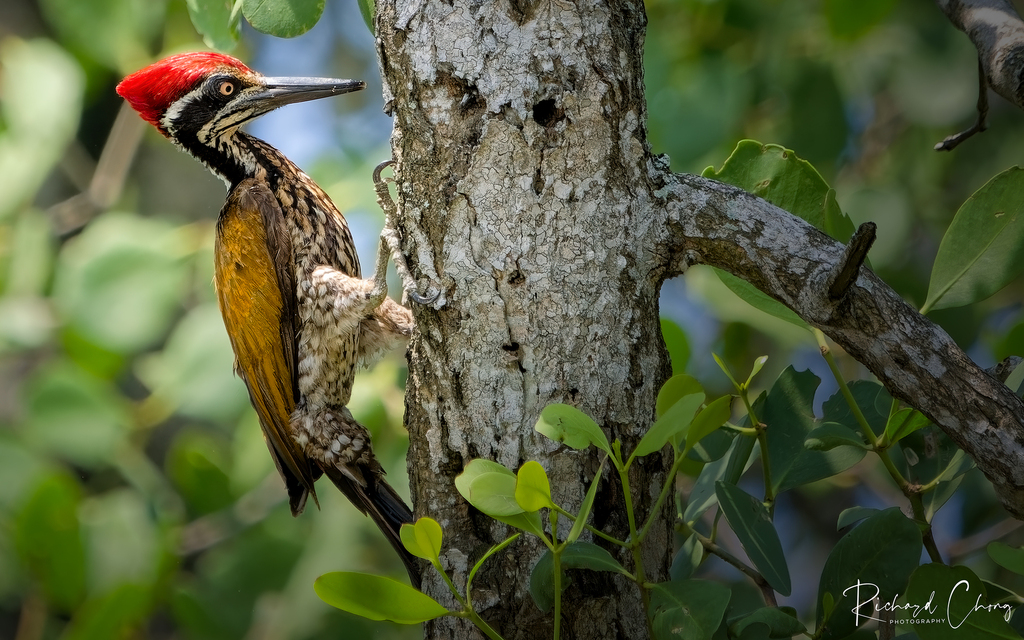
The greater flameback (Chrysocolaptes guttacristatus) also known as greater goldenback, large golden-backed woodpecker or Malherbe's golden-backed woodpecker, is a woodpecker species. It occurs widely in the Indian subcontinent, eastwards to southern China, the Malay Peninsula, Sumatra, western and central Java and northeast Borneo.
From the article Greater flameback on Wikipedia (CC BY-SA), quoted section by section
Description
The greater flameback is a large woodpecker, at 33 cm in length. It is of typical woodpecker shape, and has an erect crest and a long neck. Coloration is highly variable between subspecies; it always has unmarked golden-yellow to dark brown back and wings. The rump is red and the tail is black. The underparts are white with dark markings (chevrons, stripes, or bands), or light brown. The head is whitish with a black pattern, or it is yellow, brown, or red. The straight-pointed bill is longer than the head, and the legs have four-toed zygodactyl feet (two toes pointing forward, two backward) and are lead-grey in color. The eyes' irises are whitish to yellow. The adult male greater flameback always has a red crown. Females have a crown color varying between subspecies, such as black spotted with white, yellow, or brown with lighter dots. Young birds are like the females, but duller, with brown irises.
Similar species. White-and-black-headed greater flameback subspecies resemble some of the three-toed Dinopium flamebacks, but are not particularly closely related. Unlike the black-rumped flameback (D. benghalense) and the common flameback (D. javanense), the greater flameback's dark moustache stripes are divided by white (making them inconspicuous at a distance); except in C. …
What it does
This flameback is a species associated with a diversity of rather open forest habitat, such as found in the foothills of the Himalayas or in the Western Ghats; it also inhabits mangrove forest. It seems to be well-adapted to particular forest types, while the similar-looking common flameback (Dinopium javanense) is more of a generalist; thus, depending on what forests predominate in a region, C. lucidus may be more (e.g. in Thailand) or less common (e.g. in peninsular Malaysia) than D. javanense. In Malaysian mangrove forest, for example, the greater flameback has been found to prefer tall Avicennia alba for foraging, while the common flameback rather indiscriminately uses that species, as well as Bruguiera parviflora and Sonneratia alba. Like other woodpeckers, the greater flameback uses its bill to dig out food from trees, and its zygodactyl feet and stiff tail to provide support against tree trunks. The long tongue can be darted forward to extract wood-boring arthropod prey; while mainly feeding on small invertebrates, greater flamebacks also drink nectar. They nest in tree holes, laying three or four white eggs.
Wikipedia: “Behaviour and ecology”
Listen
Looking for field recordings…
Where it lives
Recorded sightings
—
geo-referenced records in GBIF, from museums, herbaria and field observers.
Drag the globe to turn it. Dots are where records exist, not a range map; darker means more records.
In the stacks
This page is assembled live from iNaturalist, GBIF, Wikipedia, the Source Library and the Internet Archive. It is not yet part of the hand-edited codex. iNaturalist taxon 201081.