- Animals
- ›Arthropods
- ›Hexapods
- ›Insects
- ›Winged and Once-winged Insects
- ›Grasshoppers, Crickets, and Katydids
- ›Grasshoppers, Locusts, and Allies
- ›Grasshoppers
- ›Short-horned Grasshoppers and Locusts
- ›Short-horned Grasshoppers
- ›Bandwing Grasshoppers
- ›Chortoicetes
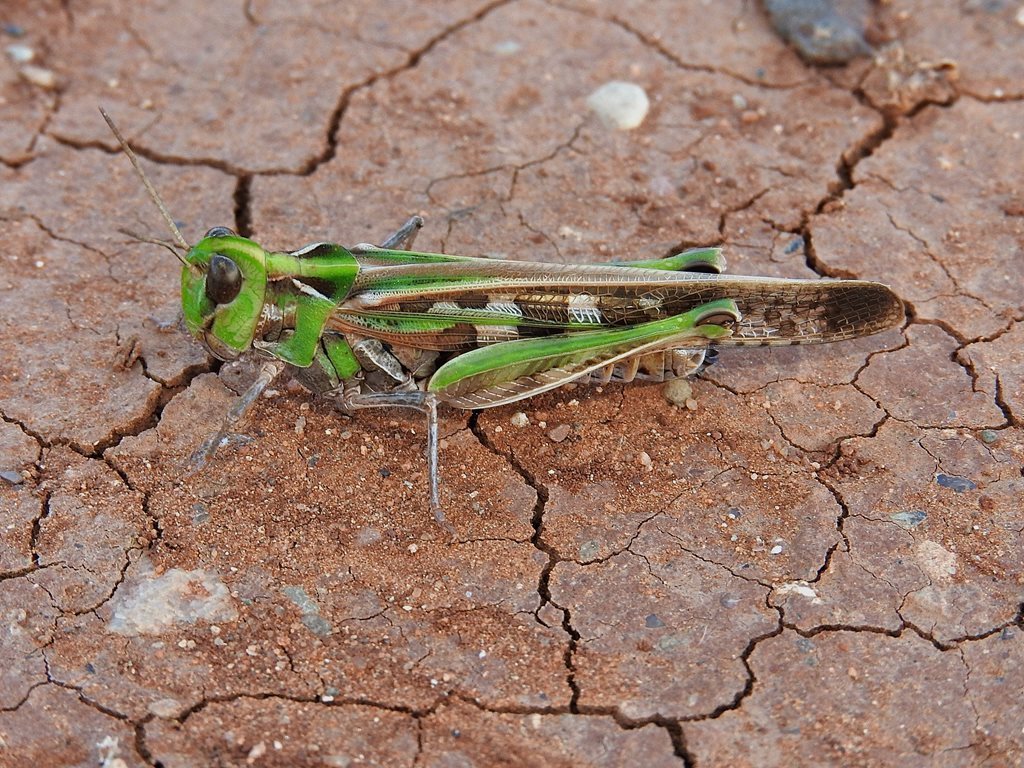
Australian Plague Locust
Chortoicetes terminifera
The Australian plague locust (Chortoicetes terminifera) is a species of locust in the family Acrididae native to Australia, where it is a significant agricultural pest.
From the article Australian plague locust on Wikipedia (CC BY-SA), quoted section by section
Description
Adult Australian plague locusts range in size from 20 to 45 mm (0.79 to 1.77 in) in length, and the colour varies from brown to green. In profile, the head is higher than the thorax, and the thorax has an X-shaped mark. The legs have a reddish shank and the wings are clear other than for a dark spot on the periphery.
Range & habitat
The locusts occur naturally in far northwestern New South Wales and the adjoining areas of Queensland and South Australia, as well as Western Australia. From these areas, the locusts can expand from time to time to be found in the agricultural areas of South Australia, New South Wales, including the Riverina, and Victoria. The locust can be found in a variety of grassland and open wooded habitats across the inland areas of the Australian mainland. Upper-level winds may occasionally carry locusts to coastal areas of the mainland and northern Tasmania and may establish populations in the eastern valleys of the Great Dividing Range; these populations usually fail to establish themselves for more than a few generations. Climatic change is projected to influence spatial patterns of pest outbreaks, as climate change is a primary limiting factor for insect dispersal. The most commercially important locust species in Australia is the Australian plague locust, Chortoicetes terminifera. Invasions wreak havoc on agricultural crops and pastures on a massive scale.
Wikipedia: “Range and habitat”
Listen
Looking for field recordings…
Where it lives
Recorded sightings
—
geo-referenced records in GBIF, from museums, herbaria and field observers.
Drag the globe to turn it. Dots are where records exist, not a range map; darker means more records.
In the stacks
Searching the stacks…
Every page naming Chortoicetes terminifera in the Biodiversity Heritage Library →
This page is assembled live from iNaturalist, GBIF, Wikipedia, the Source Library and the Internet Archive. It is not yet part of the hand-edited codex. iNaturalist taxon 201621.