
bamboos, canes, and allies
Bambusoideae
Bamboos are a diverse group of mostly evergreen perennial flowering plants making up the subfamily Bambusoideae of the grass family Poaceae. Giant bamboos are the largest members of the grass family, in the case of Dendrocalamus sinicus having individual stalks (culms) reaching a length of 46 meters (151 ft), up to 36 centimeters (14 in) in diameter and a weight of up to 450 kilograms (1,000 lb). It grows in tropical and subtropical regions, especially in Asia. The internodes of bamboos can also be of great length. Kinabaluchloa wrayi has internodes up to 2.5 meters (8 ft) in length, and Arthrostylidium schomburgkii has internodes up to 5 meters (16 ft) in length, exceeded in length only by papyrus. By contrast, the stalks of the tiny bamboo Raddiella vanessiae of the savannas of French Guiana measure only 10–20 millimeters (0.4–0.8 in) in length by about 2 millimeters (0.08 in) in width. The origin of the word "bamboo" is uncertain, but it most likely comes from the Dutch or Portuguese language, which originally borrowed it from Malay.
In bamboo, as in other grasses, the internodal regions of the stem are usually hollow and the vascular bundles in the cross-section are scattered throughout the walls of the stalk instead of in a cylindrical cambium layer between the bark (phloem) and the wood (xylem) as in dicots and conifers. The dicotyledonous woody xylem is also absent. The absence of secondary growth wood causes the stems of monocots, including the palms and large bamboos, to be columnar rather than tapering.
3 branches of this subfamily, most-observed first
See this branch on the Wheel of Life →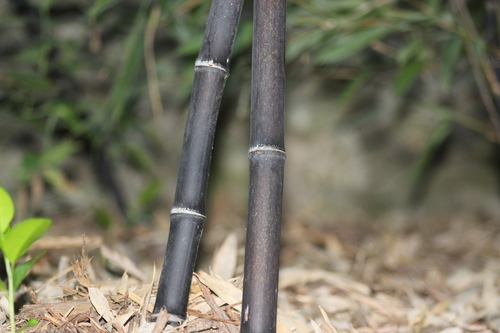


Where it lives
Recorded sightings
—
geo-referenced records in GBIF, from museums, herbaria and field observers.
Drag the globe to turn it. Dots are where records exist, not a range map; darker means more records.
In the stacks
Searching the stacks…
Every page naming Bambusoideae in the Biodiversity Heritage Library →
This page is assembled live from iNaturalist, GBIF, Wikipedia, the Source Library and the Internet Archive. It is not yet part of the hand-edited codex. iNaturalist taxon 201656.