- Animals
- ›Arthropods
- ›Hexapods
- ›Insects
- ›Winged and Once-winged Insects
- ›Beetles
- ›Water, Rove, Scarab, Long-horned, Leaf, and Snout Beetles
- ›Scarabaeiform Beetles
- ›Scarabs, Stag Beetles, and Allies
- ›Scarabs
- ›Shining Leaf Chafers
- ›Anoplognathini
- ›Anoplognathina
- ›Anoplognathus
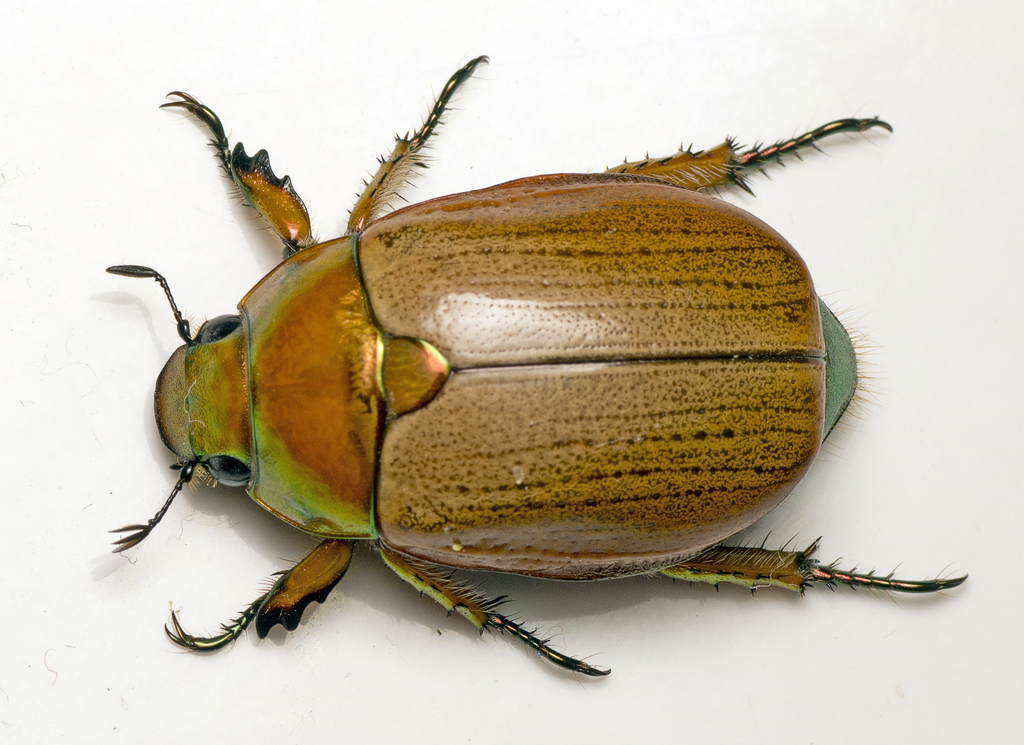
Emerald Tip Beetle
Anoplognathus brunnipennis
Anoplognathus brunnipennis, commonly known as the brown- or golden-brown Christmas beetle, is a beetle of the family Scarabaeidae native to eastern Australia, being common in coastal Queensland, New South Wales and Victoria, the Great Dividing Range and the Murray-Darling river basin.
From the article Anoplognathus brunnipennis on Wikipedia (CC BY-SA), quoted section by section
Description
As its name suggests, the golden-brown Christmas beetle is a yellow- or biscuit-brown with a green or gold-red sheen. The abdomen and thorax are green with white hairs. The adult male is 19–23 mm long, while the female is 21–26 mm long.
What it does
Like many of its relatives, the brown Christmas beetle has large strong jaws capable of chewing tough eucalypt leaves to the point of defoliating stands of trees, which can impact plantations. It is an economically important pest of eucalypt plantations in Victoria, and New South Wales. In particular it feeds on Tasmanian blue gum (Eucalyptus globulus), manna gum (E. viminalis), shining gum (E. nitens), flooded gum (E. grandis), white gum (E. dunnii), mountain white gum (E. dalrympleana) and broad-leaved peppermint (E. dives). It rarely eats Sydney blue gum (E. saligna), and ignores blackbutt (E. pilularis). Fieldwork in Coffs Harbour showed that brown Christmas beetle generally fed on leaves of intermediate age, avoiding new growth and old leaves, and trees of 2.5 m height and taller. Clones of E. grandis have been selected and bred on the basis of unpalatability to this species to minimise damage to plantations.
== References ==
Wikipedia: “Feeding and relationship with humans”
In human culture
Belgian naturalist Auguste Drapiez described the species in 1819 as Rutela chloropyra, reporting that it was found in summer in Australia. French naturalist Jean Baptiste Boisduval described Anoplognathus nitidulus in 1835. The latter name was recognized as the same species as the former and hence made a synonym by William John Macleay in 1873. The species name was misspelt chloropygus by Ohaus in a 1918 catalogue and picked up by many authors. A 2021 review indicated that the species was misidentified as Anoplognathus chloropygus, and thus made a synonym of Anoplognathus brunnipennis.
Wikipedia: “History”
Listen
Looking for field recordings…
Where it lives
Recorded sightings
—
geo-referenced records in GBIF, from museums, herbaria and field observers.
Drag the globe to turn it. Dots are where records exist, not a range map; darker means more records.
In the stacks
Searching the stacks…
Every page naming Anoplognathus brunnipennis in the Biodiversity Heritage Library →
This page is assembled live from iNaturalist, GBIF, Wikipedia, the Source Library and the Internet Archive. It is not yet part of the hand-edited codex. iNaturalist taxon 201873.