- Animals
- ›Arthropods
- ›Hexapods
- ›Insects
- ›Winged and Once-winged Insects
- ›Beetles
- ›Water, Rove, Scarab, Long-horned, Leaf, and Snout Beetles
- ›Cucujiform Beetles
- ›Longhorn Beetles and Allies
- ›Longhorn Beetles
- ›Round-necked Longhorn Beetles
- ›Phoracanthini
- ›Phoracantha
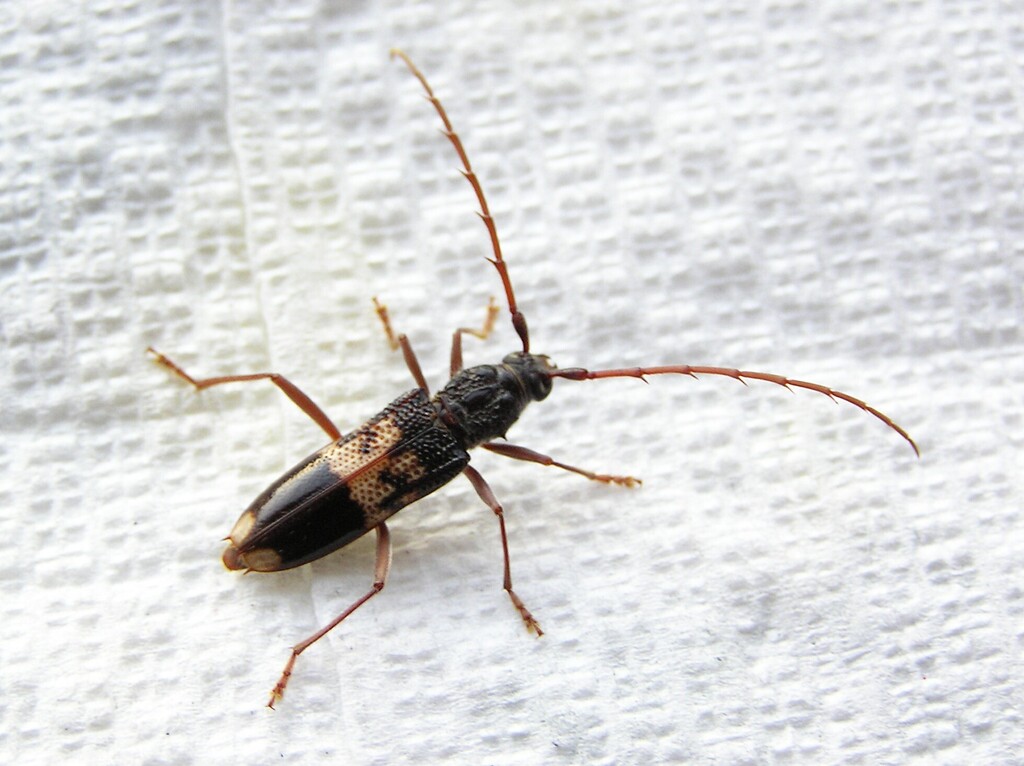
Common Eucalyptus Longhorn
Phoracantha semipunctata
Phoracantha semipunctata, the Australian Eucalyptus longhorn, is a species of beetle in the family Cerambycidae. Native to Australia, it has now spread to many parts of the world, including practically all countries where tree species of Eucalyptus have been introduced. It has been classified as an invasive pest species of Eucalyptus outside Australia.
Within Australia, Phoracantha semipunctata primarily seeks for decaying trees and branches which have been critically impaired due to natural disasters. In other regions of the world, it inflicts critical damage upon introduced Eucalyptus trees. However, the damage inflicted by Phoracantha semipunctata may be seen as a positive factor in some regions, as Eucalyptus trees that are introduced are seen as invasive plant species imposing harm on the natural environment.
From the article Phoracantha semipunctata on Wikipedia (CC BY-SA), quoted section by section
Description
Phoracantha semipunctata ranges from 15-23 mm in length; however, females are recorded to be slightly larger than their male counterparts. Their bodies are of a darker reddish colour, and typically consists of a protruding spine at the end. Adults are primarily found during the spring and summer seasons, coming out during the evening hours, commonly feeding on pollen & nectar within host trees. It is similar to the related P. recurva, but differs in the larger size and more extensive dark markings.
Elytra. The wings of Phoracantha semipunctata are predominantly dark brown and cream in colour, with a zigzag line dividing the cream coloured area of the elytra. Being crepuscular insects, adult flight activity is restricted to the warmer evening hours, when temperatures are above 15 degrees celsius. Adults fly, seeking mates and females scout for any potential areas in which they can oviposit. Flight activity is determined by host tree odours. This influences adults to fly in a more upwind motion and land on specific areas of the tree, and also acts as a factor upon when they fly-off. When adults acquire a distinct sense for the odour, they fly in a manner where they move in a compressed non-linear motion. When searching for a host tree, adults utilise a specific flight mechanic that consists of an odour oriented optomotor and autonomous contrary zig-zag movements.
Antennae. …
Range & habitat
Phoracantha semipunctata was first deemed as an insect pest problem in 1906 in South Africa. They have now spread across all regions around the world, and typically affect areas characterised by arid heat and areas with an abundance of Eucalyptus plants. The main cause of invasion is not completely known; however, the process of dunnage may be one of the key factors responsible for the degree of invasiveness of the species. The transportation of beetle populated firewood, is also another rationale which may explain its invasiveness. P. semipunctata is not considered as a major pest and a factor of much economic importance in its native country of Australia. Significant damage imposed by this eucalyptus borer is not common in Australia, as the majority of attacks are limited to trees subject to droughts. However, these insects have been found to impose damage amongst juvenile jarrah (Eucalyptus marginata) trees within the Southwestern region of Australia, primarily in bauxite mines which have been recently replanted. In their non-native ecosystems, they are considered as a major pest problem imposing a great amount of damage upon natural biodiversity, typically on trees that are placed under stress. This is primarily due to their inability to sufficiently accommodate to the new environmental conditions. …
Wikipedia: “Distribution & habitat”
What it does
Phoracantha semipunctata are more active in the earlier warmer evening hours, and are found in host trees primarily characterised by a more male ratio based population. Being an Eucalyptus long-horned borer, these beetles predominantly targets host trees which are impaired in condition.
Host determination. Phoracantha semipunctata's antennae serve as primary olfactory tools, enabling them to distinguish certain environmental factors — one of them being the detection of host tree determination. The degree of olfaction effectiveness is indicative by the movement of adult beetles towards single stressed host trees and by their movement towards host trees, characterised by fresher conditions. By utilising olfaction to distinguish between host tree odours, adults are able to discriminate certain plant species which do not exhibit certain components and volatiles, shared by host plant species. However, adult beetles do not single out host trees; logs based on vision or contact with bark surface, within a constricted area. …
Wikipedia: “Behaviour & ecology”
Listen
Looking for field recordings…
Where it lives
Recorded sightings
—
geo-referenced records in GBIF, from museums, herbaria and field observers.
Drag the globe to turn it. Dots are where records exist, not a range map; darker means more records.
In the stacks
Searching the stacks…
Every page naming Phoracantha semipunctata in the Biodiversity Heritage Library →
This page is assembled live from iNaturalist, GBIF, Wikipedia, the Source Library and the Internet Archive. It is not yet part of the hand-edited codex. iNaturalist taxon 201891.