- Plants
- ›Vascular Plants
- ›flowering plants
- ›monocots
- ›grasses, sedges, cattails, and allies
- ›grasses
- ›Panicums, Bluestems, Paspalums, and Allies
- ›bristle, rosette, and barnyard grasses, and allies
- ›Cenchrinae
- ›Cenchrus
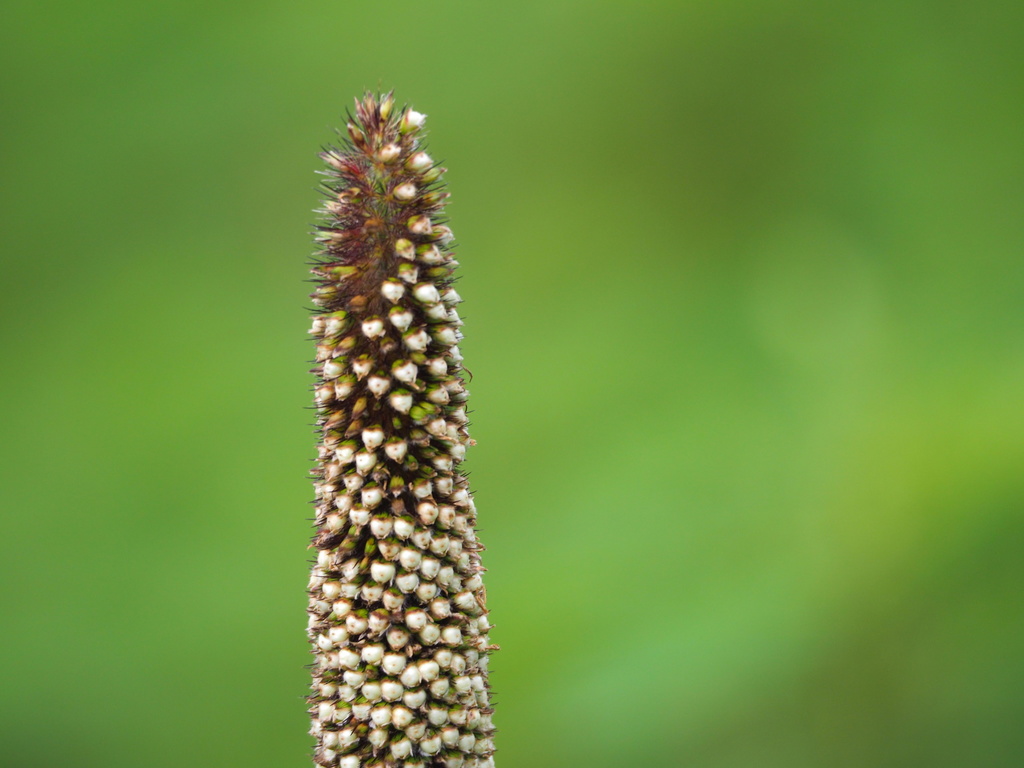
Pearl millet
Cenchrus americanus
Pearl millet (Cenchrus americanus, commonly known as the synonym Pennisetum glaucum) is the most widely grown type of millet. It has been grown in Africa and the Indian subcontinent since prehistoric times. The center of diversity, and suggested area of domestication, for the crop is in the Sahel zone of West Africa. Recent archaeobotanical research has confirmed the presence of domesticated pearl millet on the Sahel zone of northern Mali between 2500 and 2000 BC. 2023
From the article Pearl millet on Wikipedia (CC BY-SA), quoted section by section
Description
Pearl millet has ovoid grains of 3–4 millimetres (1⁄8–5⁄32 in) length, the largest kernels of all varieties of millet (not including sorghum). These can be nearly white, pale yellow, brown, grey, slate blue or purple. The 1,000-seed weight can be anything from 2.5 to 14 g with a mean of 8 g. The height of the plant ranges from 0.5–4 metres (1 ft 8 in – 13 ft 1 in). Pearl millet varieties from the world collection probably have more variation in physical characteristics than any other millet. Kernel shape has different classifications: obovate, hexagonal, lanceolate, globular and elliptical. In Africa, pearl millet is classified as either globular or lanceolate and hexagonal. Most of the millets are very similar to each other in basic structures, although there are some very specific differences.
At the table
Pearl millet is commonly used to make bhakri. It is also boiled to make a Tamil porridge called kamban choru or kamban koozh. In Rajasthani cuisine bajre ki khatti rabdi is a traditional dish made with pearl millet flour and yogurt. Flatbreads made of pearl millet flour are served with various types of kadhi and bhaaji in meals. In Namibia, pearl millet flour is used to make oshifima, a staple food in the northern part of Namibia. In Africa especially Nigeria and some areas, they use millet for making traditional foods like Gruel/porridge and even local beer. The local alcoholic (Burukutu) beverage is often produced in Tropical African countries such as Nigeria, Togo, Kenya, Ethiopia, and Burundi as one of the major traditional and local alcoholic drinks.
India. India is the largest producer of pearl millet. India began growing pearl millet between 1500 and 1100 BCE. It is currently unknown how it made its way to India, but it likely arrived originally from across Africa, and via the Red Sea during Indus Valley Trade networks. Rajasthan is the highest-producing state in India. The first hybrid of pearl millet developed in India in 1965 is called the HB1. Sajje is the local name of the pearl millet in Karnataka and is mostly grown in the semiarid districts of North Karnataka. …
Wikipedia: “Culinary use”
How it is grown
Recent archaeobotanical research has confirmed the presence of domesticated pearl millet on the Sahel zone of northern Mali between 2500 and 2000 BCE. The Sahel zone is the species' center of diversity and suggested area of domestication. Pearl millet is well adapted to growing areas characterized by drought, low soil fertility, low moisture, and high temperature. It performs well in soils with high salinity or low pH. Because of its tolerance to difficult growing conditions, it can be grown in areas where other cereal crops, such as maize or wheat, would not survive. Pearl millet is a summer annual crop well-suited for double cropping and rotations. The grain and forage are valuable as food and feed resources in Africa, Russia, India and China. Today, pearl millet is grown on over 260,000 square kilometres (100,000 sq mi) of land worldwide. It accounts for about 50% of the total world production of millets. World production of millets has been stable during the 1980s. According to FAO, 39.4 million hectares (97 million acres) of millet were planted in 1987 with an average production of only 704 kilograms per hectare (628 lb/acre).
Pests. Insect pests include Anoecia corni, An. cornicola, Anoecia fulviabdominalis, An. vagans, Aphis gossypii, Forda hirsuta, F. …
Wikipedia: “Cultivation”
In human culture
2023 was the International Year of Millets, declared by the United Nations General Assembly in 2021.
Wikipedia: “In culture”
Where it lives
Recorded sightings
—
geo-referenced records in GBIF, from museums, herbaria and field observers.
Drag the globe to turn it. Dots are where records exist, not a range map; darker means more records.
In the stacks
Searching the stacks…
Every page naming Cenchrus americanus in the Biodiversity Heritage Library →
This page is assembled live from iNaturalist, GBIF, Wikipedia, the Source Library and the Internet Archive. It is not yet part of the hand-edited codex. iNaturalist taxon 202342.