- Fungi Including Lichens
- ›Basidiomycete Fungi
- ›Higher Basidiomycetes
- ›Mushrooms, Bracket Fungi, Puffballs, and Allies
- ›Agaricomycetidae
- ›Common Gilled Mushrooms and Allies
- ›Agaricineae
- ›Field Mushrooms and Allies
- ›Leucocoprineae
- ›Leucocoprinus
- ›Denudati
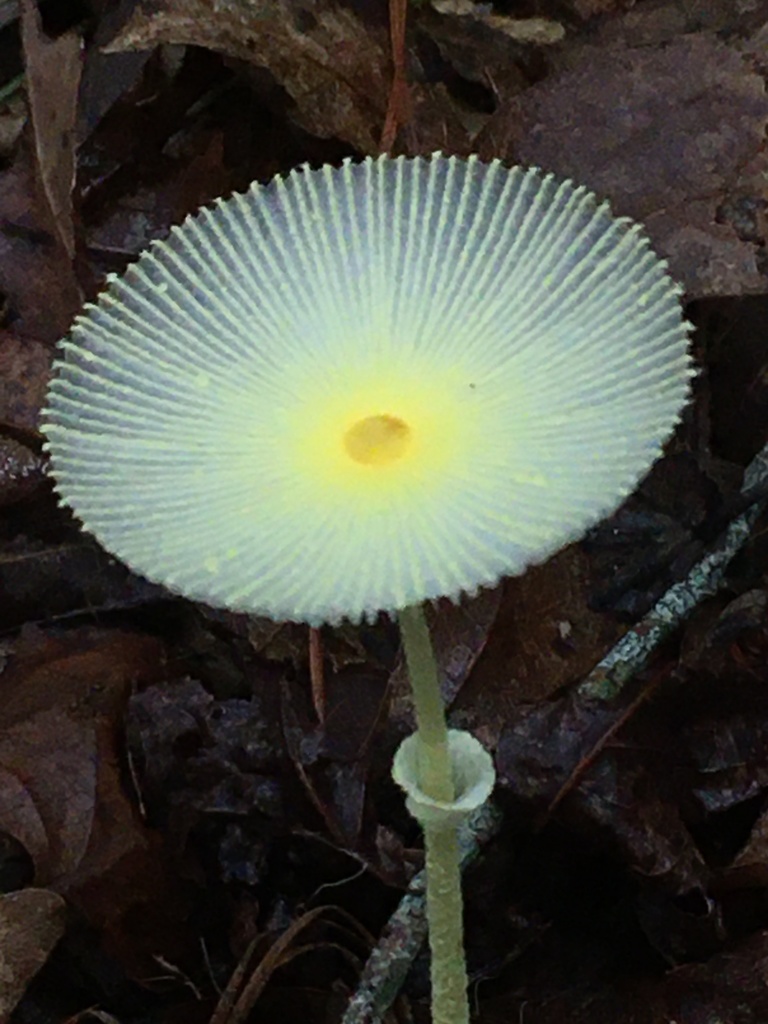
Fragile Dapperling
Leucocoprinus fragilissimus
Leucocoprinus fragilissimus, commonly known as the fragile dapperling, is a species of gilled mushroom in the family Agaricaceae.
From the article Leucocoprinus fragilissimus on Wikipedia (CC BY-SA), quoted section by section
Description
Leucocoprinus fragilissimus is a small dapperling mushroom with very thin, extremely fragile, yellow flesh. Cap: 2–4.5 cm wide, convex expanding to almost flat with a small central disc or umbo. The surface is pale greenish yellow with a darker centre but it fades to nearly white with a yellowish centre. Gills: Free, distant and pale yellow. Stem: 4–9 cm long and 1-2mm thick running equally down to a small, very slightly bulbous base. The stem is extremely fragile with a surface that is pale yellow and smooth but also fades to nearly white. The yellow stem ring is located towards the middle of the stem (median) but is likewise fragile and may disappear. The spore print is white. Spores: Ellipsoid with a large pore. Dextrinoid. 9–12 x 7–8 μm. The smell is indistinct.
Similar species. Leucocoprinus magnicystidiosus is a similar mushroom, with a darker disc and larger cheilocystidia. Bolbitius titubans is often mistaken with Leucocoprinus fragilissimus as the caps can appear superficially similar when mature. It is easily distinguished by the gill colour however. Various species in the Psathyrellacea family, especially Parasola species are often confused with L. fragilissimus based on similar cap appearance.
Range & habitat
Like all Leucocoprinus species, L. fragilissimus is a saprotroph, living on very decayed plant matter (humus or compost). It grows individually or sparsely in wooded areas. The species is found in southern North America, South America, southern Europe, Africa, southern and eastern Asia, Australia, and New Zealand. In 1867 the Belgian botanist Jean Kickx documented Agaricus flammula growing in tanbark in the greenhouses of the Ghent Botanical garden during August and September. In 1871 Berkeley and Broome described Lepiota licmophorus from Peradeniya, Sri Lanka (then known as Ceylon) where it was found growing on the ground. Many of their observations were conducted in this area so it is possible that they were in or around the vicinity of the Royal Botanical Gardens, Peradeniya, which were founded in 1843. They noted that it was also found in their hothouses and concluded it was likely introduced into them with the exotic plants. In 1874 Gillet described Lepiota flammula from France where they were observed growing in small tufts of 3-4 mushrooms in greenhouses in the Summer and Autumn. In 1907 Morgan documented Lepiota fragilissima growing on earth and decayed vegetation on the edges of swamps in South Carolina where it was found individually and in groups.
== References ==
Wikipedia: “Habitat and distribution”
Where it lives
Recorded sightings
—
geo-referenced records in GBIF, from museums, herbaria and field observers.
Drag the globe to turn it. Dots are where records exist, not a range map; darker means more records.
In the stacks
Searching the stacks…
Every page naming Leucocoprinus fragilissimus in the Biodiversity Heritage Library →
This page is assembled live from iNaturalist, GBIF, Wikipedia, the Source Library and the Internet Archive. It is not yet part of the hand-edited codex. iNaturalist taxon 202380.