- Fungi Including Lichens
- ›Basidiomycete Fungi
- ›Higher Basidiomycetes
- ›Mushrooms, Bracket Fungi, Puffballs, and Allies
- ›Agaricomycetidae
- ›Common Gilled Mushrooms and Allies
- ›Agaricineae
- ›Brittlestems and Allies
- ›Coprinellus
- ›Domestici
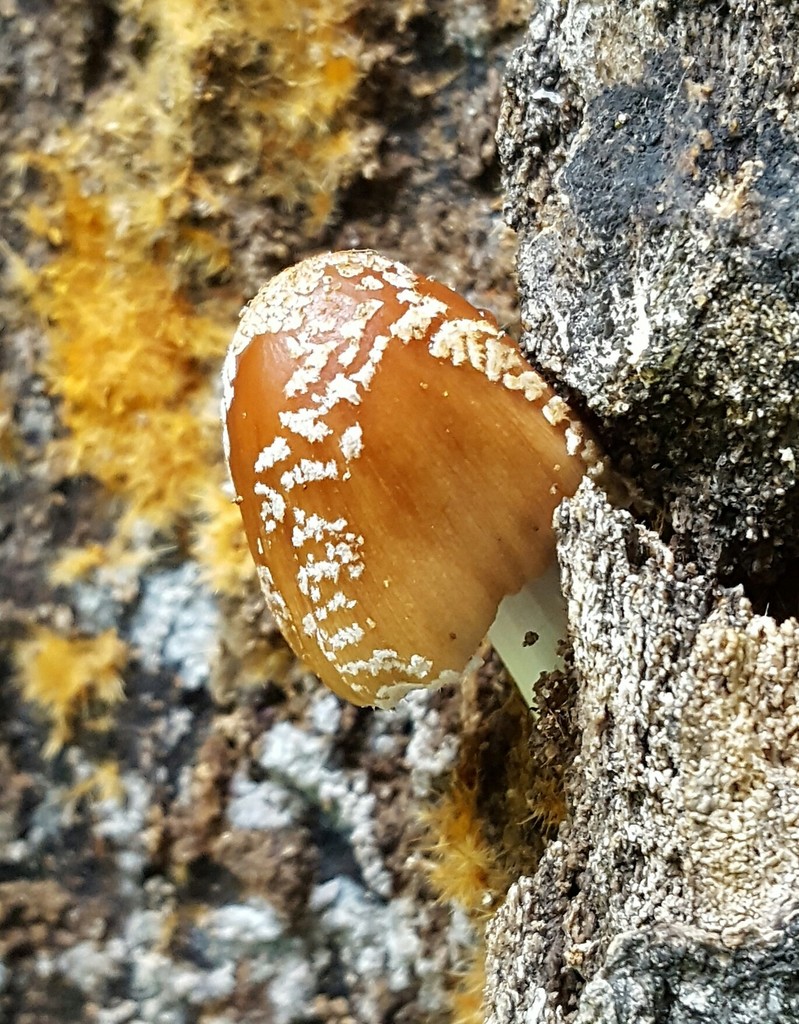
Firerug Inkcap
Coprinellus domesticus
Coprinellus domesticus, commonly known as the firerug inkcap, is a species of mushroom in the family Psathyrellaceae. First described as Agaricus domesticus by James Bolton in 1788, it was later known as Coprinus domesticus before it was transferred to the genus Coprinellus in 2001.
From the article Coprinellus domesticus on Wikipedia (CC BY-SA), quoted section by section
Description
The cap is yellowish, thin and grooved, grows up to 5 centimetres (2 in) tall prior in a shape resembling a closed umbrella before expanding to nearly flat. The gills are adnexed, close, and whitish before darkening. The stem is up to 10 cm (4 in) long and 8 millimetres (3⁄8 in) wide. The spore print is black. The firerug inkcap gets its name from the bright orange carpet of hyphae grown around the mushroom. The covering is known as an ozonium, which resembles an aboveground mycelium. The ozonium is not always present and can also grow in the absence of any mushrooms. Spores are 6-9 x 3.5-5 µm, elliptical, smooth, with an eccentric pore. Basidia are 4-spored; surrounded by 4-6 brachybasidia. Pleurocystidia are subglobose to subcylindric; up to 120 x 65 µm. Cheilocystidia variously shaped; up to 100 x 60 µm.
Similar species. Coprinellus radians is identical in every aspect except for its larger spore size. These are the only two species that are known to form this ozonium. Microscopy may be required to distinguish related species in the group.
Range & habitat
It is present worldwide. It grows on hardwood stumps, logs, and debris in North America from May to September in the East and November to April near the West Coast.
Wikipedia: “Habitat and distribution”
At the table
Although it is difficult to identify, it has been said to be edible.
== References ==
Wikipedia: “Uses”
Where it lives
Recorded sightings
—
geo-referenced records in GBIF, from museums, herbaria and field observers.
Drag the globe to turn it. Dots are where records exist, not a range map; darker means more records.
In the old herbals & bestiaries

In the stacks
Searching the stacks…
Every page naming Coprinellus domesticus in the Biodiversity Heritage Library →
This page is assembled live from iNaturalist, GBIF, Wikipedia, the Source Library and the Internet Archive. It is not yet part of the hand-edited codex. iNaturalist taxon 203062.