- Animals
- ›Arthropods
- ›Crustaceans
- ›Typical Crustaceans
- ›Malacostracans
- ›Decapods, Isopods, and allies
- ›Amphipods, Isopods, and Allies
- ›Isopods
- ›Valvetails
- ›Common Valvetails
- ›Idotea
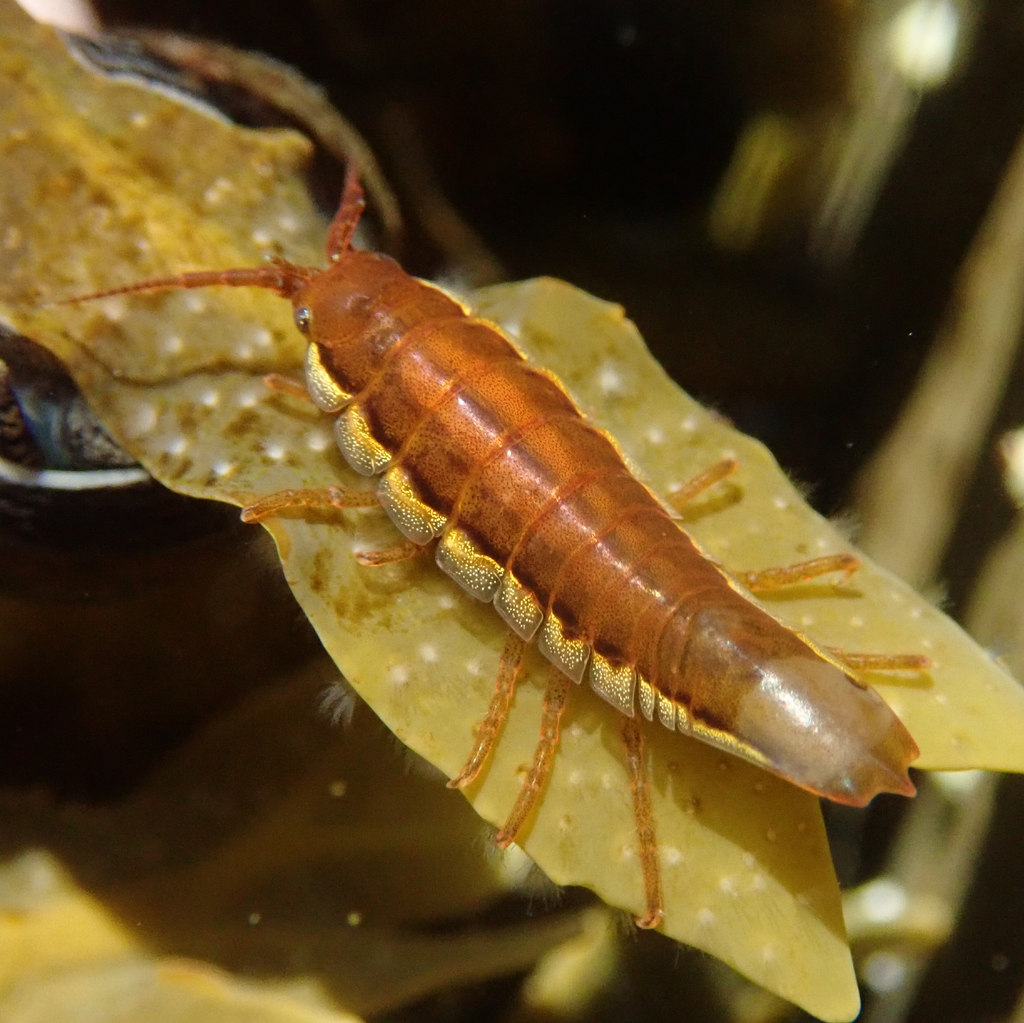
Baltic Isopod
Idotea balthica
Idotea balthica, also known as the Baltic isopod and the smooth seaweed isopod, is a species of marine isopod which lives on seaweed and seagrass in the subtidal zone of rocky shores and sandy lagoons.
From the article Idotea balthica on Wikipedia (CC BY-SA), quoted section by section
Description
The male is larger than female, and can reach 4 centimetres (1.6 in) long, while the female reaches a maximum length of around 1.8 cm. The male has most likely evolved to be larger than the female on average because larger size is more vital for the reproductive success of the male compared to the female. The color of the body is extremely variable, ranging from muted greens to striking black-and-silver patternings; the female is usually darker. The males are frequently colored a light green. Color intensity is variable and can be altered through the restriction and dilation of chromatophores. Males and females display different coloration (sexual dimorphism) due to selection for different behaviors in the two sexes. Researchers also believe that the primary cause of selection for this color polymorphism within localized populations is predation (from carnivorous fish, crabs) in conjunction with gene flow and varying microhabitats. The color polymorphism allows for the isopod to display cryptic coloration in multiple microhabitats. The species can be distinguished from other idoteids by the shape of the telson, which is dorsally keeled with straight sides in I. balthica, and has a distinct protrusion at the end.
Wikipedia: “Appearance”
Range & habitat
Idotea balthica has a broad geographical distribution, having been recorded from the Belgian Exclusive Economic Zone, the British Isles, Cobscook Bay, Dutch Exclusive Economic Zone, European waters, Greek Exclusive Economic Zone, Gulf of Maine, Knokke, North West Atlantic, Red Sea, Voordelta, West Coast of Norway, Wimereux and the Black Sea.
Wikipedia: “Distribution”
What it does
In 2022, I. balthica was discovered to help Gracilaria gracilis reproduce – the first known case of an animal helping algae reproduce.
Wikipedia: “As a pollinator”
Where it lives
Recorded sightings
—
geo-referenced records in GBIF, from museums, herbaria and field observers.
Drag the globe to turn it. Dots are where records exist, not a range map; darker means more records.
In the stacks
Searching the stacks…
Every page naming Idotea balthica in the Biodiversity Heritage Library →
This page is assembled live from iNaturalist, GBIF, Wikipedia, the Source Library and the Internet Archive. It is not yet part of the hand-edited codex. iNaturalist taxon 203466.