Snail Fur
Hydractinia echinata
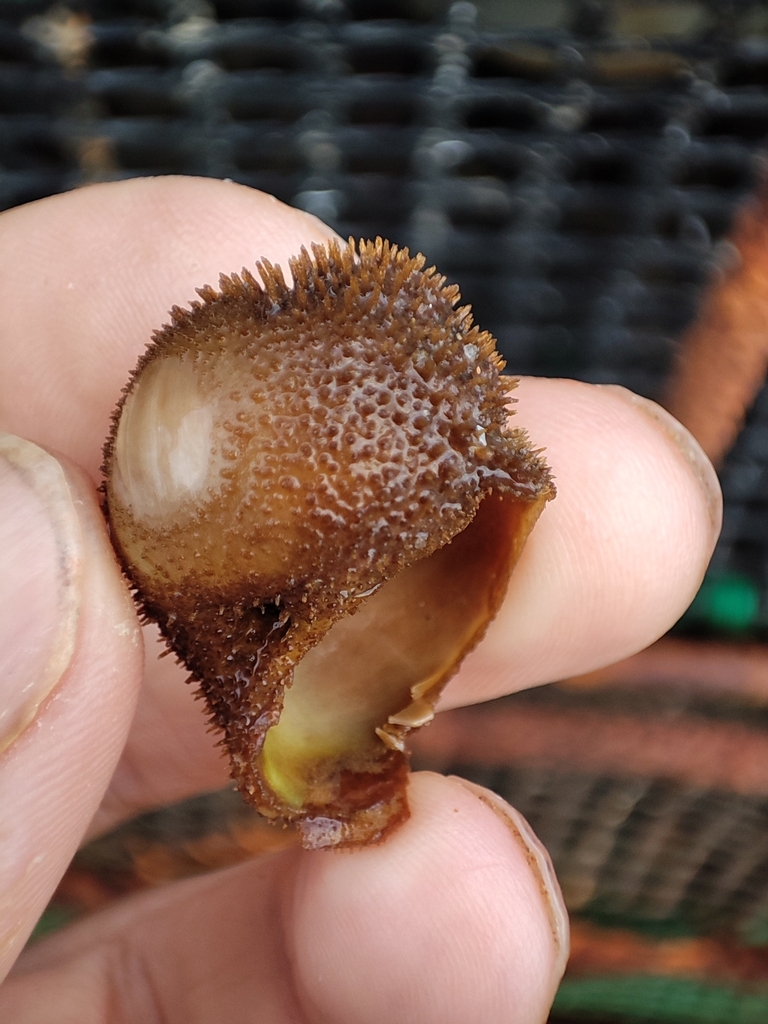
Hydractinia echinata is a colonial marine hydroid which is often found growing on dead, hermit-crabbed shells of marine gastropod species. This hydroid species is also commonly known as snail fur, a name which refers to the furry appearance that the hydroids give to a shell.
In the northwestern Atlantic, these hydroids are especially common on the outside of shells that are occupied by the flat-clawed hermit crab.
From the article Hydractinia echinata on Wikipedia (CC BY-SA), quoted section by section
Description
Hydractinia echinata forms pinkish-brown (when alive) or plain brown (when dead) patches on gastropod shells that are occupied by a hermit crab, often near the aperture of the shell. The horny mat or hydrorhiza is about three millimetres thick. It consists of thick jagged spines that reach three millimetres in height. Amongst these there are three types of polyps. The club-like feeding polyps grow up to thirteen millimetres in length, and have two rows of eight tentacles, the lower set being shorter than the upper ones. There are also male and female reproductive polyps (gonozoids) that have a few short terminal tentacles. Scattered among these are specialized defensive stinging polyps (dactylozooids) that are long, coiled threads. The gonozoids liberate crawling planula larvae that search out moving gastropod shells.
Range & habitat
H. echinata is found on all sides of the northern Atlantic Ocean, including the Arctic Ocean, the Saint-Lawrence Gulf, the Baltic Sea and the North Sea south to northwest Africa, as well as the Western Atlantic including the Gulf of Mexico. It is common around the coasts of Britain and Ireland, and there it is found where hermit crabs (Eupagurus bernhardus) occur, on the lower shore on sandy substrates.
Wikipedia: “Distribution”
Where it lives
Recorded sightings
—
geo-referenced records in GBIF, from museums, herbaria and field observers.
Drag the globe to turn it. Dots are where records exist, not a range map; darker means more records.
In the stacks
Searching the stacks…
Every page naming Hydractinia echinata in the Biodiversity Heritage Library →
This page is assembled live from iNaturalist, GBIF, Wikipedia, the Source Library and the Internet Archive. It is not yet part of the hand-edited codex. iNaturalist taxon 203796.