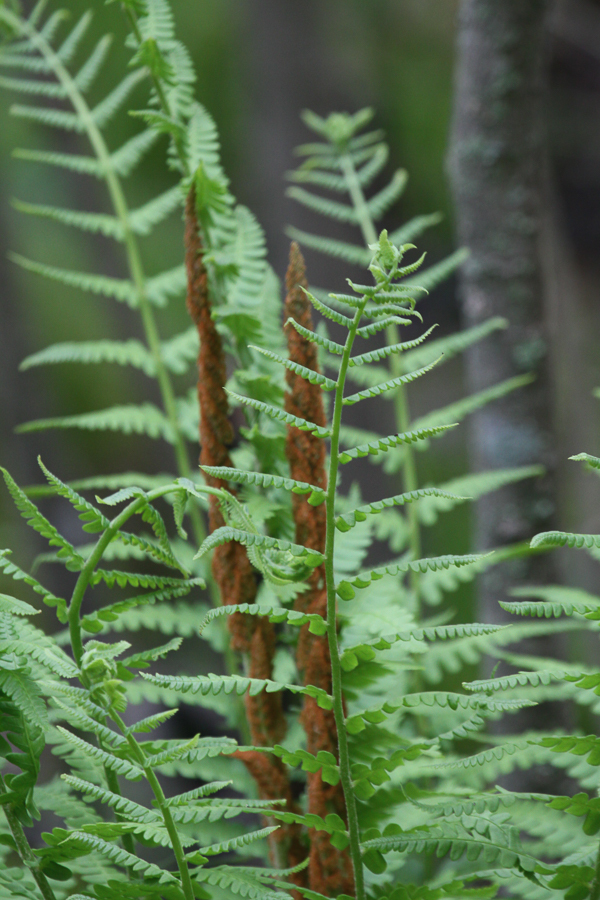
cinnamon fern
Osmundastrum cinnamomeum
Osmundastrum cinnamomeum, commonly known as the cinnamon fern or the buckhorn fern, is a species of royal fern native to the Americas and Asia. It is the sole living representative of the genus Osmundastrum, which was separated from Osmunda after modern phylogenetic studies demonstrated that Osmunda was not monophyletic. In North America it occurs from southern Labrador west to Ontario, and south through the eastern United States to eastern Mexico and the West Indies; in South America it occurs west to Peru and south to Paraguay. In Asia it occurs from southeastern Siberia south through Japan, Korea, China and Taiwan to India, Myanmar, Thailand and Vietnam.
Osmundastrum cinnamomeum has a fossil record extending into the Late Cretaceous of North America, approximately 73 million years ago, making it one of the oldest living plant species. The genus itself goes back to the Triassic.
From the article Osmundastrum cinnamomeum on Wikipedia (CC BY-SA), quoted section by section
Description
Osmundastrum cinnamomeum is a semi evergreen but usually deciduous herbaceous plant that produces separate fertile and sterile fronds. The sterile fronds are spreading, 30–150 cm (0.98–4.92 ft) tall and 15–20 cm (5.9–7.9 in) broad, pinnate, with pinnae 5–10 cm (2.0–3.9 in) long and 2–2.5 cm (0.79–0.98 in) broad, deeply lobed (so the fronds are nearly, but not quite, bipinnate). The fertile spore-bearing fronds are erect and shorter, 20–45 cm (7.9–17.7 in) tall; they become cinnamon-colored, which gives the species its name. The fertile leaves appear first; their green color slowly becomes brown as the season progresses and the spores are dropped. The spore-bearing stems persist after the sterile fronds are killed by frost, until the next season. The spores must develop within a few weeks or fail. It has shallow, black, fibrous roots, and its rhizome, like that of its close relatives, can be trunk-like and erect.
The Osmundastrum cinnamomeum fern forms huge clonal colonies in swampy areas. These ferns form massive rootstocks with densely matted, wiry roots. This root mass is an excellent substrate for many epiphytal plants. They are often harvested as osmunda fiber and used horticulturally, especially in propagating and growing orchids. …
Range & habitat
The range of the cinnamon fern spans both the Old World and the New World, yet it is notably absent from western North America, despite the modern species having evolved there. This distribution makes the cinnamon fern a classic example of the eastern Asian–eastern North American disjunction, a biogeographic pattern in which plant lineages that once had widespread ranges in past geological periods become restricted to the eastern regions of North America and eastern Asia over time. Evidence shows that it continued to persist in Western North America up until the Neogene. In North America, the cinnamon fern is found throughout much of the Eastern United States, primarily in Alabama, Arkansas, Connecticut, Delaware, Washington D.C., Florida, Georgia, Illinois, Indiana, Iowa, Kentucky, Louisiana, Maine, Maryland, Massachusetts, Michigan, Minnesota, Mississippi, Missouri, New Hampshire, New Jersey, New York, North Carolina, Ohio, eastern Oklahoma, Pennsylvania, Rhode Island, South Carolina, Tennessee, eastern Texas, Vermont, Virginia, West Virginia, and Wisconsin. …
Wikipedia: “Distribution and habitat”
What it does
The cinnamon fern typically grows in moist, acidic soils and shows a strong preference for wetland environments (although it does thrive in dry-mesic forests with seasonal sub-irrigation). The fern can grow in Organic soil but it can also grow in sand. It prefers shade but can be found to grow in areas with more direct sunlight. It also thrives in expansive meadowlands, where it often becomes one of the most dominant species present. In a study examining forest understory vegetation, the cinnamon fern was found in the wettest plots and exhibited high sensitivity to changes in soil moisture, suggesting a strong adaptation to saturated or hydric soils. The fern is very cold hardy. The cinnamon fern plays a multifaceted ecological role in its habitats—from altering carbon and water dynamics to participating in complex reproductive signaling and hosting symbiotic fungi. In constructed wetlands treating aquaculture wastewater, cinnamon fern helped reduce pollutants such as total phosphorus, ammonia nitrogen, and turbidity. This shows potential for the fern's use in phytoremediation and nutrient cycling in wetland systems. …
Wikipedia: “Ecology”
At the table
Cinnamon fern has been historically used by the Abenaki and Menominee as a food source. The Iroquois and Cherokee tribes used the fern for a wide variety of medicinal purposes including as a cold remedy, gynecological aid, venereal aid, and as a remedy to snake bites. The Cinnamon fern is often used in constructed wetlands for wastewater treatment, due to its ability to tolerate waterlogged conditions and contribute to nutrient removal. It is mainly hardy in USDA hardiness zones 4–9, though it can also be grown down to USDA zone 11.
== References ==
Wikipedia: “Uses”
In human culture
Historically, the cinnamon fern—now recognized as Osmundastrum cinnamomeum—was classified within the genus Osmunda as Osmunda cinnamomea L., along with other extant osmundaceous ferns. This broad circumscription of Osmunda was based primarily on general morphological similarities shared among royal ferns, such as large fronds, robust rhizomes, and a preference for moist habitats. However, the advent of molecular phylogenetics, combined with renewed morphological scrutiny, has significantly altered our understanding of relationships within the Osmundaceae. Genetic analyses by Metzgar et al. (2008) utilized multiple chloroplast DNA regions to produce a comprehensive phylogeny of the Osmundaceae. Their results demonstrated that Osmunda cinnamomea occupies a unique and deeply diverging lineage, forming a sister group to the rest of the extant members of the family—including Osmunda sensu stricto, Todea, and Leptopteris. These findings were corroborated by Jud et al. (2008), who made detailed morphological assessments of fossil finds and morphological features. Their study further confirmed that O. cinnamomeum differs from other Osmunda species in several key traits, including soral structure, leaf development, and stem anatomy. The phylogenetic position of Osmundastrum cinnamomeum as sister to all other living Osmundaceae has direct implications for classification. …
Wikipedia: “Taxonomic history and classification”
Where it lives
Recorded sightings
—
geo-referenced records in GBIF, from museums, herbaria and field observers.
Drag the globe to turn it. Dots are where records exist, not a range map; darker means more records.
In the stacks
Searching the stacks…
Every page naming Osmundastrum cinnamomeum in the Biodiversity Heritage Library →
This page is assembled live from iNaturalist, GBIF, Wikipedia, the Source Library and the Internet Archive. It is not yet part of the hand-edited codex. iNaturalist taxon 204165.