- Plants
- ›Vascular Plants
- ›flowering plants
- ›Dicots
- ›Sunflowers, Bellflowers, Fanflowers, and Allies
- ›Sunflowers, Daisies, Asters, and Allies
- ›Asteroideae
- ›bonesets, blazingstars, and allies
- ›Eupatoriinae
- ›Eupatorium
- ›Eupatorium rotundifolium
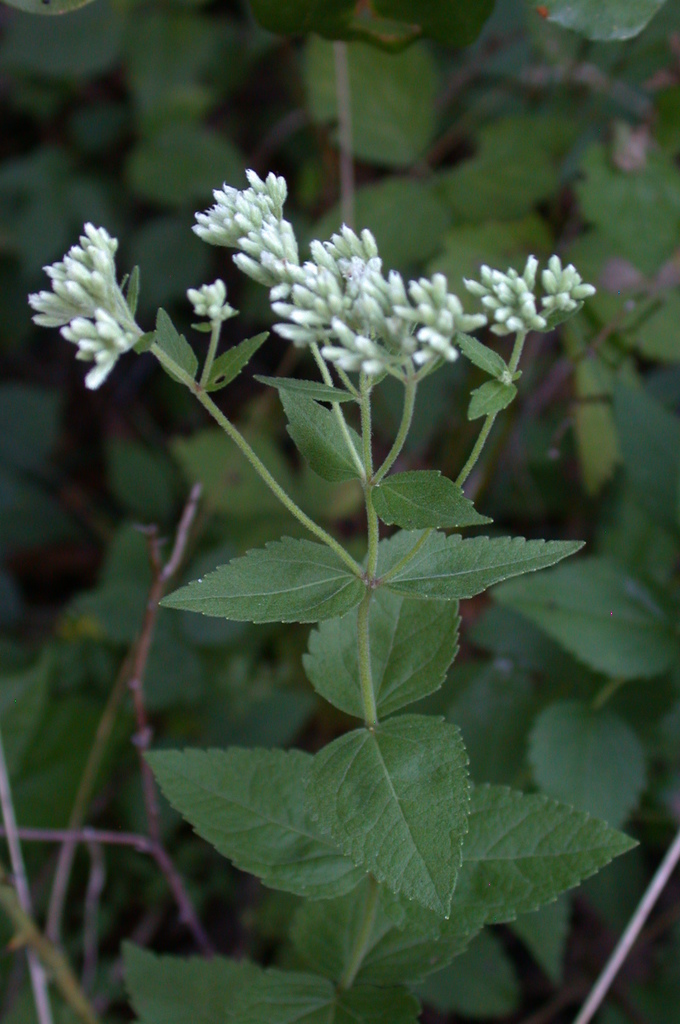
roundleaf thoroughwort
Eupatorium pubescens
Eupatorium rotundifolium, commonly called roundleaf thoroughwort, is a North American species of plant in the family Asteraceae. It native to the eastern and central United States, in all the coastal states from Maine to Texas, and inland as far as Missouri and the Ohio Valley. It is found in low, moist habitats such as wet savannas and bogs.
From the article Eupatorium rotundifolium on Wikipedia (CC BY-SA), quoted section by section
Description
The stems up to 100 cm (40 inches) tall and are produced from short rhizomes. The inflorescences are composed of a large number of small white flower heads, each with 5 disc florets but no ray florets. Plants can be highly variable due to hybridization.
Range & habitat
Eupatorium rotundifolium is found from Massachusetts, New York, Indiana, and Oklahoma south to southern Florida and Texas. It grows in moist to dry woodlands, pine savannas, seepage bogs, as well as along roadsides.
Wikipedia: “Distribution and habitat”
At the table
Eupatorium rotundifolium contains sesquiterpene lactones of the guaianolide type including euparotin acetate and eupachlorin acetate, both of which inhibit tumor growth in vitro when isolated from the plant. Medicinally, the plant was used to treat intermittent fevers in the past.
== References ==
Wikipedia: “Uses”
Where it lives
Recorded sightings
—
geo-referenced records in GBIF, from museums, herbaria and field observers.
Drag the globe to turn it. Dots are where records exist, not a range map; darker means more records.
In the stacks
Searching the stacks…
Every page naming Eupatorium pubescens in the Biodiversity Heritage Library →
This page is assembled live from iNaturalist, GBIF, Wikipedia, the Source Library and the Internet Archive. It is not yet part of the hand-edited codex. iNaturalist taxon 204184.