- Plants
- ›Vascular Plants
- ›flowering plants
- ›Dicots
- ›beeches, oaks, walnuts, and allies
- ›birch family
- ›Betula
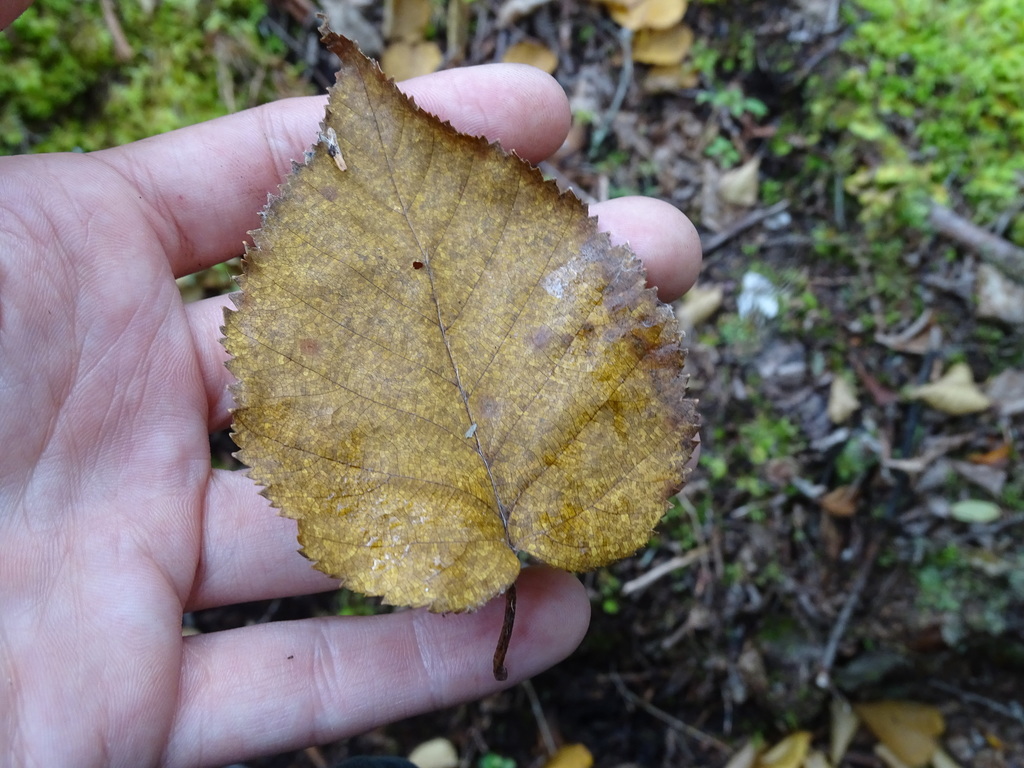
heartleaf paper birch
Betula cordifolia
Betula cordifolia, the mountain paper birch or heartleaf birch (also known as mountain white birch or eastern paper birch) is a birch species native to Eastern Canada and the Northeastern United States. Until recently it was considered a variety of Betula papyrifera (paper birch), with which it shares many characteristics, and it was classified as B. papyrifera var. cordifolia (Regel) Fern.
From the article Betula cordifolia on Wikipedia (CC BY-SA), quoted section by section
Description
Betula cordifolia is a deciduous tree that reaches heights of about 60 feet or 25 m and a trunk diameter of about 30 inches or about 75 cm. Mature bark is white or bronze-white, peeling in thin layers. The inner surface of the bark is copper-coloured and the young bark is shiny brown with pale brown lenticels. The leaves are alternate, ovate, 6–12 cm long, and double-toothed. As the specific epithet suggests, the leaf base is generally cordate (heart-shaped), however this can be misleading as it is occasionally flat or rounded. The leaves are dotted with many resin glands and the buds are ovoid and blunt. The twigs are yellow-brown to dark-brown and are dotted with resin glands and gray lenticels. They lack the hairs found on Betula papyrifera. The flowers are catkins, with pollen catkins 2–4 cm long and seed catkins 1–2 cm long. The seed catkins mature to about 3–5 cm long and bear winged nutlets about 2–3 mm long.
Range & habitat
Betula cordifolia is found in Atlantic Canada, Quebec, northwestern Ontario, Northern New York State, and New England. It is generally found in northern habitats or high elevations, particularly on moist ground. It is also found at high elevations on the slopes of the Black Mountains in Western North Carolina.
Wikipedia: “Distribution”
Where it lives
Recorded sightings
—
geo-referenced records in GBIF, from museums, herbaria and field observers.
Drag the globe to turn it. Dots are where records exist, not a range map; darker means more records.
In the stacks
Searching the stacks…
Every page naming Betula cordifolia in the Biodiversity Heritage Library →
This page is assembled live from iNaturalist, GBIF, Wikipedia, the Source Library and the Internet Archive. It is not yet part of the hand-edited codex. iNaturalist taxon 204188.