- Plants
- ›Vascular Plants
- ›flowering plants
- ›monocots
- ›Agaves, Orchids, Irises, and Allies
- ›iris family
- ›Iridoideae
- ›Irideae
- ›Iris
- ›Pardanthopsis
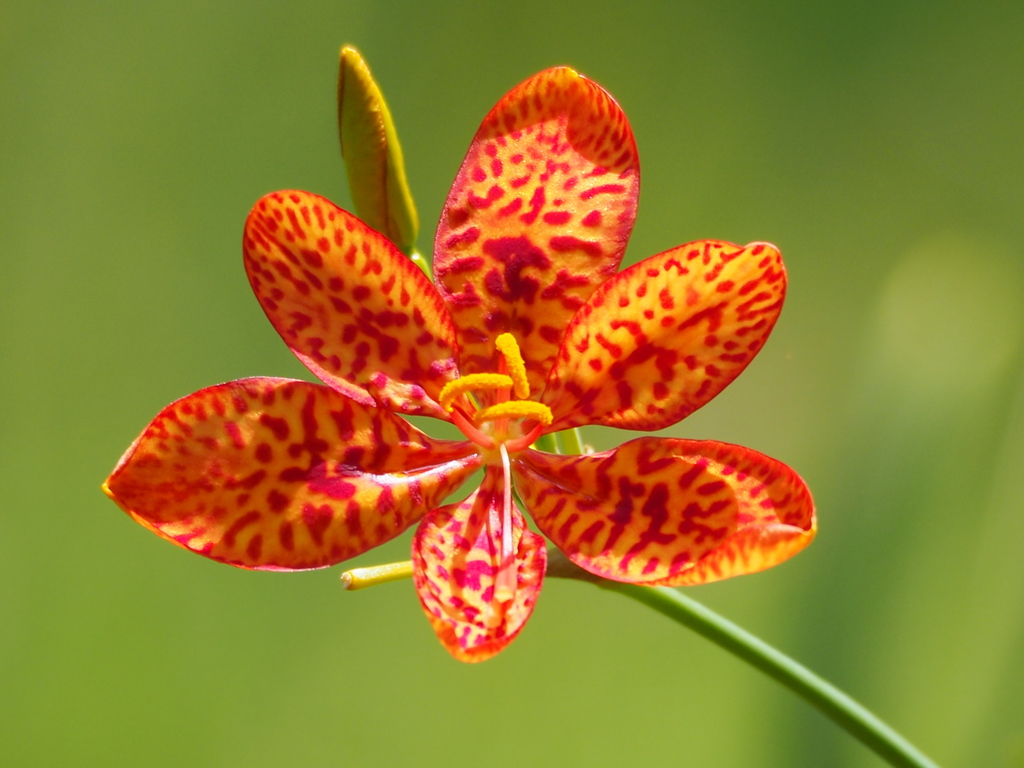
Blackberry Lily
Iris domestica
Iris domestica, commonly known as leopard lily, blackberry lily, and leopard flower, is an ornamental plant in the Iridaceae family. In 2005, based on molecular DNA sequence evidence, Belamcanda chinensis, the sole species in the genus Belamcanda, was transferred to the genus Iris and renamed Iris domestica. Other synonyms are Epidendrum domesticum L., Vanilla domestica (L.) Druce, Belamcanda punctata Moench, Gemmingia chinensis (L.) Kuntze, Ixia chinensis L., Morea chinensis, and Pardanthus chinensis Ker Gawl.)
From the article Iris domestica on Wikipedia (CC BY-SA), quoted section by section
Description
A perennial herb, I. domestica may grow to a height of 0.6–1 metre (2 ft 0 in – 3 ft 3 in), with its rhizomes in shallow ground, extending horizontally. It has 3-5-stems and 8–14 leaves per stem growing in a fan, with flowers ascending proximally having orange-red scattered spots of darker pigment, blooming during summer. The seed pods open in the fall, showing clusters of black, shiny seeds whose resemblance to those of a blackberry gives the plant its common name, "blackberry lily". The plant is hardy to USDA plant hardiness zone 5 and is propagated by seeds or division. In the wild, it grows in grasslands, pastures, forest clearings, meadows, and mountainous regions or shrublands. Although it has escaped cultivation in many regions, it is not considered to have potential as an invasive species.
Range & habitat
The plant is native to Eastern Asia and has been cultivated worldwide in subtropical and temperate climates. Due to the ornamental value of its attractive flowers, the plant was distributed to Europe as early as the 18th century and the United States and Caribbean countries in the 19th century.
Wikipedia: “Distribution”
At the table
I. domestica is a common ornamental plant in private and public gardens, zoos, and floral displays. Its flowers provide nectar and pollen to insects and birds. The plant has been used in traditional medicine.
Wikipedia: “Uses”
Where it lives
Recorded sightings
—
geo-referenced records in GBIF, from museums, herbaria and field observers.
Drag the globe to turn it. Dots are where records exist, not a range map; darker means more records.
In the old herbals & bestiaries

Illustrated Compendium of Materia Medica (Vol. 23)
吳其濬 · 1848 · p.69

Illustrated Compendium of Materia Medica (Vol. 23)
吳其濬 · 1848 · p.65

Commentaries on the Six Books of Dioscorides on Medical Matter
Pietro Andrea Mattioli · 1563 · p.121

Collected Illustrations of the Three Realms: Herbs
王圻, 王思義 · 1607 · p.22
In the stacks
Searching the stacks…
Every page naming Iris domestica in the Biodiversity Heritage Library →
This page is assembled live from iNaturalist, GBIF, Wikipedia, the Source Library and the Internet Archive. It is not yet part of the hand-edited codex. iNaturalist taxon 204330.