- Plants
- ›Vascular Plants
- ›flowering plants
- ›Dicots
- ›saxifrages, stonecrops, and allies
- ›stonecrop family
- ›Sempervivoideae
- ›Umbilicieae
- ›Phedimus
- ›Phedimus
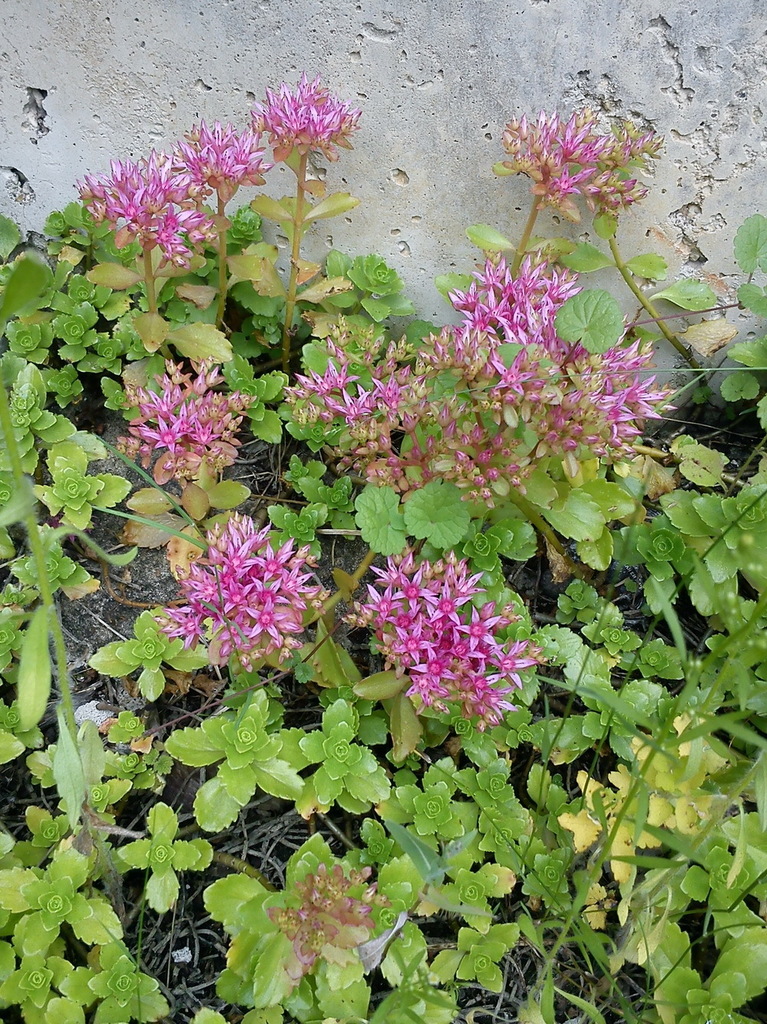
Caucasian Stonecrop
Phedimus spurius
Phedimus spurius, formerly Sedum spurium, the Caucasian stonecrop or two-row stonecrop, is a species of flowering plant in the family Crassulaceae. It is a low-growing, spreading succulent with stems that creep along the ground and root as they grow.
P. spurius occurs naturally in the rocky subalpine meadows of Georgia, northern Iran, and northeastern Turkey. It has naturalized in Europe, often found along roadsides, walls, and waste areas, escaping cultivation to form persistent colonies. It is widely grown for its tolerance of drought and rocky conditions. Wild populations and cultivars vary in color from white to red; greener-leaved plants produce paler blooms and those with red or purple foliage developing deeper-colored flowers.
From the article Phedimus spurius on Wikipedia (CC BY-SA), quoted section by section
Description
Phedimus spurius is a stonecrop with numerous stems that either sprawl along the ground or creep, often taking root as they grow. These stems, which are smooth or slightly bumpy, are typically 5–15 cm long. The leaves, which are usually arranged in opposite pairs but occasionally alternate, are either attached directly to the stem or have very short stalks. They grow in two rows along the stems, which is why the plant is sometimes called "two-row stonecrop", and vary in shape from spoon-like to rounded or oblong, with a wedge-shaped base and small, rounded teeth along the upper edges. Leaf size ranges from 15–35 mm in length and 10–12 mm in width. The leaves are succulent and medium green with edges tinged in red. The older leaves (on the lower parts of the stems) are deciduous, while the newer leaves (near the stem tips) are evergreen. In autumn, these upper leaves deepen to a rich burgundy color, persisting through winter.
Flowering stems, which can lie along the ground or grow at an angle, reach 10–30 cm and have a rough texture and reddish color. The flowers are densely clustered in flat-topped groups called corymbs, each containing 15–30 blooms. The bracts (small, leaf-like structures beneath the flowers) are narrow and elongated. The flowers themselves usually have five, but occasionally six, petals and sit on very short stalks or are nearly stalkless. …
Range & habitat
The type specimen of Phedimus spurius was collected in Georgia. The species is distributed in Georgia, northern Iran, and northeastern Turkey, where it inhabits cool, rocky sites and subalpine meadows at elevations ranging from 1,250 to 3,000 meters. Phedimus spurius has become naturalized in many parts of Europe, especially in various disturbed habitats, such as walls, rocky areas, roadsides, refuse sites, and waste ground. It frequently escapes cultivation, likely through garden waste disposal or dispersal by birds. Once established, it can form persistent colonies.
Wikipedia: “Distribution and habitat”
How it is grown
The horticulturist Ray Stephenson has described Phedimus spurius as "perhaps ... the most common stonecrop in cultivation". It thrives in well-drained, acidic to neutral soils with dry to moderate moisture levels and prefers full sun, though it can handle some light shade. It grows well in sandy or gravelly soil, adapts to nutrient-poor conditions, and requires proper drainage to stay healthy. It is highly drought-resistant and should not be overwatered. Pests and diseases rarely attack it, but snails, slugs, and scale insects may appear. Phedimus spurius is commonly planted in rock gardens, small-scale ground cover, and border fronts, this plant also thrives in stone wall crevices, sunny slopes, and along edges. Due to its vigorous spreading habit, it is unsuitable for small rock gardens but excels as a fast-growing ground cover. It can overtake more delicate species and requires management. The plant struggles in containers, needing ample space to expand. It may also be used in green roofs. It spreads easily by rooting at nodes that touch the ground and can be propagated effortlessly through cuttings or division. Dark-leaved and variegated forms grow more slowly, making them valuable for contrast in borders. Numerous cultivars of Phedimus spurius have been developed, though many lack distinguishing traits. …
Wikipedia: “Cultivation”
Where it lives
Recorded sightings
—
geo-referenced records in GBIF, from museums, herbaria and field observers.
Drag the globe to turn it. Dots are where records exist, not a range map; darker means more records.
In the stacks
Searching the stacks…
Every page naming Phedimus spurius in the Biodiversity Heritage Library →
This page is assembled live from iNaturalist, GBIF, Wikipedia, the Source Library and the Internet Archive. It is not yet part of the hand-edited codex. iNaturalist taxon 204380.