- Plants
- ›Vascular Plants
- ›flowering plants
- ›Dicots
- ›Mints, Plantains, Olives, and Allies
- ›Plantain Family
- ›Veroniceae
- ›Veronica
- ›Pseudolysimachium
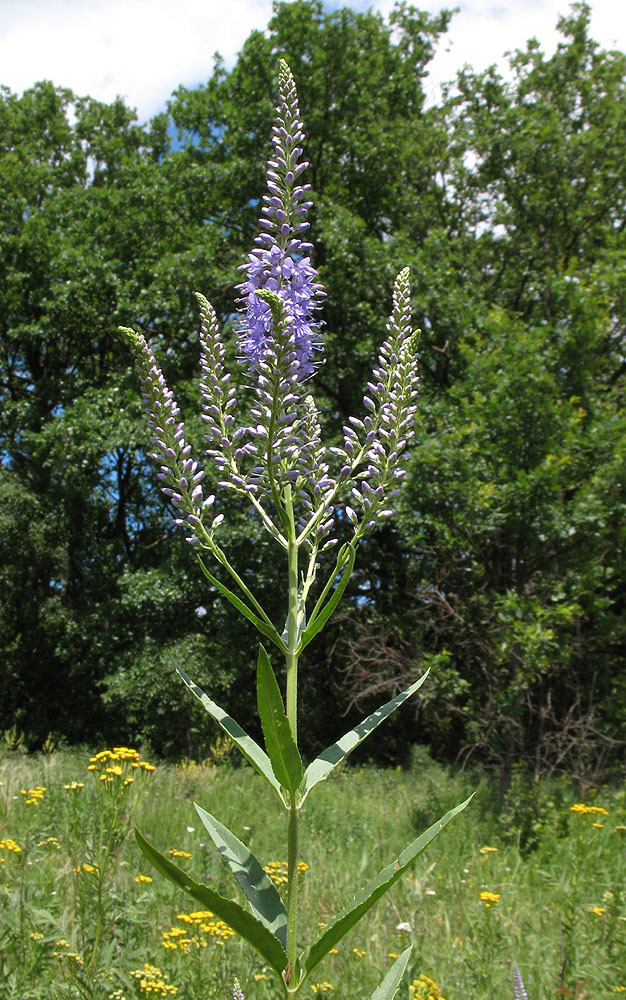
bastard speedwell
Veronica spuria
Veronica spuria, the bastard speedwell is a perennial flower in the Plantaginaceae family native in eastern Europe and western Asia.
From the article Veronica spuria on Wikipedia (CC BY-SA), quoted section by section
Description
A tall (30 to 100 cm), perennial, speedwell, with long floral spikes of blue to purple flowers. It is rather similar to the familiar garden speedwell but the topmost floral display is much more branched, with numerous branches of flowers emerging from leaf bases at lower levels. The flowers by comparison are larger (7–14 mm vs. 4–8 mm), on longer stalks ((2)3–5 mm vs. 1–2 mm), and they mature into capsules (2.5-4 x 2–3 mm).
Photographic examples can be seen on iNaturalist.
Range & habitat
Its native range is Altay, Austria, Baltic States, Belarus, Bulgaria, Central European Russia, Czechoslovakia, East European Russia, Hungary, Kazakhstan, Kyrgyzstan, Mongolia, North Caucasus, North European Russia, Poland, Romania, South European Russia, Tadzhikistan, Ukraine, West Siberia, Xinjiang, Yugoslavia, doubtfully present in Germany, Italy, and introduced into Vermont In NW Xinjiang its habitat is mountain slopes, steppes, c. 1100 m. In Europe its habitat is grassy and rocky places.
== References ==
Wikipedia: “Distribution and habitat”
Where it lives
Recorded sightings
—
geo-referenced records in GBIF, from museums, herbaria and field observers.
Drag the globe to turn it. Dots are where records exist, not a range map; darker means more records.
In the stacks
Searching the stacks…
Every page naming Veronica spuria in the Biodiversity Heritage Library →
This page is assembled live from iNaturalist, GBIF, Wikipedia, the Source Library and the Internet Archive. It is not yet part of the hand-edited codex. iNaturalist taxon 204432.