- Animals
- ›Chordates
- ›Vertebrates
- ›Birds
- ›Woodpeckers and Allies
- ›Woodpeckers
- ›Typical woodpeckers
- ›Campephilini
- ›Chrysocolaptes
On eBird ↗
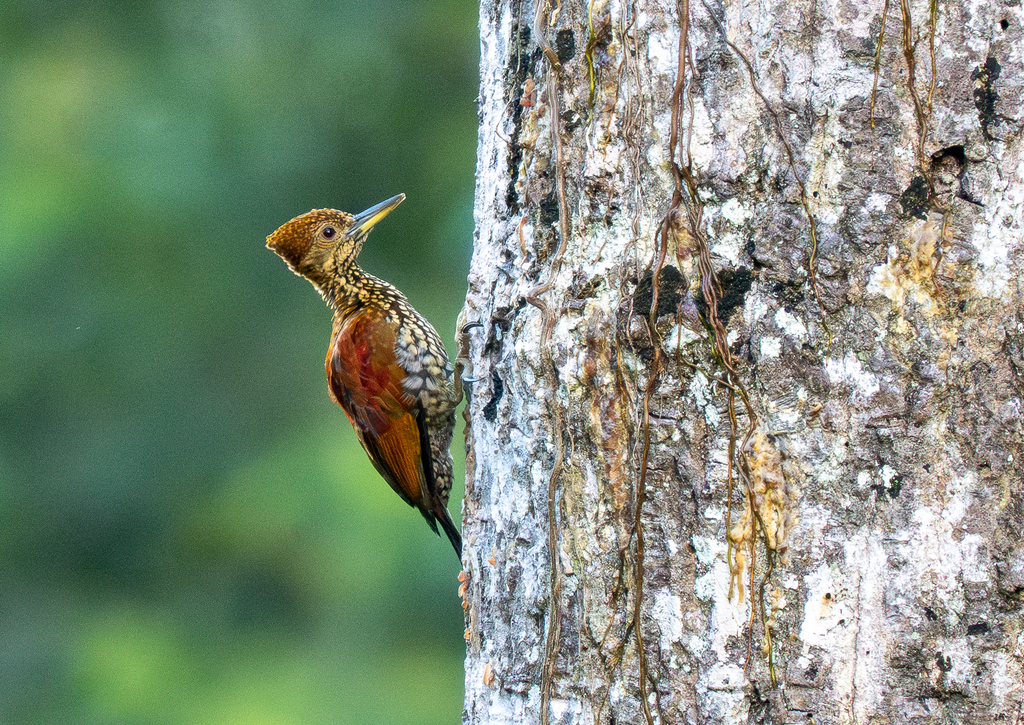
Buff-spotted Flameback
Live sightings near you, the range map, bar charts of when it is seen, and Macaulay Library photos and recordings.
Buff-spotted Flameback
Chrysocolaptes lucidus
The buff-spotted flameback (Chrysocolaptes lucidus) is a species of bird in the family Picidae. It is found on the Philippine islands of Bohol, Leyte, Samar, Biliran, Panaon, Mindanao, Basilan, and Samal. Along with the other Philippine species, Yellow-faced flameback, Luzon flameback, Red-headed flameback, it was formerly conspecific greater flameback
From the article Buff-spotted flameback on Wikipedia (CC BY-SA), quoted section by section
Range & habitat
It is found in tropical moist lowland forest with dense understory up to 1,500 meters above sea level IUCN has assessed this bird as least-concern species but the population is decreasing. This species' main threat is habitat loss with wholesale clearance of forest habitats as a result of logging, agricultural conversion and mining activities occurring within the range. The most affected part of its range is Bohol which only has 4% forest cover remaining. Occurs in a few protected areas like Pasonanca Natural Park, Mount Apo and Mount Kitanglad on Mindanao, Rajah Sikatuna Protected Landscape in Bohol and Samar Island Natural Park but actual protection and enforcement from illegal logging and hunting are lax.
Wikipedia: “Habitat and conservation status”
What it does
Presumably feeds on insects and wood boring larvae. Typically seen in pairs or family parties and may sometimes associate with White-bellied woodpecker and Southern sooty woodpecker. Buff-spotted flamebacks, like other woodpeckers, drum—meaning rapidly tap their beak against objects such as dead trees—to attract mates. This species has one of the longest drums, averaging about 51 beats per drum. Nests in tree cavities. Breeding is believed to occur from January to May. The very similar Greater flameback lays 2 to 5 eggs which incubate in 2 weeks and fledge within a month.
Wikipedia: “Ecology and behavior”
Listen
Looking for field recordings…
Where it lives
Recorded sightings
—
geo-referenced records in GBIF, from museums, herbaria and field observers.
Drag the globe to turn it. Dots are where records exist, not a range map; darker means more records.
In the stacks
Searching the stacks…
Every page naming Chrysocolaptes lucidus in the Biodiversity Heritage Library →
This page is assembled live from iNaturalist, GBIF, Wikipedia, the Source Library and the Internet Archive. It is not yet part of the hand-edited codex. iNaturalist taxon 204485.