- Plants
- ›Vascular Plants
- ›flowering plants
- ›Dicots
- ›Mallows, Rock Roses, and Allies
- ›Mallow and Hibiscus Family
- ›Malvoideae
- ›Hibisceae
- ›Hibiscus
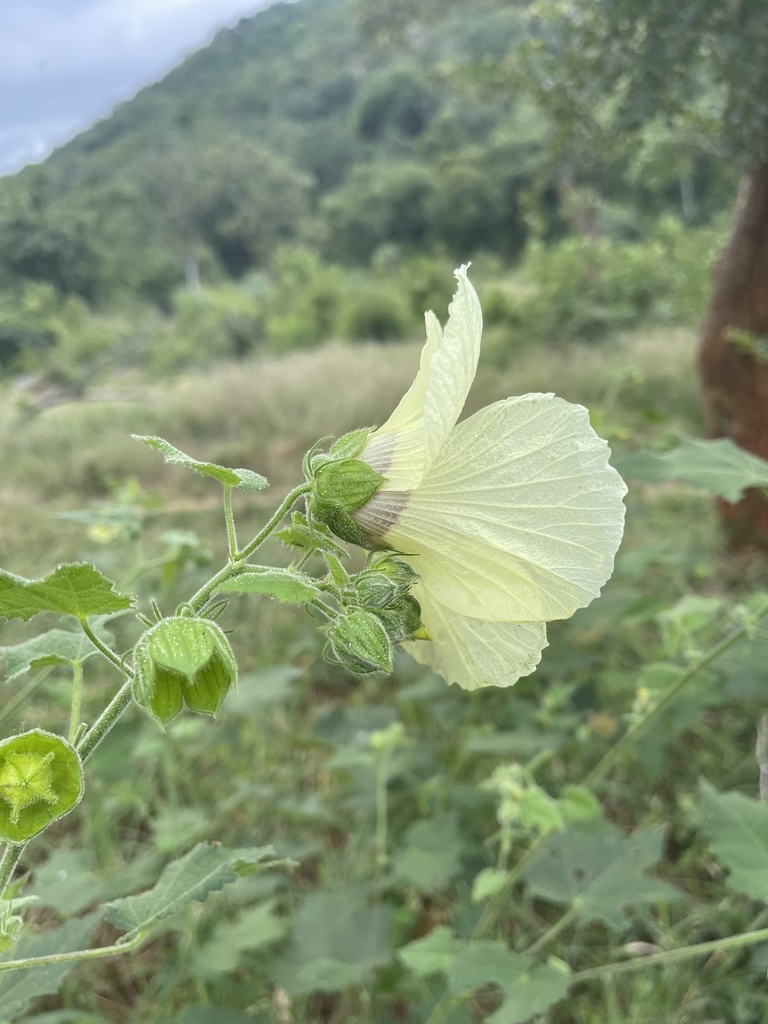
Wineleaf Hibiscus
Hibiscus vitifolius
Hibiscus vitifolius, the grape-leaved mallow or tropical rose mallow, is a species of flowering plant in the family Malvaceae. It is native to the seasonally dry Old World tropics and subtropics, and has been introduced to the West indies. A perennial herb reaching 2 m (6 ft) and becoming woody at maturity, it is found in a wide variety of habitats, and is a weed of cultivation. It is used locally as a source of fiber, often mixed with jute.
From the article Hibiscus vitifolius on Wikipedia (CC BY-SA), quoted section by section
Description
The plant is a stiff and erect, growing to up to two metres, with a sometimes red-tinged stem. The leaves are broadly ovate, with a cordate or truncate base and a crenate margin. The inflorescence grows in a terminal cyme and in the leaf axils. The calyx is semi-fused. The corolla has five overlapping petals, yellow or pale lilac, with a dark red blotch at the base. The flower is followed by a pale brown capsule containing blackish, wedge-shaped seeds.
Range & habitat
Hibiscus vitifolius is native to tropical parts of Africa, the Middle East, India and southeastern Asia. It has been introduced to most of the islands of the Caribbean.
Wikipedia: “Distribution”
Where it lives
Recorded sightings
—
geo-referenced records in GBIF, from museums, herbaria and field observers.
Drag the globe to turn it. Dots are where records exist, not a range map; darker means more records.
In the stacks
Searching the stacks…
Every page naming Hibiscus vitifolius in the Biodiversity Heritage Library →
This page is assembled live from iNaturalist, GBIF, Wikipedia, the Source Library and the Internet Archive. It is not yet part of the hand-edited codex. iNaturalist taxon 204772.