 NL·0665
Herbarium of the Nature Library
- Name
- Rhea americana
- Family
- Rheidae
- Native to
- Eastern and central South America: Brazil, Bolivia, Paraguay, Uruguay and Argentina; a feral population in northern Germany descends from escaped birds
- Habitat
- Pampas grassland, Savanna (Cerrado), Chaco scrub, Farmland
On eBird ↗
Greater Rhea
Live sightings near you, the range map, bar charts of when it is seen, and Macaulay Library photos and recordings.
Greater rhea
Rhea americana
Also calledÑandú (Spanish, from Guaraní ñandu) · Ema (Portuguese) · Ñandu guasu (Guaraní)
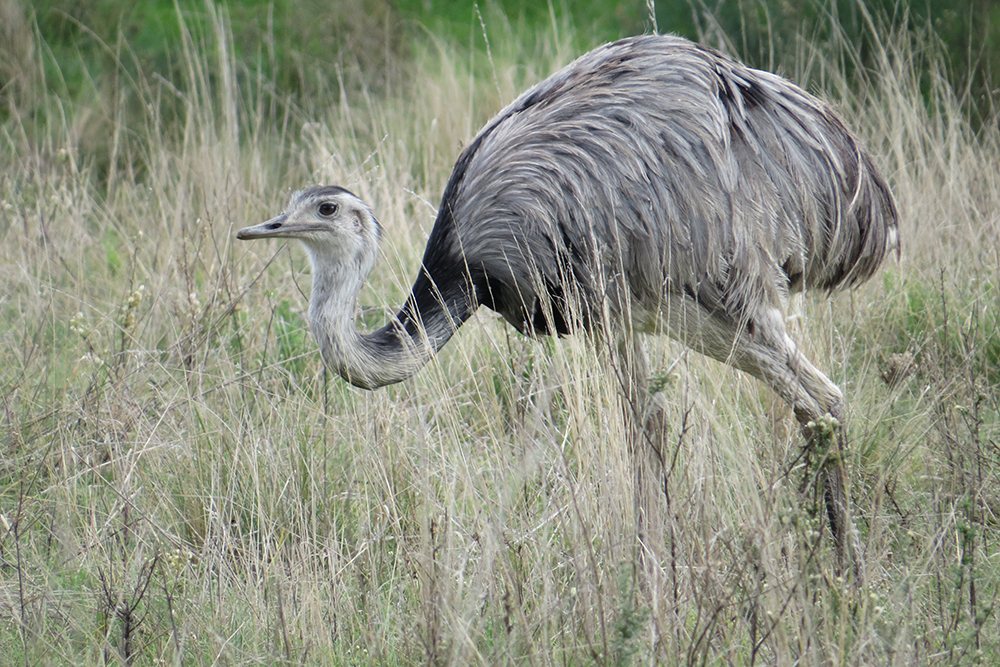
The largest bird in the Americas, a flightless ratite of the pampas and savannas of South America. Males alone build the nest, incubate eggs laid by several females, and fiercely guard the chicks.
The greater rhea is a species of flightless bird native to eastern South America. Other names for the greater rhea include the grey, common, or American rhea; ema (Portuguese); or ñandú. One of two species in the genus Rhea, in the family Rheidae, it inhabits a variety of open areas, such as grasslands, savanna or grassy wetlands. Weighing 20–27 kilograms (44–60 lb), the greater rhea is the largest native bird in the Americas. In the wild, the greater rhea has a life expectancy of 10.5 years. It is also notable for its reproductive habits, and for the fact that a population has established itself in Northern Germany in the 2000s and 2010s. The species is listed as Near Threatened by the IUCN. Wikipedia
What it can do
- iRuns at up to about 60 km/h, using its wings like rudders to zigzag
- iiOne male's nest may hold dozens of eggs laid by several females
- iiiMales defend chicks aggressively, charging people and horses
- ivEats plants toxic or unpalatable to many grazers
In the field
Field marks
- aVery large, flightless, grey-brown bird with a long neck
- bBlack feathering at the base of the neck and upper back in males
- cThree forward-pointing toes
- dShaggy, drooping wings covering the body
- Voice
- Breeding males give a deep, booming 'nan-doo'.
- Not to be confused with
- Lesser (Darwin's) Rhea of Patagonia and the high Andes is smaller and spotted white. There are no other large flightless birds in South America.
- Where to see it
- The Pampas of Argentina and Uruguay, Emas National Park and the Pantanal (Brazil), the Chaco of Paraguay.
- When
- Resident year-round
Listen
Looking for field recordings…
Life & habits
- Diet
- Broad-leaved plants, seeds, fruit, insects, small vertebrates
- Habitat
- Open grassland, savanna and farmland
- Size
- Up to about 1.5 m tall; 20–40 kg
- Lifespan
- Around 10–15 years in the wild; longer in captivity
Outside the breeding season rheas form flocks of 10–100, often alongside deer, guanacos or cattle.
Where it lives
Recorded sightings
—
geo-referenced records in GBIF, from museums, herbaria and field observers.
Native range
Eastern and central South America: Brazil, Bolivia, Paraguay, Uruguay and Argentina; a feral population in northern Germany descends from escaped birds
Drag the globe to turn it. Dots are where records exist, not a range map; darker means more records.
In the stacks
Searching the stacks…
Every page naming Rhea americana in the Biodiversity Heritage Library →
Marginalia
Guaraní and other Indigenous peoples of Brazil see a rhea constellation (Ema) in the sky near the Southern Cross; gauchos hunted it on horseback with boleadoras.
Curiosity
Its genus name Rhea comes from the mother of the gods in Greek myth.
Kinship





Fact-checked: 2 corrections made to this sheet. Photographs: iNaturalist contributors under the licences shown. Records: GBIF.org. Historical plates: Source Library (CC BY-SA 4.0; originals public domain). Summary text: Nature Library editors and Wikipedia (CC BY-SA). Medicinal and edibility notes are historical and educational, not advice. iNaturalist taxon 20512.