- Fungi Including Lichens
- ›Basidiomycete Fungi
- ›Higher Basidiomycetes
- ›Mushrooms, Bracket Fungi, Puffballs, and Allies
- ›Cantharellales
- ›Hydnaceae
- ›Multiclavula
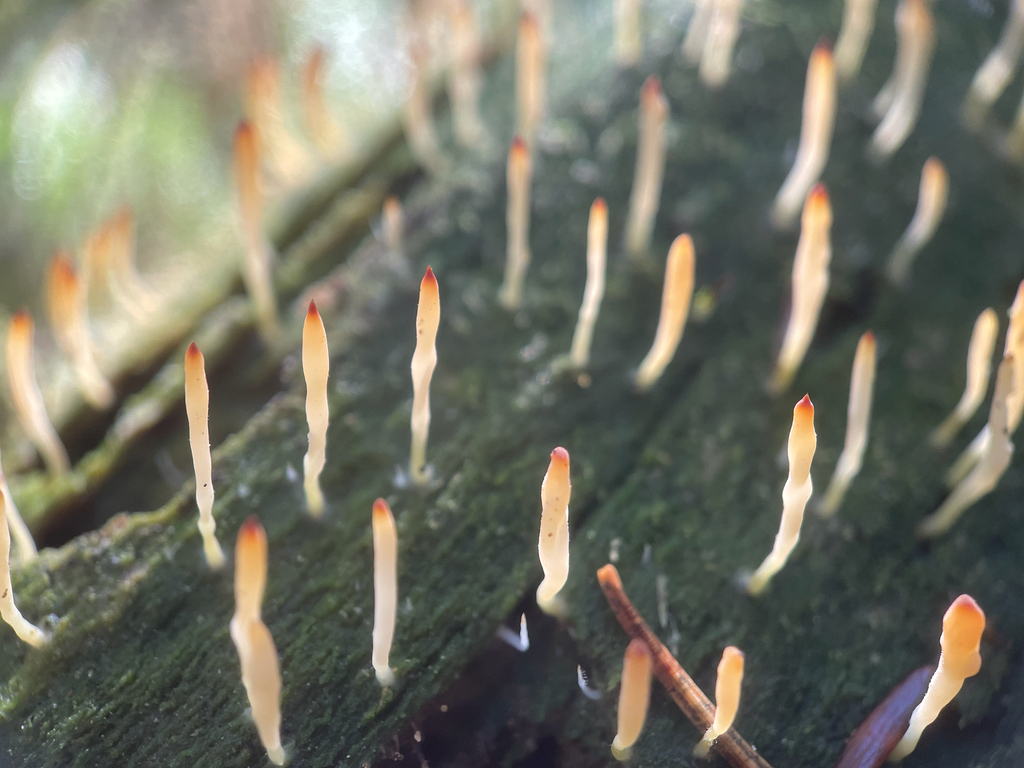
White green-algae coral
Multiclavula mucida
Multiclavula mucida is a globally distributed species of basidiolichen belonging to the family Hydnaceae. Since its initial classification by Christiaan Hendrik Persoon in 1797, the species has been described under various synonyms and associated with multiple genera. Persoon described its fruiting bodies as gregarious (i.e. growing in groups but separate at the base), varying from simple to branching structures, predominantly whitish in colour with yellow to brownish tips. He also noted its frequent appearance in autumn on decaying, moist wood, often covered with a greenish crust necessary for its growth.
The cosmopolitan distribution of Multiclavula mucida and its variability in appearance have led to a complex nomenclature and historical confusion with other species and genera. Though widespread, it is considered rare in Europe and faces threats in many countries. It can be distinguished from similar species such as Multiclavula petricola, M. vernalis, M. coronilla, and Clavicorona taxophila by differences in basidiospore size, growth substrate, fruiting body structure, and microscopic features, despite similarities in colour and general form.
From the article Multiclavula mucida on Wikipedia (CC BY-SA), quoted section by section
Description
In the thallus of M. mucida, the algae are not merely scattered. Instead, they are organised into small, closely situated globules embedded in a gelatinous matrix on moist, rotting wood. This Botrydina-type thallus structure, common in basidiolichens, serves multiple functions. It protects the algae from UV light and desiccation, while ensuring close contact through a hyphal network that provides a continuous water and minerals supply. The fruiting bodies (basidiocarps) are typically simple to lobed and can reach up to 2 cm (0.8 in) in height. They are waxy-tough but can become slimy, transitioning from white or creamy colour to grey or pale tan as they mature. These structures often dry to show a pure white tip. The fruiting bodies' stickiness often causes debris to adhere to their surfaces. The algal partners are encapsulated in tiny pockets of fungal tissue, yet they retain a loose, unstructured form, manifesting as a green granular crust where the fungus produces its fruiting bodies. Despite their mutualistic relationship, both the algae and the fungus maintain their individual morphology. The relationship between coccomyxoid green algae and M. mucida was documented by Geitler in 1955, noting that the algae are larger within the lichen than when free-living. …
Range & habitat
This species is commonly found on decomposing wood, often in the presence of algae. It thrives on a wide variety of substrates, including bamboo, beech, cedar, poplar, and oak. In Central Europe, coniferous wood is a particularly favoured substrate. M. mucida is widely distributed, found in Asia, Europe, North and South America, and possibly Australia, with its North American range extending as far north as Alaska. The discovery of M. mucida at unusually low elevations, specifically around 130 to 135 m (427 to 443 ft) above sea level in the Bienwald area of Rhineland-Palatinate, has prompted a reevaluation of its distribution and naming inconsistencies across different scientific literatures. Unlike other members of its genus, which prefer sandy soils, this species predominantly relies on rotting wood in moist environments. Lothar Geitler first identified this species as an extratropical lichen in 1955, challenging the then-prevailing view that basidiolichens were exclusively tropical. Previously considered native to Northern Europe and the mountains of Central Europe, M. mucida has been increasingly observed across most European countries and globally. This expansion in its geographical range could be attributed to the establishment and maintenance of natural forest reserves, environments that foster the decay of thick logs and provide suitable habitats for the fungus. …
Wikipedia: “Habitat and distribution”
In human culture
The species epithet mucida is from the Latin word mucidum, meaning "mouldy" or "slimy"; the genus name Multiclavula means "many clubs". In North American literature, this fungus is known by several vernacular names, including "scum lover", "common club mushroom lichen", "frail bones", and "club lichen", the last of which is also used to refer to the entire genus.
Wikipedia: “Etymology and vernacular names”
Where it lives
Recorded sightings
—
geo-referenced records in GBIF, from museums, herbaria and field observers.
Drag the globe to turn it. Dots are where records exist, not a range map; darker means more records.
In the stacks
Searching the stacks…
Every page naming Multiclavula mucida in the Biodiversity Heritage Library →
This page is assembled live from iNaturalist, GBIF, Wikipedia, the Source Library and the Internet Archive. It is not yet part of the hand-edited codex. iNaturalist taxon 205261.