- Fungi Including Lichens
- ›Ascomycete Fungi
- ›Sac Fungi and Lichens
- ›Arthoniomycetes
- ›Arthoniales
- ›Christmas lichens, comma lichens, and allies
- ›Arthonia
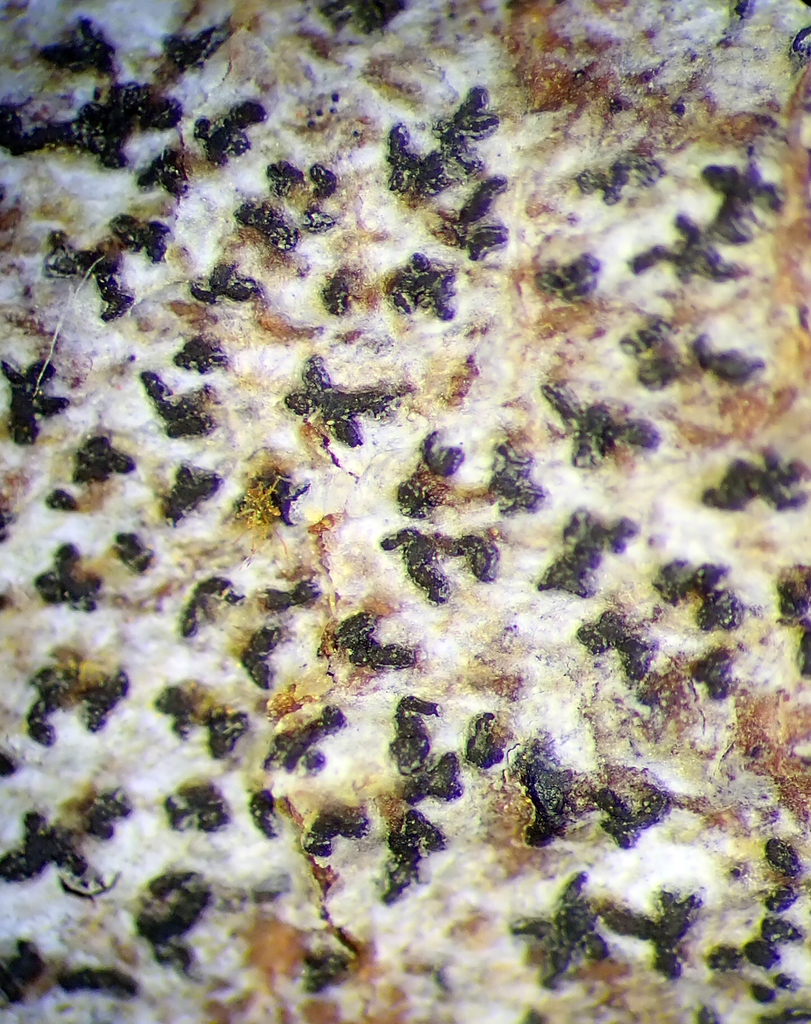
Asterisk Lichen
Arthonia radiata
Arthonia radiata, the asterisk lichen, is a common and widepspread species of corticolous (bark-dwelling), crustose lichen in the family Arthoniaceae.
From the article Arthonia radiata on Wikipedia (CC BY-SA), quoted section by section
Description
Arthonia radiata is a crustose lichen with an immersed thallus, often separated from its surroundings by a thin brown line. The thallus is typically pale, ranging from white to pale grey, sometimes with a brown or olive tinge, and often forms a mosaic-like pattern on its substrate. Its reproductive structures, called apothecia, are black and can appear in various shapes—rounded, star-like (stellate), or elongated. These apothecia can measure between 0.15 and 2.2 mm across, and are usually flat or slightly convex. They lack a frosted appearance, often referred to as being non-pruinose.
Under a microscope, the apothecia have a thin epithecium (the upper layer) that is brown or olive-brown, reacting to certain chemical tests by turning pale green. The internal structure includes a clear hymenium (spore-producing layer) and a hypothecium (the layer beneath) that is also colourless to pale olive-brown. The paraphysoids (sterile filaments within the hymenium) are narrow, 1–2 μm wide, but can expand to 3 μm, and they are often capped with darker brown tips. Arthonia radiata produces spores that are cylindric-obovoid to cylindrical, with 3 internal walls (septa) dividing the spore into 4 cells. These ascospores measure between 15 and 20 μm long and 4.5 to 6 μm wide, and the uppermost cell is not enlarged. …
Range & habitat
Arthonia radiata is a widespread and common species. It grows on the smooth bark of many trees and shrubs.
Wikipedia: “Habitat and distribution”
What it does
Lichenicolous fungi that have been recorded growing on Arthonia radiata include Muellerella polyspora, Stigmidium arthoniae, and an undescribed species of Opegrapha.
Wikipedia: “Species interactions”
Where it lives
Recorded sightings
—
geo-referenced records in GBIF, from museums, herbaria and field observers.
Drag the globe to turn it. Dots are where records exist, not a range map; darker means more records.
In the stacks
Searching the stacks…
Every page naming Arthonia radiata in the Biodiversity Heritage Library →
This page is assembled live from iNaturalist, GBIF, Wikipedia, the Source Library and the Internet Archive. It is not yet part of the hand-edited codex. iNaturalist taxon 205492.