- Fungi Including Lichens
- ›Basidiomycete Fungi
- ›Higher Basidiomycetes
- ›Mushrooms, Bracket Fungi, Puffballs, and Allies
- ›Agaricomycetidae
- ›Common Gilled Mushrooms and Allies
- ›Agaricineae
- ›Hymenogastraceae
- ›Psilocybe
- ›Zapotecorum
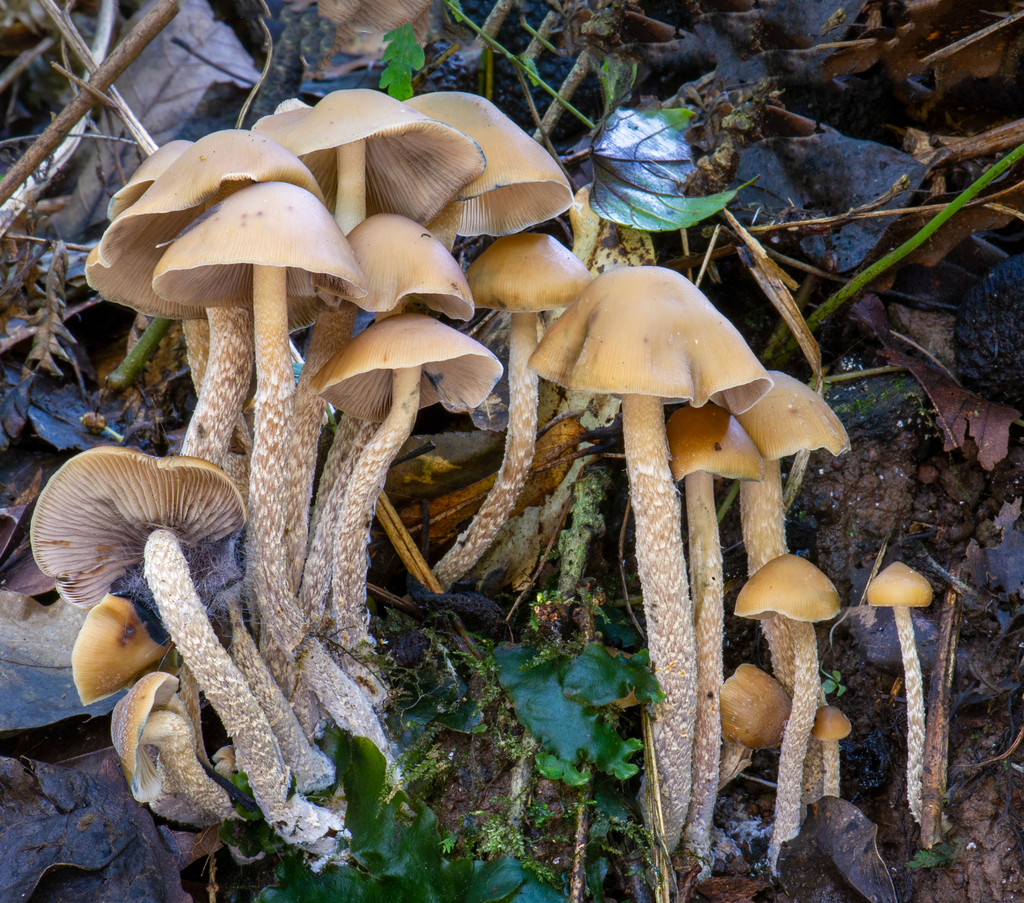
drunken mushroom
Psilocybe zapotecorum
Psilocybe zapotecorum is a psilocybin mushroom which has psilocybin and psilocin as main active compounds. It is in the section Zapotecorum, other members of this section include Psilocybe angustipleurocystidiata, Psilocybe aucklandii, Psilocybe collybioides, Psilocybe graveolens, Psilocybe kumaenorum, Psilocybe muliercula, Psilocybe pintonii, Psilocybe subcaerulipes, Psilocybe moseri, Psilocybe zapotecoantillarum, Psilocybe zapotecocaribaea, and Psilocybe antioquiensis.
From the article Psilocybe zapotecorum on Wikipedia (CC BY-SA), quoted section by section
Range & habitat
Psilocybe zapotecorum grows solitarily or gregariously, sometimes in cespitose clusters of around a 50 mushrooms. It is found near rivers, creeks and ravines, sometimes growing directly from steep mossy ravine walls. Psilocybe zapotecorum is also found in humid and shadowed places in mesophytic forests, oak-and-pine forests, or cloud forests. Psilocybe zapotecorum is often found in subtropical forests containing Alnus sp., Magnolia sp., Fraxinus sp., Quercus sp., large pines, and blackberry bushes. Psilocybe zapotecorum grows in Argentina, Brazil, Chile, Colombia, Mexico, Peru, Guatemala, El Salvador, Venezuela, Nicaragua and Ecuador.
Wikipedia: “Distribution and habitat”
In human culture
It is named for the Zapotec Natives, who are native to the Sierra Madre mountains of Oaxaca Mexico, as well as the area they inhabited. According to Richard E. Schultes the Zapotec name translates as "Crown of thorns mushroom". Other sources give the Zapotec name as badao zoo translated as "hongo borracho", "drunken mushroom".
1956: Holotype collected August 4, 1956 in Santiago Yaitepec by Roger Heim and R. Gordon Wasson. 1957: Roger Heim and R. Gordon Wasson describe Magic Mushrooms with illustrations in "Magic Mushrooms" LIFE Magazine May 13, 1957. 1958-9: Roger Heim published the first scientific description of this fungus. Albert Hofmann also finds Psilocybin. 1963: Roger Heim describes this mushroom in the work "Les Champignons Toxiques et Hallucinogènes." 1976: Jonathan Ott and Gaston Guzman publish again about the fungus, but describe it as Psilocybe candidipes.
Wikipedia: “Etymology and history”
Where it lives
Recorded sightings
—
geo-referenced records in GBIF, from museums, herbaria and field observers.
Drag the globe to turn it. Dots are where records exist, not a range map; darker means more records.
In the stacks
Searching the stacks…
Every page naming Psilocybe zapotecorum in the Biodiversity Heritage Library →
This page is assembled live from iNaturalist, GBIF, Wikipedia, the Source Library and the Internet Archive. It is not yet part of the hand-edited codex. iNaturalist taxon 206149.