On eBird ↗
Collared Trogon
Live sightings near you, the range map, bar charts of when it is seen, and Macaulay Library photos and recordings.
Collared Trogon
Trogon collaris
The collared trogon (Trogon collaris) is a near passerine bird in the trogon family, Trogonidae. It is found in the warmer parts of the Neotropics and includes numerous subspecies, including T. c. exoptatus from northern Colombia, northern Venezuela and Trinidad and Tobago. The subspecies T. c. aurantiiventris is recognized by many authorities as a separate species: the orange-bellied trogon.
From the article Collared trogon on Wikipedia (CC BY-SA), quoted section by section
Description
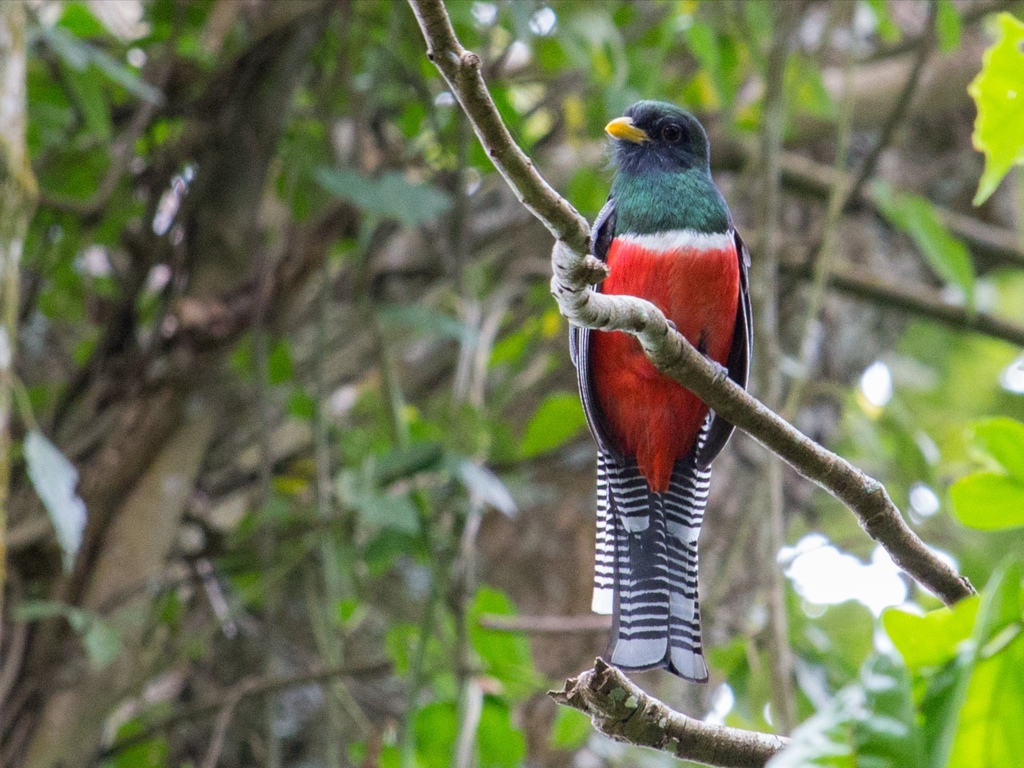
Trogons have distinctive male and female plumages, with soft, often colorful, feathers. The collared trogon is about 25 to 29 cm (9.8 to 11.4 in) long and weigh about 41 to 64 g (1.4 to 2.3 oz). Both sexes have a black face and throat. The male's crown, nape, back, and rump are bright metallic green. The folded wing shows black and white vermiculation. The breast is also metallic green with a white band separating it from the bright red belly and vent. The upperside of the tail is green with a black tip and the underside is barred black and white. The female is olive brown where the male is green, the closed wing is brown with black vermiculation, and the belly is a duller red than the male's. The underside of the tail is gray with a few black bars and white tips.
Range & habitat
The 10 subspecies of collared trogon are found thus:
T. c. puella, central Mexico to western Panama T. c. underwoodi, northwestern Costa Rica T. c. aurantiiventris, central Costa Rica to western Panama T. c. extimus, eastern Darién Province in northeastern Panama T. c. heothinus, Panama's Serranía del Darién T. c. virginalis, western Colombia through western Ecuador into northwestern Peru T. c. subtropicalis, central Colombia, especially the Magdalena and Cauca valleys T. c. exoptatus, northern Venezuela (and Trinidad and Tobago?) T. c. collaris, east of the Andes from Colombia south to northern Bolivia and east through the Guianas and much of west central Brazil (and Trinidad and Tobago?) T. c. castaneus, southeastern Colombia south to eastern Peru and northern Bolivia and into northwestern Brazil; also eastern Brazil Clements places T. c. exoptatus in Trinidad & Tobago; the IOC places T. c. collaris there instead. In South America the collared trogon inhabits humid lowland evergreen forest, both primary and well-established secondary. In Mexico and Central America it inhabits those forest types and in addition humid montane, semideciduous, and pine-evergreen forests. It is found as high as 2,400 m (7,870 ft) in Mexico and 2,300 m (7,550 ft) in Costa Rica, but in the Andes it is mostly below 1,300 m (4,270 ft) in Ecuador and 1,200 m (3,940 ft) in Peru.
Wikipedia: “Distribution and habitat”
What it does
The collared trogon usually perches between the higher understory and the lower part of the canopy. It is usually seen singly or in pairs, but small groups may gather outside the breeding season.
Feeding. The collared trogon eats small fruits (such as berries) and invertebrates such as caterpillars, crickets, cicadas, beetles, and phasmids. They often accompany the edges of mixed-species foraging flocks but do not mix with the other members.
Breeding. The collared trogon's nesting season is highly variable across the species' wide distribution, beginning as early as November in French Guiana and as late as April in Venezuela. It nests in cavities in decaying wood or arboreal termite nests; the cavity is often so shallow that much of the bird is visible. The normal clutch size is two eggs. Both sexes incubate the eggs and care for the young.
Vocalization. The collared trogon's song varies geographically. The Mexican and Central American populations sing "a plaintive 2-3 noted kyow'-kyow or caow' caow, and a faster kyow kyow-kyow". South American songs are described as "a series of mellow whistled notes, usually with a stuttered introductory note: whi'whi whew-whew-whew." Calls include "a prolonged charr" and a "snorting chur-r-r-r".
Wikipedia: “Behavior”
Listen
Looking for field recordings…
Where it lives
Recorded sightings
—
geo-referenced records in GBIF, from museums, herbaria and field observers.
Drag the globe to turn it. Dots are where records exist, not a range map; darker means more records.
In the stacks
Searching the stacks…
Every page naming Trogon collaris in the Biodiversity Heritage Library →
This page is assembled live from iNaturalist, GBIF, Wikipedia, the Source Library and the Internet Archive. It is not yet part of the hand-edited codex. iNaturalist taxon 20754.