- Plants
- ›Vascular Plants
- ›flowering plants
- ›Dicots
- ›myrtles, evening primroses, and allies
- ›myrtle family
- ›Myrtoideae
- ›gum trees
- ›Eucalyptus
- ›Eucalyptus
- ›Eucalyptus
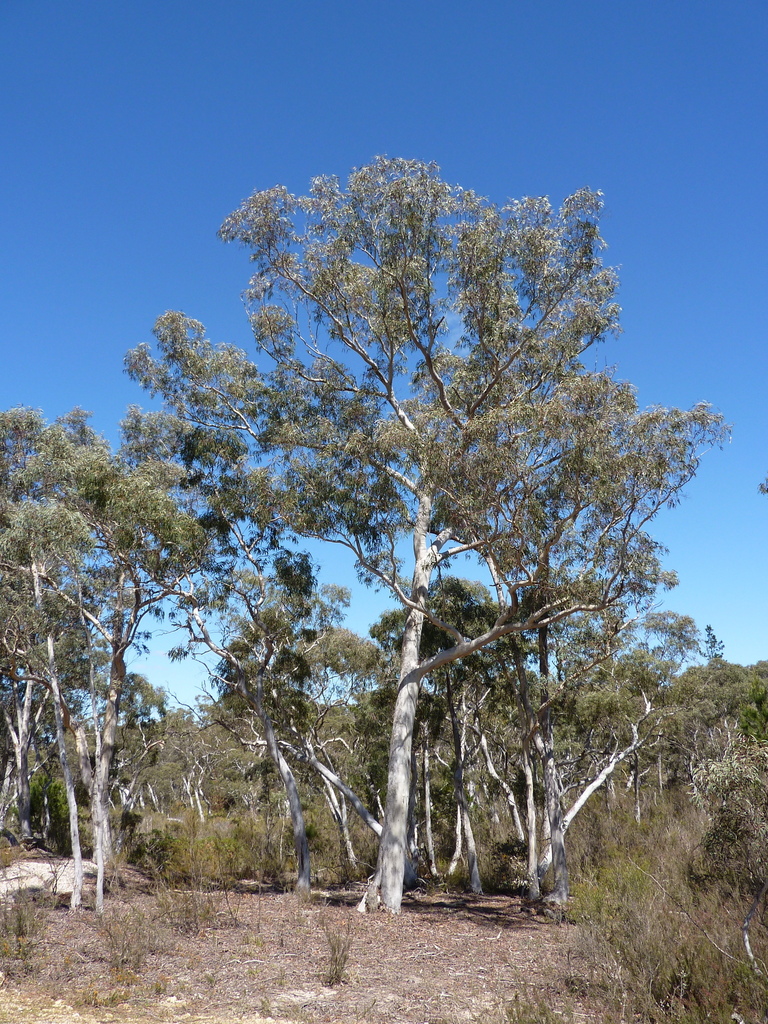
Western Scribbly Gum
Eucalyptus rossii
Eucalyptus rossii, commonly known as inland scribbly gum or white gum, is a species of small to medium-sized tree that is endemic to New South Wales and the Australian Capital Territory. It has smooth bark with insect scribbles, lance-shaped adult leaves, flower buds in groups of between nine and fifteen, white flowers and hemispherical or shortened spherical fruit.
From the article Eucalyptus rossii on Wikipedia (CC BY-SA), quoted section by section
Description
Eucalyptus rossii is a tree that typically grows to a height of around 15 to 20 m (49 to 66 ft) and forms a lignotuber. It normally has a solitary straight trunk and an open, moderately dense crown that reaches a width of about 9 m (30 ft). The smooth yellowish bark sheds in patches throughout the year and usually has insect scribbles. Young plants and coppice regrowth have lance-shaped, narrow lance-shaped or curved leaves that are 70–140 mm (2.8–5.5 in) long and 15–40 mm (0.59–1.57 in) wide. Adult leaves are arranged alternately, the same shade of green on both sides, narrow lance-shaped to lance-shaped, 55–150 mm (2.2–5.9 in) long and 8–25 mm (0.31–0.98 in) wide, tapering to a petiole 7–20 mm (0.28–0.79 in) long. The flower buds are mostly arranged in leaf axils in clusters of between five and fifteen on an unbranched peduncle 7–11 mm (0.28–0.43 in) long, the individual buds on pedicels 3–6 mm (0.12–0.24 in) long. Mature buds are oval to club-shaped, 3–5 mm (0.12–0.20 in) long and 2–3 mm (0.079–0.118 in) wide with a rounded operculum. Flowering occurs between September and February and the flowers are white. The fruit is a woody, cup-shaped, hemispherical or shortened spherical capsule 3–6 mm (0.12–0.24 in) long and 4–6 mm (0.16–0.24 in) wide with the valves near rim level.
Range & habitat
Inland scribbly gum has a scattered distribution over the New South Wales tablelands, western slopes and the central coast, from Tenterfield in the north to Bombala in the south. The trees grow well in sandy and stony well-drained soils, usually on slopes. They are found in areas with moderate temperatures and rainfall of 600 to 1,000 mm (24 to 39 in) per annum. They are part of open dry sclerophyll woodland communities and associated species include E. haemastoma and E. racemosa.
Wikipedia: “Distribution and habitat”
What it does
These trees usually have scribble marks on the bark formed by the burrowing larvae of a small moth, Ogmograptis scribula. The insect lays eggs within layers of bark and when the larvae hatch they burrow into the bark.
Wikipedia: “Ecology”
How it is grown
E. rossii is available commercially in seed form or as seedlings. It is useful as a shade tree which grows well in full sun with well drained soils that can cope in poor shallow, stony soils. It is both drought and frost tolerant with a flower display through summer that will attract birds.
Wikipedia: “Use in horticulture”
Where it lives
Recorded sightings
—
geo-referenced records in GBIF, from museums, herbaria and field observers.
Drag the globe to turn it. Dots are where records exist, not a range map; darker means more records.
In the stacks
Searching the stacks…
Every page naming Eucalyptus rossii in the Biodiversity Heritage Library →
This page is assembled live from iNaturalist, GBIF, Wikipedia, the Source Library and the Internet Archive. It is not yet part of the hand-edited codex. iNaturalist taxon 207910.